Frequently Asked Questions
The most-asked questions about Mango angelfish.
What exactly is a Mango angelfish?
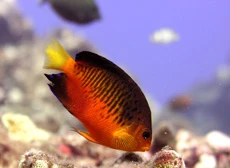
The Mango angelfish is a selectively bred color morph of the freshwater angelfish (Pterophyllum scalare), prized for its uniform golden-orange to deep amber body color. Unlike the wild-type, it lacks the bold black vertical bars and instead displays a smooth, solid hue that resembles the skin of a ripe mango.
Where do Mango angelfish originate from?
They are native to the slow-moving rivers and blackwater tributaries of the Amazon basin, primarily in Brazil. In the hobby they are almost always captive-bred, so most specimens you encounter have never seen the wild.
How large do they typically grow?
A healthy adult usually reaches six to eight inches in height, with the dorsal and anal fins fully extended. In a spacious, well-maintained tank some individuals can approach ten inches, so planning for that size early is important.
What do Mango angelfish eat?
They are opportunistic omnivores that will take high-quality flakes, sinking pellets, frozen brine shrimp, bloodworms, and occasional live or freeze-dried treats. A varied diet helps maintain their vivid orange coloration over time.
Are they aggressive or good tank mates?
They are semi-aggressive and noticeably territorial, especially around feeding time and during spawning. They do best with similarly sized, peaceful community fish or in a species-only setup, and should never be housed with small, fin-nipping species.
What tank size and setup do they need?
A minimum of 75 gallons is widely recommended, with open swimming space, gentle filtration, and a few broad-leaf plants or decorations to break up sight lines. They prefer warm water in the mid-70s °F (around 25 °C) with a soft, slightly acidic to neutral pH.
How long can a Mango angelfish live?
With stable water parameters and a proper diet, most individuals live five to eight years, and some reach ten or more. The most common cause of early death is chronic stress from an undersized tank or poor water quality rather than a specific disease.
How is a Mango angelfish different from a Gold or Yellow angelfish?
The distinction is largely one of shade and breeding lineage: Mango tends toward a warmer, deeper orange with a slightly reddish undertone, while Gold and Yellow variants skew paler or more lemon-toned. In practice the lines overlap, and hobbyists often use the terms loosely depending on the breeder's naming.
Can they be bred at home?
Yes—they are mouthbrooders that form pairs, fan out a substrate, and the female deposits a few hundred eggs before both parents carry the fry in their mouths for roughly two weeks. Providing a flat spawning surface and reducing disturbance once a pair bonds greatly improves success rates.
What is the most common mistake new owners make?
The single most frequent error is keeping a pair or small group in a 20- or 30-gallon tank, which leads to ammonia spikes, stunted growth, and chronic aggression. Upgrading to a 75-gallon-plus system before or shortly after purchase is the single best step for their long-term health.