Frequently Asked Questions
The most-asked questions about Dusky angelfish.
What exactly is a Dusky angelfish?
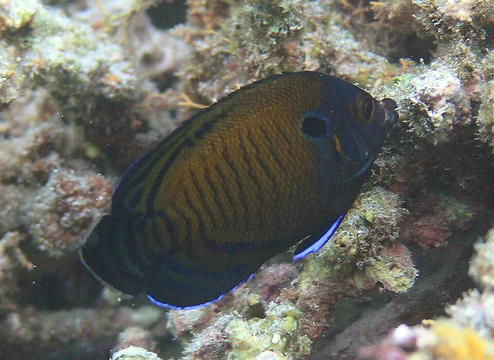
It is a marine reef fish (Pomacanthus vaigiensis) in the angelfish family, recognizable in adult form by its dark grayish-brown body, vivid blue face, and bright yellow tail. It is one of the more widespread species in the Pomacanthus genus.
Where in the wild can you find them?
Their range spans the entire Indo-Pacific, from the Red Sea and East African coast eastward through Southeast Asia to the central Pacific islands. They typically inhabit coral reefs at depths of roughly 2 to 40 meters.
How large do Dusky angelfish grow?
Adults generally reach a total length of about 20 to 25 centimeters (roughly 8 to 10 inches), making them a mid-sized member of the angelfish group.
What do they eat in the wild?
Their diet is heavily sponge-based, supplemented by tunicates, bryozoans, and other small invertebrates scraped from reef surfaces. This specialized feeding makes them difficult to sustain on typical aquarium foods.
Are they suitable for a home reef tank?
They are considered advanced-to-difficult for hobbyists because of their narrow dietary needs and their tendency to become highly territorial and aggressive toward other angelfish as they mature. A large, well-established system with plenty of hiding space is usually recommended.
How long do Dusky angelfish live?
In the wild, individuals can live in the neighborhood of 10 to 15 years, though exact longevity data is limited because they are rarely tracked over their full life.
How do you tell a Dusky angelfish apart from a Yellowtail angelfish?
The two look very similar, but the Dusky angelfish has a more uniformly dark body with a broader blue facial patch, while the Yellowtail (Pomacanthus sexstriatus) tends to show faint vertical bars and a slightly different blue-to-yellow boundary on the tail.
What is their temperament like?
Juveniles are relatively shy, but adults become strongly territorial, defending a home range against other angelfish and similarly sized mid-water fish. They will chase and nip intruders that venture too close to their chosen reef patch.
What is their current conservation status?
The IUCN lists Pomacanthus vaigiensis as Least Concern, reflecting its broad distribution and general abundance. However, ongoing coral-reef degradation and targeted collection for the aquarium trade are recognized as long-term pressures.
What is the basic taxonomic classification?
It sits in the genus Pomacanthus, family Pomacanthidae, order Acanthuriformes (sometimes still placed under Perciformes in older references), class Actinopterygii. The specific epithet 'vaigiensis' references the waters near Waigeo in Indonesia, where the species was first described.