Frequently Asked Questions
The most-asked questions about Rusty angelfish.
What is a Rusty angelfish?
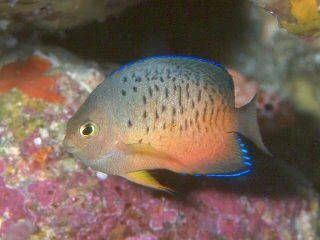
The Rusty angelfish (Centropyge ferrugina) is a small marine fish in the dwarf-angelfish group of the damselfish family. It is one of the smaller species in the genus Centropyge and is best known for its warm, rust-toned body coloration.
Where does the Rusty angelfish live in the wild?
It is native to the western Pacific, with records from the Philippines, Indonesia, Papua New Guinea, and nearby island chains. It typically occupies coral-reef habitats in both lagoon and outer-reef settings at moderate depths.
How large does a Rusty angelfish grow?
Adults generally reach a total length of roughly five to six centimeters (about two inches), placing it firmly in the dwarf-angelfish size class. It is among the smaller members of its genus.
What does a Rusty angelfish look like?
The body is predominantly a warm rusty-brown to reddish-orange, often with subtle darker markings or a faint vertical bar. Males and females are very similar in appearance, with only subtle differences between the sexes.
What does the Rusty angelfish eat?
In the wild it is an omnivore, grazing on microalgae, small crustaceans, and other tiny invertebrates found on and around coral structures. In captivity it will readily accept a varied diet of frozen and prepared foods.
Is the Rusty angelfish a good aquarium fish?
It can do well in a well-established reef tank, though it prefers a larger setup with plenty of live rock for grazing. It is generally peaceful toward other fish but may show mild territoriality toward similar-sized species.
What is the scientific classification of the Rusty angelfish?
It sits in the family Pomacentridae, subfamily Centropygini, genus Centropyge, species ferrugina. The specific epithet 'ferrugina' is Latin for 'rusty,' a direct reference to its color.
What is the behavior and temperament of the Rusty angelfish?
It is a relatively calm, reef-dwelling fish that patrols a small territory around a section of coral or rock. It is not aggressive by angelfish standards but will defend its immediate area from intruders of similar size.
How does it differ from other dwarf angelfishes?
Its consistently rust-colored body sets it apart from many congeners that display more contrasting patterns or brighter hues. It is also less commonly encountered in the aquarium trade than popular species like the Bicolor or Flame angelfish.
What is the conservation status of the Rusty angelfish?
It is currently listed as Least Concern by the IUCN, as its range is broad and it is not heavily targeted by the commercial fish trade. Local overcollection in popular reef areas can still pose a minor threat, but no major population declines have been documented.