Frequently Asked Questions
The most-asked questions about California moray.
What exactly is the California moray?
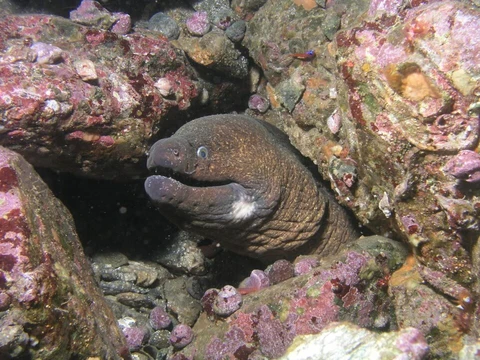
It is a species of moray eel (Gymnothorax eurostus) native to the eastern Pacific, stretching from Baja California southward through Mexican coastal waters. It is a medium-sized, robust eel that favors rocky reef and tide-pool habitats.
Who originally described the species and when?
The California moray was formally named and described by ichthyologists Jordan and Starks in 1902, making it one of the better-documented Pacific morays from the early era of marine taxonomy.
Where in the wild can you actually see one?
Look along the rocky shores of the Gulf of California and the Pacific coast of western Mexico, where they shelter under boulders in the upper intertidal and shallow subtidal zones. They are most active during low tide when the pools they occupy are exposed.
How large does a California moray typically grow?
Adults generally top out around 60 to 75 cm (roughly 24–30 inches) in total length, placing it in the mid-range for the genus Gymnothorax. It is noticeably shorter and stockier than its larger relatives like the giant moray.
What does it eat?
Its diet centers on small crustaceans, crabs, and juvenile fish that live among the rocky crevices it occupies. It is an ambush predator that lunges out from its shelter to grab prey rather than actively chasing it.
Is it dangerous to swimmers or divers?
Like all morays it has sharp, inward-pointing teeth and will bite if grabbed or poked, but it is not considered an active threat to humans. In the wild it is shy and will retreat into its crevice rather than approach people.
How does it differ from other moray eel species?
It is one of the relatively few Gymnothorax species found in the eastern Pacific, and its shorter body, specific scale-row counts, and coloration set it apart from the Atlantic and western-Pacific morays. Taxonomists use meristic characters and fin-ray counts to separate it from look-alikes.
What is its current conservation standing?
The species is not currently listed as threatened on the IUCN Red List, though localized pressure from coastal development, sedimentation, and pollution in its Mexican range is a concern for hobbyists and researchers. It does not appear on CITES schedules.
Can it be kept in a home marine aquarium?
Experienced reef-keepers do keep them, but they need a well-cycled tank with a rocky cave system, strong filtration, and a diet of live or frozen crustaceans. They are not recommended for beginners because of their size, aggression toward tank-mates, and sensitivity to water-quality swings.
Where should a newcomer start if they want to learn more?
A good path is to read a Pacific marine field guide entry for Gymnothorax eurostus, check the IUCN Red List page for the latest population notes, and then browse peer-reviewed papers on eastern-Pacific moray taxonomy. Local dive operators in Baja California can also offer in-situ observations.