Where California moray has been recorded
GBIF occurrence records for Gymnothorax mordax, mapped and tabulated by country.

163,508 georeferenced occurrence records with coordinates are published for Gymnothorax mordax through GBIF, from 8 countries or marine areas. This page maps those records and lists where they come from. Occurrence records reflect where people have looked as well as where the species lives, so well-surveyed coastlines are over-represented.
- Georeferenced records
- 163,508
- Countries / areas
- 8
- Mapped locations
- 13
- Records sampled for the map
- 3,000
- Inland records omitted
- 7
- Gbif taxonkey
- 2404017
The Engineering of the Jaw
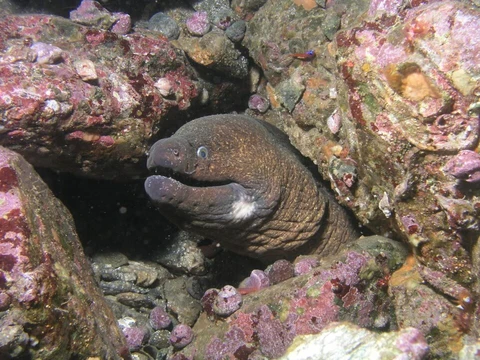
Few creatures in the ocean possess a feeding apparatus as mechanically sophisticated as that of the California moray. Like all members of the Muraenidae family, it relies on a pair of pharyngeal jaws positioned deep within the head—structures that look almost like a second set of oral jaws, complete with their own tiny teeth. When the eel lunges at prey, these internal jaws shoot forward into the mouth cavity, seize the struggling animal, and haul it backward into the throat. What makes the California moray (Gymnothorax mordax) particularly remarkable is a feature found in at least this one species: the teeth lining the roof of the mouth can fold downward as prey slides backward. This folding action prevents the teeth from snapping under pressure while simultaneously keeping a firm grip on the animal throughout its journey to the pharynx. The mouth opening itself extends unusually far back into the skull, and as the eel bites down, water is expelled from the posterior edge of the gape. This outflow dampens the pressure waves that would otherwise travel forward and startle the prey, meaning the moray can deliver a fast, decisive strike without giving its target time to flee. No other known animal uses pharyngeal jaws in this active, forward-launching manner to capture and restrain prey.
Ambush and Alliance
Moray eels are opportunistic carnivores, and their menu spans smaller fish, crabs, and octopuses. They are patient, concealed hunters that rely on a highly developed sense of smell rather than keen eyesight—small eyes sit behind a wide jaw framing a protruding snout, and the eel waits motionless until prey drifts within striking range. In the food web, many morays, particularly the larger species, sit at the top: their few known predators include groupers, barracudas, and sea snakes. One documented encounter even showed a spotted moray consuming a red lionfish without apparent harm. Yet the California moray is not always a solitary hunter. Reef-associated roving coral groupers have been observed recruiting giant morays into a cooperative hunt, initiating the partnership with a distinctive head-shaking display. This alliance lets the moray flush prey from crevices and niches that the grouper cannot reach on its own, while the grouper benefits from the eel's ability to corner animals in tight spaces. The pairing turns two very different body plans into a single, more effective predatory unit on the reef.
Skin, Burrows, and the Architecture of Survival
Because most moray species lack pectoral and pelvic fins, their elongated, scaleless bodies are sheathed in a thick layer of protective mucus produced by an unusually dense population of goblet cells in the epidermis. In some species this mucus even carries a toxin, adding a chemical defense to the physical one. For sand-dwelling morays, the mucus serves a structural purpose: glycosylated mucins cause sand granules to adhere to the walls of their burrows, making the tunnels more permanent and stable. Respiration presents a unique challenge for these eels. Their small, circular gills sit on the flanks, well behind the mouth, so the moray must maintain a constant gulping or gape motion to draw water over the gill surfaces. The California moray, like its relatives, is almost exclusively marine, though a handful of moray species do venture into brackish or even freshwater. Within the ocean, morays occupy a staggering range of depths and environments—from shallow nearshore waters and continental shelves to deep benthic zones and the mesopelagic layer—favoring shelters such as dead patch reefs and coral rubble over live coral in most cases.
The Long Drift to Adulthood
The reproductive biology of moray eels remains only partially understood, in large part because their nocturnal habits and the often inaccessible locations where spawning occurs make direct observation of courtship and gamete release exceedingly rare. Most species are oviparous, and fertilization takes place externally in the water column: males and females release their gametes simultaneously, after which ocean currents carry the fertilized eggs away. Those eggs develop into leptocephalus larvae—transparent, ribbon-like organisms that drift through the pelagic zone for extended periods, sometimes as long as a full year, feeding on microscopic plankton during that time. This prolonged larval phase is a powerful mechanism for geographic dispersal, carrying genetic material across vast stretches of open ocean before the larvae settle onto benthic substrates such as coral reefs or rocky outcrops. Metamorphosis then transforms the delicate larva into a juvenile moray, bringing with it the development of adult pigmentation, body form, and the solitary, territorial behavior that characterizes the eel's adult life. The journey from a translucent ribbon in open water to a patterned, mucus-coated predator hiding in a reef crevice is one of the most dramatic transitions in marine biology.
Frequently Asked Questions
How many California moray occurrence records are catalogued?
GBIF currently holds 163,508 georeferenced records with coordinates for Gymnothorax mordax. These come from 8 different countries or marine areas, though only 3,000 of them are sampled for the visual map to keep it readable.
Which countries or marine areas show California moray records?
The distribution page covers 8 countries or marine areas in total, with 13 distinct mapped locations across them. A small number of inland records (7) are excluded because they fall outside the species' expected marine range.
Why do some coastlines have way more California moray records than others?
Record density largely mirrors survey effort rather than true abundance, so heavily studied shorelines naturally show up as hotspots. The page itself cautions that occurrence data reflects where people have looked as much as where the moray actually lives.
What is the GBIF taxon key for California moray?
The species is indexed under GBIF taxonKey 2404017. That identifier is what links all 163,508 georeferenced occurrence records to the correct Gymnothorax mordax entry in the global database.
How many locations are actually plotted on the California moray distribution map?
Thirteen mapped locations appear on the page, drawn from a 3,000-record sample of the full 163,508-record dataset. The sampling keeps the map legible while still representing the 8 countries or marine areas where the species has been documented.
Related in California moray
Links follow this subject's own source article.
Elsewhere in California moray
Spotted an error? Know more?
Reader corrections go straight into our review queue. Suggest an edit · How this site is sourced