
Whitebanded hermit (Calcinus seurati)
Source-cited species reference: taxonomy from WoRMS, biology from SeaLifeBase, occurrence map from GBIF, description from Wikipedia.
Calcinus seurati, commonly known as Seurat's hermit crab or whitebanded hermit, is a species of hermit crab in the family Diogenidae. It was first described by French carcinologist Jacques Forest in 1951. This species is found in rocky pools where they would be seen crawling out to the wet, algae-covered rocks. Calcinus seurati can be found in Indo-Pacific regions around the tropical area.
- Scientific name
- Calcinus seurati
- Authority
- Forest, 1951
- Family
- Diogenidae
- Order
- Decapoda
- Depth range
- 0–5 m
- Habitat zone
- benthic
- Gbif occurrence records
- 1,155
Classification (WoRMS)
Full classification as recorded by WoRMS: Kingdom: Animalia · Phylum: Arthropoda · Class: Malacostraca · Order: Decapoda · Family: Diogenidae · Genus: Calcinus.
Accepted name: Calcinus seurati · Authority: Forest, 1951 · Taxonomic status: accepted · AphiaID: 208674.
Source: World Register of Marine Species (WoRMS) — https://www.marinespecies.org/aphia.php?p=taxdetails&id=208674 (CC BY 4.0). Accessed 2026-09-23.
Biology and life history (SeaLifeBase)
Measured values published by SeaLifeBase for Calcinus seurati. Only fields the database actually holds for this species are shown; these are database values, not aquarium guidance.
Depth range: 0–5 m · Habitat zone: benthic.
SeaLifeBase notes: Intertidal (Ref. 106854).
Source: SeaLifeBase species summary (SpecCode 21030) — https://www.sealifebase.se/summary/Calcinus-seurati.html (CC BY-NC 3.0 — non-commercial use only). Accessed 2026-09-23.
Distribution and occurrence records (GBIF)
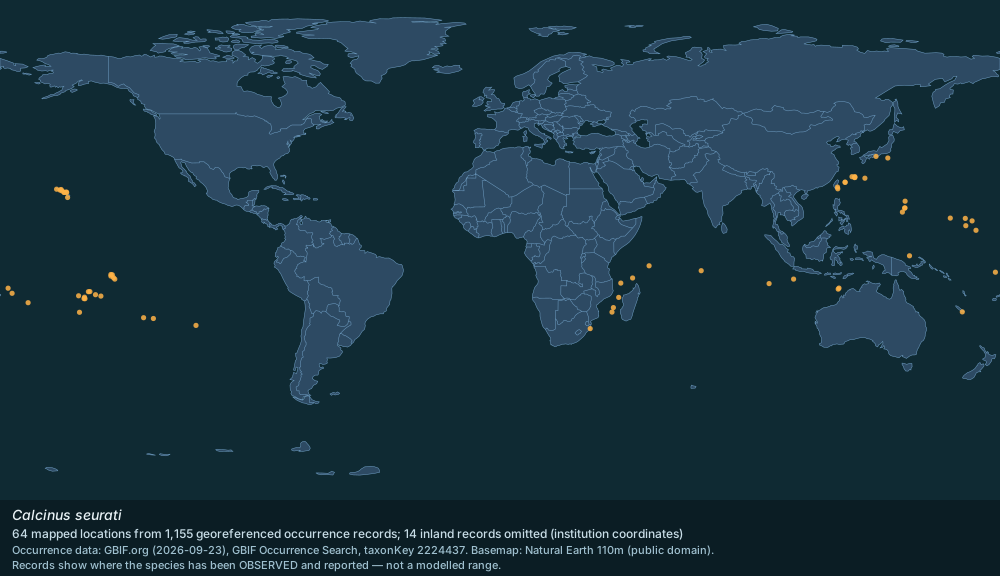
1,155 georeferenced occurrence records for Calcinus seurati are published through GBIF from 25 countries or marine areas. The map above plots 64 distinct locations from a sample of 1,155 records, omitting 14 inland records that carry an institution's coordinates rather than a collection site; it shows where the species has been observed and reported, not a modelled range.
Most records by country or area: United States of America (1,017); French Polynesia (40); Japan (18); Seychelles (11); Chinese Taipei (10).
The full country table, WoRMS marine regions and the sampling notes are on this species' Distribution page.
Source: GBIF Occurrence Search (taxonKey 2224437) — https://www.gbif.org/occurrence/search?taxon_key=2224437&has_coordinate=true (records CC0 / CC BY); WoRMS distribution records (MarineRegions) — https://www.marinespecies.org/aphia.php?p=taxdetails&id=208674 (CC BY 4.0); Natural Earth 110m basemap — https://www.naturalearthdata.com/ (public domain). Accessed 2026-09-23.
Description and natural history (Wikipedia)
Calcinus seurati is known for its vibrant appearance, with shells often decorated with patterns like spots and bands. Walking legs banded black and white, claws light or dark gray. This species is a small to medium-sized hermit, growing up to 2 in in size. It is omnivorous, feeding on a variety of plant and animal matter. This crab exhibits phototaxis, possibly as a strategy to avoid predators.
The whitebanded hermit crab is found primarily in tropical regions of the Indo-Pacific, including Taiwan, Hawaii, Guam, French Polynesia, and the Tuamotu Islands. It inhabits various coastal environments, including subtidal, sublittoral, and infralittoral zones as well as high intertidal pools. This hermit crab is typically found in areas where the water is calm and warm, often in rocky pools near the waterline, to depths of 5 m.
Source: Wikipedia: Calcinus seurati — https://en.wikipedia.org/wiki/Calcinus_seurati (CC BY-SA 4.0). Accessed 2026-09-23.
Gallery
Related in Whitebanded hermit
Links follow this subject's own source article.
Elsewhere in Whitebanded hermit
Spotted an error? Know more?
Reader corrections go straight into our review queue. Suggest an edit · How this site is sourced