
Hawaiian hermit (Calcinus laevimanus)
Source-cited species reference: taxonomy from WoRMS, biology from SeaLifeBase, occurrence map from GBIF, description from Wikipedia.
Calcinus laevimanus, the left-handed hermit crab, is a species of hermit crab in the genus Calcinus found in the Indo-West Pacific region, the type locality being Hawaii.
- Scientific name
- Calcinus laevimanus
- Authority
- (Randall, 1840)
- Family
- Diogenidae
- Order
- Decapoda
- Depth range
- 0–95 m
- Habitat zone
- benthic
- Gbif occurrence records
- 1,691
Classification (WoRMS)
Full classification as recorded by WoRMS: Kingdom: Animalia · Phylum: Arthropoda · Class: Malacostraca · Order: Decapoda · Family: Diogenidae · Genus: Calcinus.
Accepted name: Calcinus laevimanus · Authority: (Randall, 1840) · Taxonomic status: accepted · AphiaID: 208669.
Synonyms and superseded combinations recorded for this taxon: Calcinus herbstei De Man, 1888; Calcinus herbsti De Man, 1888; Calcinus herbsti var. lividus (H. Milne Edwards, 1848); Calcinus herbstii De Man, 1888; Calcinus herbstii var. lividus (H. Milne Edwards, 1848); Calcinus lividus (H. Milne Edwards, 1848); Pagurus laevimanus Randall, 1840; Pagurus levimanus Randall, 1840; Pagurus lividus H. Milne Edwards, 1848; Pagurus tibicen H. Milne Edwards, 1836.
Source: World Register of Marine Species (WoRMS) — https://www.marinespecies.org/aphia.php?p=taxdetails&id=208669 (CC BY 4.0). Accessed 2026-09-23.
Biology and life history (SeaLifeBase)
Measured values published by SeaLifeBase for Calcinus laevimanus. Only fields the database actually holds for this species are shown; these are database values, not aquarium guidance.
Depth range: 0–95 m · Habitat zone: benthic.
SeaLifeBase notes: Prefers to inhabit globose gastropod shells such as Nerites sp. in intertidal flats, reef flats and rock platforms (Ref. 2782, 81753). Also found in mangrove areas on sand mud bottoms (Ref. 81753) and on rocky shores (Ref. 81754).
Source: SeaLifeBase species summary (SpecCode 21027) — https://www.sealifebase.se/summary/Calcinus-laevimanus.html (CC BY-NC 3.0 — non-commercial use only). Accessed 2026-09-23.
Distribution and occurrence records (GBIF)
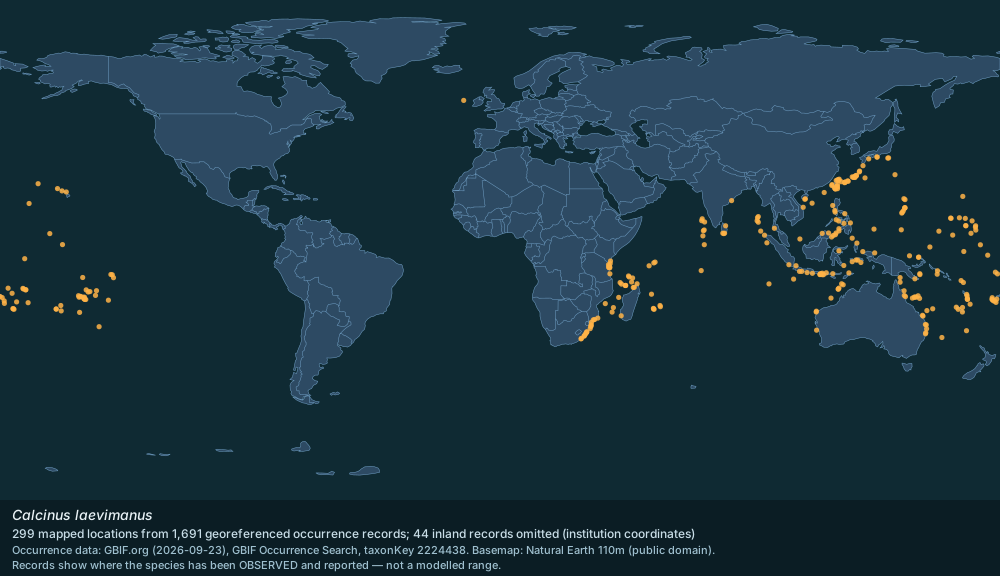
1,691 georeferenced occurrence records for Calcinus laevimanus are published through GBIF from 52 countries or marine areas. The map above plots 299 distinct locations from a sample of 1,691 records, omitting 44 inland records that carry an institution's coordinates rather than a collection site; it shows where the species has been observed and reported, not a modelled range.
Most records by country or area: United States of America (491); Chinese Taipei (217); Japan (124); French Polynesia (76); Indonesia (73).
The full country table, WoRMS marine regions and the sampling notes are on this species' Distribution page.
Source: GBIF Occurrence Search (taxonKey 2224438) — https://www.gbif.org/occurrence/search?taxon_key=2224438&has_coordinate=true (records CC0 / CC BY); WoRMS distribution records (MarineRegions) — https://www.marinespecies.org/aphia.php?p=taxdetails&id=208669 (CC BY 4.0); Natural Earth 110m basemap — https://www.naturalearthdata.com/ (public domain). Accessed 2026-09-23.
Description and natural history (Wikipedia)
The anterior part of this crab is calcified while the posterior part, protected by the shell it inhabits, is not. The total length is up to 30 mm with a shield length of up to 8 mm, with males usually being larger than females. The eyestalks are long and slender, and inflated at the base. The left cheliped (claw) is much larger than the right one. The propodus (penultimate joint) is smooth and shiny, the finger and thumb having spoon-shaped, calcified tips. The general colour of the carapace is brown to grey. The eye stalks are blue at the base and orange distally. The first pair of antennae have blue bases and orange tips and the second pair are entirely orange. The chelipeds are purplish-brown, the fingertips being white. The walking legs are orangish-brown with white tips.
C. laevimanus is found in the tropical and sub-tropical western Indo-Pacific. Its range extends from East Africa, Madagascar and the Comores, through Indonesia, the Philippines, Australia and Papua New Guinea to Hawaii, and includes many of the western Pacific archipelagoes. It is usually found between the low intertidal zone and the upper subtidal zone, typically on rocky reefs, rock and coral rubble.
When choosing a new shell, this hermit crab prefers a globose shell, especially Turbo and Nerita. In Hawaii, the shells of Trochus intextus and Turbo sandwicensis are often used, while in South Africa, an empty Lunella coronata shell is favoured. This is an aggressive hermit crab species which is prepared to fight for empty shells or other resources. The size and brightness of the white patch on the left chela seems to be a status symbol and helps its bearer in agonistic interactions.
As with other decapods, the female carries the eggs tucked under her abdomen. In Hawaii, 80% of females are carrying eggs between February and October, with about three thousand eggs being typical. Once hatched, the larvae pass through six zoeal stages and one glaucothoe stage.
Source: Wikipedia: Calcinus laevimanus — https://en.wikipedia.org/wiki/Calcinus_laevimanus (CC BY-SA 4.0). Accessed 2026-09-23.
Gallery
Related in Hawaiian hermit
Links follow this subject's own source article.
Elsewhere in Hawaiian hermit
Spotted an error? Know more?
Reader corrections go straight into our review queue. Suggest an edit · How this site is sourced