
Guam hermit (Calcinus guamensis)
Source-cited species reference: taxonomy from WoRMS, biology from SeaLifeBase, occurrence map from GBIF, description from Wikipedia.
Calcinus guamensis is a species of hermit crab belonging to the Diogenidae family. First discovered by D.S. Wooster in 1982, this species primarily lives in the tropical waters of the Indo-Pacific region, including Guam and Hawaii. It is one of several species in the genus Calcinus, known for their uneven claws and reliance on gastropod shells for protection.
- Scientific name
- Calcinus guamensis
- Authority
- Wooster, 1984
- Family
- Diogenidae
- Order
- Decapoda
- Depth range
- 0–80 m
- Habitat zone
- reef-associated
- Gbif occurrence records
- 251
Classification (WoRMS)
Full classification as recorded by WoRMS: Kingdom: Animalia · Phylum: Arthropoda · Class: Malacostraca · Order: Decapoda · Family: Diogenidae · Genus: Calcinus.
Accepted name: Calcinus guamensis · Authority: Wooster, 1984 · Taxonomic status: accepted · AphiaID: 367438.
Source: World Register of Marine Species (WoRMS) — https://www.marinespecies.org/aphia.php?p=taxdetails&id=367438 (CC BY 4.0). Accessed 2026-09-23.
Biology and life history (SeaLifeBase)
Measured values published by SeaLifeBase for Calcinus guamensis. Only fields the database actually holds for this species are shown; these are database values, not aquarium guidance.
Depth range: 0–80 m · Habitat zone: reef-associated.
SeaLifeBase notes: Minimum depth from Ref. 81753. Intertidal to subtidal (Ref. 106854). Inhabits shells of small gastropods (Ref. 8423); in coral reefs or reef flats on coral rubble (Ref. 81753).
Source: SeaLifeBase species summary (SpecCode 21024) — https://www.sealifebase.se/summary/Calcinus-guamensis.html (CC BY-NC 3.0 — non-commercial use only). Accessed 2026-09-23.
Distribution and occurrence records (GBIF)
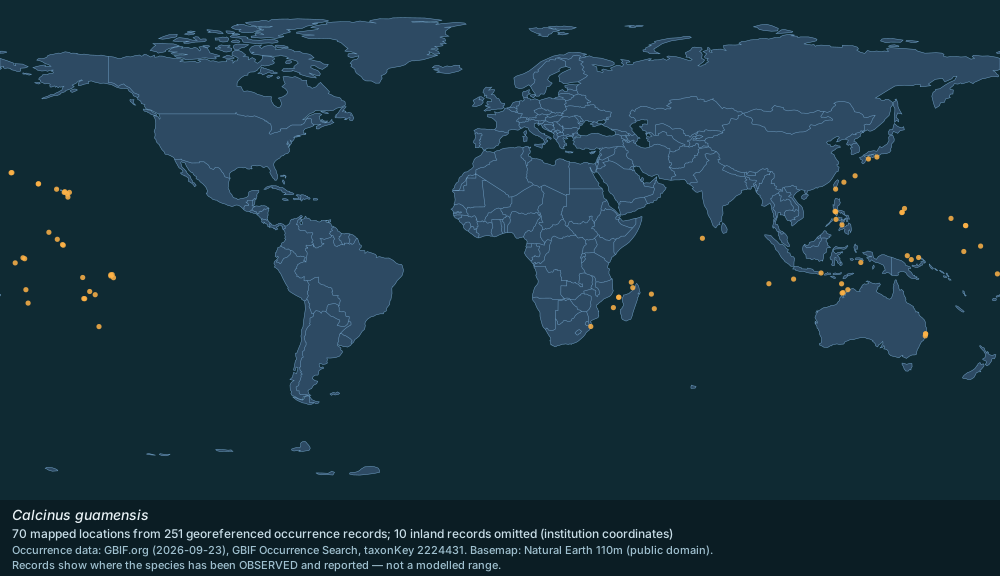
251 georeferenced occurrence records for Calcinus guamensis are published through GBIF from 24 countries or marine areas. The map above plots 70 distinct locations from a sample of 251 records, omitting 10 inland records that carry an institution's coordinates rather than a collection site; it shows where the species has been observed and reported, not a modelled range.
Most records by country or area: United States of America (103); French Polynesia (28); Papua New Guinea (25); Christmas Island (16); Kiribati (13); Australia (11); French Southern Territories (10); Japan (8); Marshall Islands (4); Philippines (4); South Africa (4); Indonesia (3); Madagascar (3); Réunion (3); Chinese Taipei (3).
Marine regions with a valid WoRMS distribution record: French Polynesian Exclusive Economic Zone; Réunion Exclusive Economic Zone.
Source: GBIF Occurrence Search (taxonKey 2224431) — https://www.gbif.org/occurrence/search?taxon_key=2224431&has_coordinate=true (records CC0 / CC BY); WoRMS distribution records (MarineRegions) — https://www.marinespecies.org/aphia.php?p=taxdetails&id=367438 (CC BY 4.0); Natural Earth 110m basemap — https://www.naturalearthdata.com/ (public domain). Accessed 2026-09-23.
Description and natural history (Wikipedia)
Calcinus guamensis was first collected and described by Daniel S. Wooster in 1982 during a study of the Mariana Islands. The species was named after Guam, where the original specimens were discovered. Wooster's research expanded the known diversity of the genus Calcinus in the Indo-Pacific region.
Calcinus guamensis is a small hermit crab with a maximum shell width of about 6 mm. It is easily recognized by its coloration of a mustard brown or olive that fades into white, with its walking legs dipped in black. Its uneven claws, with the left being significantly larger, are bluish-green and differ from its reddish-brown body. The walking legs are banded with alternating light and dark colors, and its beak is triangular and relatively short. The crab's left claw is used to block the entrance of its shell when under threat, providing an effective defense against predators—a behavior typical of many hermit crabs in the family Diogenidae.
Calcinus guamensis plays a vital role as a scavenger in reef ecosystems. It feeds on detritus, algae, and small invertebrates, helping to break down organic material and promoting nutrient cycling. Hermit crabs play a key role in reef ecosystems they are major contributors to the health and protection of coral reef by removing organic debris and preventing algae from overgrowing.
The species is nocturnal, becoming more active at night when it forages for food. It exhibits typical shell-swapping behavior, often competing with other hermit crabs for shells that are better suited to their size. Wooster described this as a very competitive challenge, where it creates aggressive behavior for individuals to obtain optimal shells.
This species inhabits shallow coral reefs and rocky environments in the Indo-Pacific region. It has been observed in Guam, Hawaii, and other parts of the Pacific. It is commonly found in deeper water areas (3-20 m) compared to other species of the Calcinus. Calcinus guamensis is particularly largely located in tide pools and surge zones, which offer food and protection from predators.
Source: Wikipedia: Calcinus guamensis — https://en.wikipedia.org/wiki/Calcinus_guamensis (CC BY-SA 4.0). Accessed 2026-09-23.
Gallery
Spotted an error? Know more?
Reader corrections go straight into our review queue. Suggest an edit · How this site is sourced