Frequently Asked Questions
The most-asked questions about Variable-lined fusilier.
What is a Variable-lined fusilier?
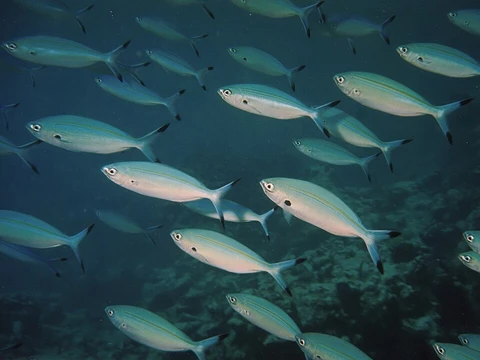
It is a small, elongated marine fish in the family Caesionidae, best known for the set of dark longitudinal stripes running along its flanks. The 'variable' in its common name refers to the fact that the number and boldness of those lines shift from one individual to another and even across life stages.
Where does it live?
The species is native to tropical and subtropical reef waters across the Indo-Pacific, favoring shallow lagoons, outer reef slopes, and areas with moderate current. It is most commonly encountered in the open water just above coral formations rather than tucked into deep crevices.
How large does it grow?
Adults typically reach a total length in the range of 15 to 20 centimeters, placing it in the mid-size tier among fusiliers. Males and females are broadly similar in size, with only subtle differences in coloration intensity.
What does it eat?
It is a carnivorous, mid-water and surface feeder that picks out small crustaceans, zooplankton, and other tiny invertebrates. Foraging is usually a group activity, with the school sweeping over the reef surface or hovering in the water column to intercept drifting prey.
How social is it?
The Variable-lined fusilier is a strongly schooling fish, regularly observed in groups of dozens to several hundred individuals moving in tight, coordinated formations. This collective behavior is a key anti-predator strategy and is one of the most visible traits noted by divers and snorkelers.
How do you tell it apart from other fusiliers?
The combination of its specific stripe pattern, the deeply forked caudal fin, and its typical depth and habitat niche separates it from look-alikes such as the yellowhead or blacktail fusiliers. The variability in line count among individuals is itself a useful field mark, since most congeners have a fixed number of stripes.
Is the species threatened?
It is generally assessed as Least Concern in conservation listings because it is geographically widespread and not a primary target of commercial or subsistence fisheries. Localized coral-reef degradation, however, can shrink suitable foraging and shelter habitat in particular regions.
Can it be kept in a home aquarium?
It does appear in the marine aquarium trade, but it needs a large, well-established system with generous open swimming space and live rock for cover. Because it is a schooling species, keeping a group of at least six to eight individuals is strongly recommended to reduce stress and encourage natural behavior.
Where does it sit in the taxonomic tree?
It belongs to the family Caesionidae within the order Acanthuriformes (formerly placed in Perciformes), and is assigned to the genus *Caesio* under most current revisions. Its binomial name encodes the lined body pattern that gives the species its common name.
Where should a newcomer start learning more?
Databases such as FishBase and the IUCN Red List provide verified distribution maps, photos, and conservation notes, while regional reef-fish field guides add behavioral and ecological context. Local aquarium clubs and reef-keeping forums are also valuable for first-hand observations from hobbyists who have seen the species in the wild or in captivity.