Frequently Asked Questions
The most-asked questions about Suez fusilier.
What is a Suez fusilier?
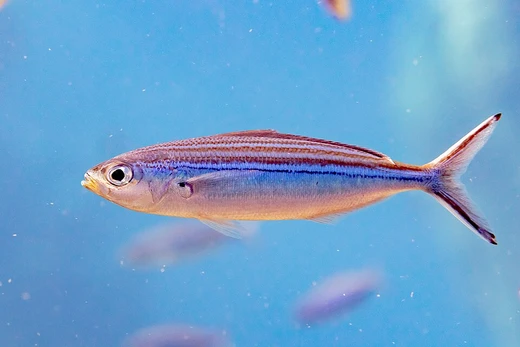
It is a small, elongated reef fish belonging to the family Caesionidae, best known from the Red Sea and the waters around the Suez Canal. Like other fusiliers, it has a laterally compressed body and a pointed snout adapted for filtering food from the water column.
What does it look like?
Adults typically show a silvery-blue to bluish-green body with a distinct yellow stripe running along the lateral line and a dark spot near the pectoral fin. Males are generally more vividly colored than females, especially during breeding season.
Where in the world can you find it?
Its range is essentially limited to the northern Red Sea, the Gulf of Aqaba, and the Suez Canal area, where it inhabits coral and rocky reefs. It is not native to the Indian Ocean or the Pacific, which sets it apart from several closely related fusilier species.
At what depth and in what kind of habitat does it live?
You will usually encounter it between roughly 5 and 30 metres on exposed reef slopes, overhangs, and open-water edges near coral heads. It tends to stay in loose groups rather than the large, tight schools seen in some tropical fusiliers.
What does it eat?
It is a mid-water feeder that picks out zooplankton, tiny crustaceans, and organic detritus with its fine, comb-like gill rakers. It often patrols just above the reef crest, darting out to capture drifting particles.
How large does it grow?
Most adults measure around 10 to 15 centimetres in total length, with a few larger individuals reaching close to 20 centimetres. It is one of the smaller members of the Caesionidae family.
Is it dangerous or a problem for divers and reef ecosystems?
It is completely harmless to humans and does not nip or sting. Ecologically it is a minor planktivore, so it poses no threat to corals or other reef organisms and is generally welcomed by divers as a colorful, curious fish.
What is its conservation status?
It is not currently listed as threatened by the IUCN and remains relatively common throughout its limited Red Sea range. As a small, non-targeted species it is rarely caught commercially, so population pressures are low.
How is it different from the more widely known blue or red fusilier?
The Suez fusilier has a more muted, silvery-blue base color with a single bold yellow lateral stripe, whereas the blue fusilier is uniformly deep blue and the red fusilier is predominantly crimson. Its restricted Red Sea range is another clear distinguishing factor.
Where can a newcomer actually see one in the wild?
Popular dive sites in the Gulf of Aqaba (Eilat/Aqaba), the Straits of Tiran, and the northern Suez Canal offer the best chances of spotting small groups patrolling just above the reef. It is also occasionally displayed in public aquariums that maintain Red Sea exhibits.