Frequently Asked Questions
The most-asked questions about Broadnosed pipefish.
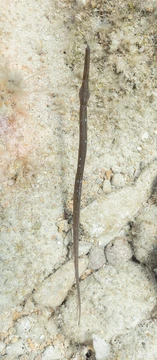
What exactly is a Broadnosed pipefish?
It is a small, slender marine fish in the syngnathid family (the same family that includes seahorses and other pipefish). Its scientific name is Dunckerocampus spatulatus, and it is found in coastal waters across the Indo-Pacific region.
How can I tell a Broadnosed pipefish apart from a seahorse?
Both share the elongated, armored body and tubular snout typical of syngnathids, but the Broadnosed pipefish lacks the prehensile, coiled tail that seahorses use to grip vegetation. Its snout is also noticeably broader and more flattened than a seahorse's.
Where in the ocean does it live?
It inhabits shallow, sheltered coastal environments such as seagrass meadows, mangrove roots, and rocky reefs. It is most commonly recorded in tropical and subtropical waters of the western Pacific and Indian Oceans.
How large does it get?
Adults are quite small, generally reaching only a few centimeters in total length. This tiny size, combined with its translucent coloration, helps it blend into surrounding vegetation and escape predators.
What does it eat?
It is a carnivorous micro-predator that snags tiny crustaceans, copepods, and other small planktonic invertebrates with its tubular mouth. It typically forages near the substrate or among dense plant growth.
How does it reproduce?
Like other syngnathids, the male carries and incubates the fertilized eggs in a specialized brood pouch, after which he releases the free-swimming young. The female transfers her eggs to the male during a courtship display.
Is it easy to keep in a home aquarium?
It is considered a challenging species for most hobbyists because it requires very stable, low-flow water, live or frozen micro-foods, and plenty of dense planting to feel secure. Success is more common in experienced public or research aquaria than in typical home tanks.
What is its conservation status?
The Broadnosed pipefish is not currently listed as threatened by major international conservation bodies, though its restricted shallow-water habitat makes it vulnerable to coastal development and seagrass loss. Ongoing surveys in the Indo-Pacific continue to refine population data.
Where should a newcomer start learning about this species?
A good starting point is reviewing the taxonomic description in a regional fish fauna guide for the Indo-Pacific, followed by observing live specimens in a well-run public aquarium that houses Indo-Pacific pipefish. Peer-reviewed papers on Dunckerocampus behavior and ecology provide deeper detail for the curious.
Are there any closely related pipefish species it is often confused with?
Yes; several other Dunckerocampus and Cosmocampus species share similar size, coloration, and habitat, and were historically lumped together before modern genetic work separated them. The broad, spatulate snout is the key field mark that distinguishes the Broadnosed pipefish from its look-alikes.