Frequently Asked Questions
The most-asked questions about Blunt-snouted clingfish.
What is a blunt-snouted clingfish?
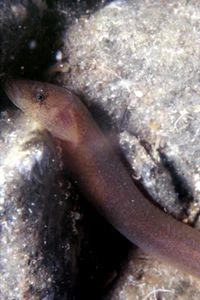
It is a small benthic fish in the family Gobiesocidae, native to coastal waters of the Indo-Pacific. Like all clingfish, it anchors itself to hard surfaces with a specialized pectoral-fin disc rather than swimming freely.
Where do blunt-snouted clingfish live?
They are found in shallow tropical and subtropical zones, typically on rocky reefs, coral outcrops, mangrove roots, and the undersides of piers or boats. Most encounters occur in the intertidal to upper subtidal range.
How large do they get?
They remain a small species, generally reaching only about 5 to 15 centimeters in total length. Their compact, laterally compressed body is well suited to life pressed flat against a substrate.
How does the 'cling' mechanism actually work?
The pectoral fins are fused into a broad oval disc whose underside is covered in thousands of microscopic papillae that form a strong vacuum seal against rock or other hard surfaces. The fish can hold on firmly even in heavy surf or when briefly lifted out of the water.
What is their diet?
They are small opportunistic carnivores, picking off tiny crustaceans, zooplankton, and other invertebrates that drift past while they are anchored to a surface. They do not typically chase prey over open water.
Are they dangerous to swimmers or divers?
No. They are non-venomous, far too small to cause harm, and generally shy, simply remaining attached to a rock or structure if a person approaches. They pose no threat in any recreational or commercial context.
How do they reproduce?
A male selects and guards a nest site on a hard surface where the female deposits her eggs, then fans them with his fins until they hatch. The resulting larvae spend a period drifting as plankton before settling onto a new substrate.
What is their conservation status?
Because they are small, widespread, and relatively abundant across the Indo-Pacific, they are not currently listed as threatened by the IUCN. They are nonetheless vulnerable to coastal habitat loss, sedimentation, and water pollution.
How are they different from gobies or blennies?
The key distinction is the adhesive pectoral-fin disc, which gobies and blennies lack; clingfish also tend to have a more elongate, eel-like silhouette compared to the deeper-bodied blennies. All three are small bottom-dwellers, but the clingfish's attachment strategy is unique among them.
Where should a newcomer start learning more?
Field guides to Indo-Pacific reef fish and the FishBase entry for the family Gobiesocidae are solid first references. For a hands-on experience, observing them at a rocky shore or coral reef in the Pacific or Indian Ocean is one of the most rewarding ways to appreciate their behavior up close.