Frequently Asked Questions
The most-asked questions about Black-striped pipefish.
What exactly is a Black-striped pipefish?
It is a small marine fish, scientifically named Dunckerocampus pessuliferus, belonging to the seahorse family (Syngnathidae). It is native to shallow waters across the Indo-Pacific region.
What does it look like?
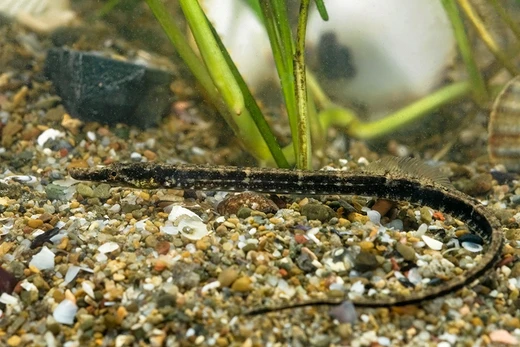
The body is long, slender, and slightly compressed, covered in a pale or whitish base color crossed by several bold black longitudinal stripes. Its tubular snout and lack of a coiled tail give it a snake-like, eel-like silhouette rather than the upright shape people associate with seahorses.
How large does it grow?
Adults typically reach only about five to six centimeters in total length, making it one of the smaller members of the pipefish group.
Where can you find it in the wild?
It inhabits coral reefs, rocky outcrops, and seagrass beds in the western Pacific and eastern Indian Oceans, usually at depths of a few meters to around twenty meters.
What does it eat?
It is a carnivore that ambushes or actively pursues tiny crustaceans, copepods, and other small zooplankton, drawing them in through its narrow, pipe-like mouth.
How does it reproduce?
As with most syngnathids, the male is the parent who carries the young: he possesses a ventral brooding pouch in which he incubates fertilized eggs until they hatch as free-swimming larvae.
How is it different from a seahorse?
Although both share the same family and the male-carries-the-eggs trait, the Black-striped pipefish swims horizontally with a free, undulating body and lacks the prehensile, coiled tail and rigid bony plates that define seahorses.
Is it easy to keep in a home aquarium?
It is generally considered challenging because it demands stable, highly oxygenated water, a diet of live or frozen micro-prey, and a tank with gentle flow and plenty of hiding structures. Most experienced aquarists advise against it for beginners.
What is its conservation outlook?
The species is not currently listed as threatened by the IUCN, but its dependence on healthy coral and seagrass habitats makes it vulnerable to reef degradation, coastal development, and climate-driven ocean warming.
What is the most common mix-up with similar species?
It is frequently confused with other Dunckerocampus pipefishes and with certain small syngnathids; the consistent pattern of full-length black stripes on an otherwise light body is the most reliable field mark for telling it apart.