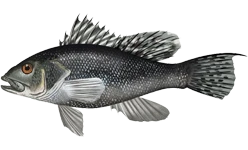
Black sea bass (Centropristis striata)
Source-cited species reference: taxonomy from WoRMS, biology from FishBase, occurrence map from GBIF, conservation from IUCN Red List, description from Wikipedia.

The black sea bass (Centropristis striata) is a species of marine ray-finned fish, a sea bass from the subfamily Serraninae which is part of the family Serranidae, which also includes the groupers and anthias. It is found in the western Atlantic Ocean, where it is an important species for commercial and recreational fisheries.
- Scientific name
- Centropristis striata
- Authority
- (Linnaeus, 1758)
- Family
- Serranidae
- Order
- Perciformes
- Maximum length
- 66 cm
- Habitat zone
- reef-associated
- Iucn red list
- Least Concern
- Gbif occurrence records
- 9,080
Classification (WoRMS)
Full classification as recorded by WoRMS: Kingdom: Animalia · Phylum: Chordata · Class: Teleostei · Order: Perciformes · Family: Serranidae · Genus: Centropristis.
Accepted name: Centropristis striata · Authority: (Linnaeus, 1758) · Taxonomic status: accepted · AphiaID: 159348.
Synonyms and superseded combinations recorded for this taxon: Centropristes melanus Ginsburg, 1952; Centropristes striatus (Linnaeus, 1758); Centropristis melana Ginsburg, 1952; Labrus striatus Linnaeus, 1758.
Source: World Register of Marine Species (WoRMS) — https://www.marinespecies.org/aphia.php?p=taxdetails&id=159348 (CC BY 4.0). Accessed 2026-09-23.
Biology and life history (FishBase)
Measured values published by FishBase for Centropristis striata. Only fields the database actually holds for this species are shown; these are database values, not aquarium guidance.
Maximum length: 66 cm · Common length: 30 cm · Habitat zone: reef-associated · Body shape: fusiform / normal · Vulnerability index: 32.4 of 100 · Fishery importance: commercial · Aquarium trade: public aquariums.
FishBase notes: Commonly found around rock jetties and on rocky bottoms in shallow water. Marketed fresh and eaten fried, broiled and baked (Ref. 9988).
Source: FishBase species summary (SpecCode 361) — https://www.fishbase.se/summary/Centropristis-striata.html (CC BY-NC 3.0 — non-commercial use only). Accessed 2026-09-23.
Distribution and occurrence records (GBIF)
9,080 georeferenced occurrence records for Centropristis striata are published through GBIF from 9 countries or marine areas. The map above plots 95 distinct locations from a sample of 3,000 records, omitting 51 inland records that carry an institution's coordinates rather than a collection site; it shows where the species has been observed and reported, not a modelled range.
Most records by country or area: United States of America (8,608); Puerto Rico (443); Canada (19); Martinique (5); Aruba (1).
The full country table, WoRMS marine regions and the sampling notes are on this species' Distribution page.
Source: GBIF Occurrence Search (taxonKey 2387483) — https://www.gbif.org/occurrence/search?taxon_key=2387483&has_coordinate=true (records CC0 / CC BY); WoRMS distribution records (MarineRegions) — https://www.marinespecies.org/aphia.php?p=taxdetails&id=159348 (CC BY 4.0); Natural Earth 110m basemap — https://www.naturalearthdata.com/ (public domain). Accessed 2026-09-23.
Conservation status (IUCN Red List)
The IUCN Red List assesses Centropristis striata (Linnaeus, 1758) as Least Concern (code LC). No trend, population estimate or threat analysis is given here, because none is available from this source without the Red List API; follow the source link for the full assessment, including its date.
Source: IUCN Red List of Threatened Species (taxon 16435325) — https://www.iucnredlist.org/species/16435325/0; GBIF IUCN Red List category endpoint (taxonKey 2387483) — https://api.gbif.org/v1/species/2387483/iucnRedListCategory. Accessed 2026-09-23.
Description and natural history (Wikipedia)
The black sea bass was first formally described as Labrus striatus by Carolus Linnaeus in the tenth edition of his Systema Naturae published in 1758, Linnaeus gave the type locality as America. When the French anatomist and zoologist Georges Cuvier created the genus Centropristis he used Bloch and Schneider's 1801 Coryphaenus nigrescens as the type species for the new genus, this is a synonym of Linnaeus's Labrus striatus so the black sea bass is the type species of the genus Centropristis. The generic name is a compound of the Greek words kentron meaning "sting" and pristis which means "saw".
The black sea bass is found in the western Atlantic Ocean from Nova Scotia south along the eastern coast of North America as far as the Florida Keys and into the Gulf of Mexico as far as Louisiana where the western limit is just to the west of the Mississippi Delta.
This species attains a maximum total length of 66 cm, however they are normally found at a total length of around 30 cm, and a maximum published weight of 4.1 kg.The black sea bass has an oblong, laterally compressed body. It has a large mouth, armed with bands of teeth on the jaw and with a triangular patch of teeth in the front part roof of the mouth and more teeth along the sides of that area, the mouth extending as far as below the middle of the eye. The preopercle has fine serrations on its margin and is evenly rounded, while the gill cover bears three flat spines. The dorsal fin has ten spines, the front spines being longer than the rearmost, and 11 soft rays. The membranes between the spines of the dorsal fin are deeply notched. The anal fin has three spines and seven soft rays. The caudal fin has three lobes created by the long and pointed upper, middle and lower rays.
The colour pattern is normally smoky grey, dusky brown or blue-black on the back and upper body, fading towards the underside. In the middle of each scale there is a pale blue to white spot and these form longitudinal stripes along the back and flanks. The dorsal fin has a series of white spots and bands along its length. The flanks can frequently appear mottled or have dark and light vertical barring. In the breeding season the males develop bright fluorescent blue and green around the eyes and nape and a hump on the head contrasting with the paler and duller females which are brownish or blue-grey in colour. The juveniles are found in four colour phases; the first is an overall light grey phase which has small dark spots, there is a dark phase which has pale white spots, a striped phase with a longitudinal dark stripe and a barred phase which has six vertical bars.
The black sea bass is commonly found in the vicinity of rock jetties and over rocky substrates in shallow water, although they have also been recorded in deeper, offshore waters to depths of 130 m. They spend most of their time near the bottom where they frequently aggregate around features on the bottom such as piles of rocks, wrecks and man-made structures. It is often encountered resting in either a head-down or head-up position. Normally the dorsal fin is folded down but will be raised and spread out as an aggressive signal to other members of its own species. The juveniles remain in the protected estuarine waters where they are found around man-made structures, wrecks and over shell substrates.
Females live to around 8 years of age while males can live to 12 years old. This species is a slow growing fish and they reach sexual maturity at between one and three years old. They are protogynous hermaphrodites, the majority of them begin life as females and then change to males. The stimulus for the change is not known but it is thought that the largest females change sex in response to a shortage of males within a spawning group. These fishes spawn from January to July with the smaller females producing as few as 30,000 eggs while the larger females can produce 500,000 eggs. Their eggs are pelagic and have a diameter of 0.9-1.0mm. They hatch 75 hours after laying, in water temperatures of 16 °C. The larvae are pelagic until they grow to around 13 mm in length when they change to a demersal or estuarine habit.
This predatory species has a broad diet which includes crabs, shrimps, barnacles, worms, tunicates, small fish and bivalves. They are also preyed on by larger fish and their known predators include monkfish (Lophius americanus), spotted hake (Urophycis regia), summer flounder (Paralichthys dentatus), striped bass (Morone saxatilis), bluefish (Pomatomus saltatrix), weakfish (Cynoscion regalis), little skate (Leucoraja erinacea), spiny dogfish (Squalus acanthias), bignose shark (Carcharhinus altimus) and dusky shark (Carcharhinus obscurus).
This species has lean, white flesh which has a relatively firm texture, breaks into small flakes and has a delicate flavour. These small size of most of the fish available means that they are often cooked whole. They are caught using otter trawls, hook and line and in pots or traps. They have shown some promise in aquaculture but have not been farmed commercially yet. In sheltered environments the black sea bass can attain a high growth rate but this does not lead to long-term survival of their populations.
Black sea bass are highly sought after by recreational and commercial fisherman. There are two populations identified for fisheries management. NOAA Fisheries, the Mid-Atlantic Fishery Management Council, and the Atlantic States Marine Fisheries Commission cooperate in the management of the black sea bass fishery in the seas north of Cape Hatteras in North Carolina while NOAA Fisheries and the South Atlantic Fishery Management Council manage the fishery south of Cape Hatteras. Management includes catch limits, permits and a close season.
Source: Wikipedia: Black sea bass — https://en.wikipedia.org/wiki/Black_sea_bass (CC BY-SA 4.0). Accessed 2026-09-23.
Frequently Asked Questions
Who is Black sea bass (Centropristis striata)?
It is a marine ray-finned fish placed in the subfamily Serraninae of the family Serranidae, the same family that also contains groupers and anthias. Linnaeus first gave it its formal scientific name in 1758, and individuals can reach up to 66 cm in total length.
What are Black sea bass (Centropristis striata)'s powers or role?
As a reef-associated species, it depends on structured underwater habitats in the western Atlantic to forage and shelter. Its position within the Serraninae subfamily marks it as one of the ecologically central sea-bass types in that basin.
Why is Black sea bass (Centropristis striata) important?
It is a high-value target for two major fishing sectors—commercial landings and recreational angling—making it economically significant to coastal communities along the western Atlantic. Its reef association also means it plays a keystone role in the food web of those structured habitats.
Where does Black sea bass (Centropristis striata) live, and what are its key stats?
Its range is confined to the western Atlantic Ocean, where it is tied to reef zones rather than open water. Taxonomically it sits in the order Perciformes, family Serranidae, and tops out at roughly 66 cm, a size that makes it a prized catch for anglers.
Related in Black sea bass
Links follow this subject's own source article.
Elsewhere in Black sea bass
Spotted an error? Know more?
Reader corrections go straight into our review queue. Suggest an edit · How this site is sourced