Frequently Asked Questions
The most-asked questions about Bigtooth cardinalfish.
What exactly is a Bigtooth cardinalfish?
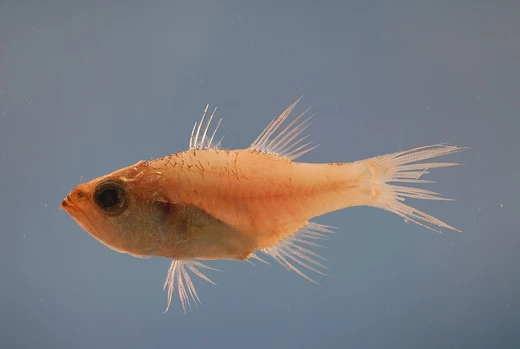
It's a small reef-dwelling fish (Siphamia cephalus) native to the Indo-Pacific, belonging to the cardinalfish family Apogonidae. The common name highlights its noticeably prominent teeth relative to its very small body.
How big does a Bigtooth cardinalfish get?
Adults typically reach roughly 5 to 6 centimeters in total length, placing them among the smaller members of the Apogonidae family. At full size they're about the length of a human thumb.
Where do they live in the wild?
They occupy shallow coral reefs stretching from the Red Sea and East African coast across to the central Pacific. They favor reef zones with abundant crevices, overhangs, and rubble where they can hide during the day.
What's on their menu?
They graze on tiny crustaceans, small polychaete worms, and other minute invertebrates picked off the reef substrate. Foraging activity peaks during low-light hours when they're most active.
What does a typical day look like for one?
Like many cardinalfishes, they're predominantly nocturnal, emerging to hunt from dusk through the night and retreating into shelter by morning. Males in particular stake out a small territory around a crevice and actively defend it from intruders.
What does it mean to be a 'cardinalfish'?
Apogonidae is a family of over 300 small, laterally compressed reef fish found in tropical and subtropical waters worldwide. They share a single dorsal fin, relatively large eyes, and often vivid or patterned coloration.
Can you keep one in a home aquarium?
They do surface in the marine aquarium trade, but they're considered delicate and best suited to well-established, low-stress nano reef setups. Their small size and generally gentle temperament make them a niche but interesting choice for experienced hobbyists.
What makes them visually stand out?
They show a silvery to pale greenish body with subtle darker markings, and their most eye-catching trait is the set of relatively large, clearly visible teeth. Males often display slightly more saturated coloration, particularly during the breeding season.
How do they reproduce?
A male builds and guards a small nest in a crevice while the female deposits eggs, which he then fertilizes and watches until they hatch. The resulting free-swimming larvae drift with the plankton for a period before settling back onto the reef.
Is the species under any conservation threat?
They are generally common and widespread across their range and are not listed as threatened by any major body. Their dependence on healthy reef structure does make them somewhat sensitive to coral degradation, but they are not a current conservation priority.