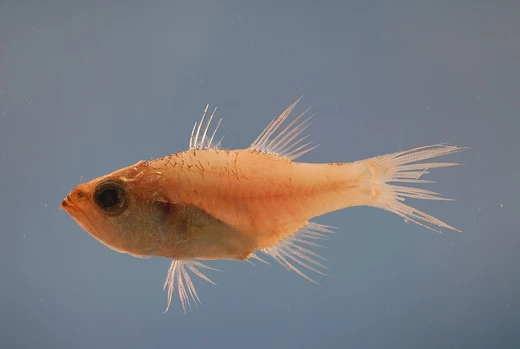
Bigtooth cardinalfish (Paroncheilus affinis)
Source-cited species reference: taxonomy from WoRMS, biology from FishBase, occurrence map from GBIF, conservation from IUCN Red List, description from Wikipedia.

SEFSC Pascagoula Laboratory; Collection of Brandi Noble, NOAA/NMFS/SEFSC · Public domain
The bigtooth cardinalfish or longtooth cardinalfish (Paroncheilus affinis) is a species of marine fish in the family Apogonidae and the only member of its genus. The bigtooth cardinalfish lives in the west-central Atlantic, off southern Florida, United States, and from the Bahamas to Venezuela, and as far south as Suriname. This species also is found in the east-central Atlantic and the Gulf of Guinea, and has been reported as far as Cape Verde. It is a pale orangeish colour.
- Scientific name
- Paroncheilus affinis
- Authority
- (Poey, 1875)
- Family
- Apogonidae
- Order
- Apogoniformes
- Maximum length
- 11 cm
- Depth range
- 20–300 m
- Habitat zone
- reef-associated
- Iucn red list
- Least Concern
- Gbif occurrence records
- 188
Morphology and Distinctive Features
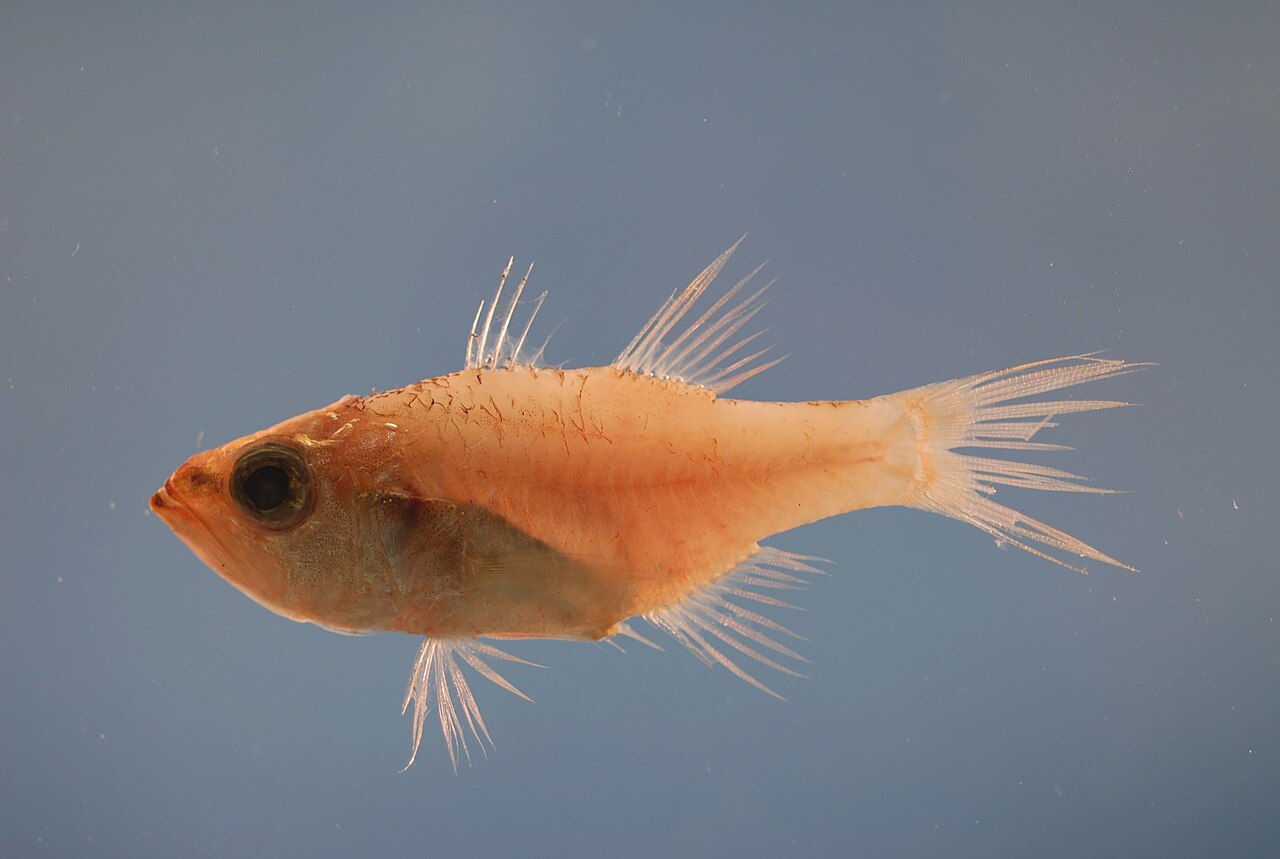
The bigtooth cardinalfish stands alone as the sole representative of the genus Paroncheilus within the cardinalfish family Apogonidae. Reaching a maximum length of roughly eleven centimeters, this small marine species presents a laterally compressed body plan dominated by a disproportionately large head, a notably short snout, and a prominent eye. Its obliquely oriented mouth is moderately sized, with the lower jaw projecting slightly forward. What gives the species its common name is the dental arrangement: each jaw carries a row of minute teeth broken up by several large canine-like teeth, while the palate bears additional vomerine teeth, some of which are also canine-sized. The dorsal fin is split into two distinct structures—the anterior one bearing seven spines and the posterior one seven soft rays—while the anal fin carries two spines and nine soft rays. Coloration is a translucent salmon, orange, or bronze along the back, fading to silvery tones beneath the head and body. A subtle dark line traces from the mouth through the eye to the upper edge of the gill cover, and the outer margin of the caudal fin can appear darkened.
Geographic Range and Preferred Habitats
The bigtooth cardinalfish inhabits tropical Atlantic waters on both sides of the ocean basin. On the eastern side, its distribution stretches along the African coast from Ivory Coast down to Angola, encompassing the Gulf of Guinea, the Cape Verde archipelago, and Ascension Island. On the western side, the range begins in northeastern Florida and extends southward and westward through the Bahamas and the Gulf of Mexico, continuing along the Mexican coast to northwestern Cuba. From there it spans the Caribbean Sea, the coasts of Venezuela and Suriname, and reaches as far south as Ilha Itaparica in Brazil. In terms of depth, this species occupies a broad vertical window from fifteen to three hundred meters, though it is most frequently encountered between twenty and ninety meters. Its preferred substrates include coral and rocky reefs, exposed rocky outcrops, and in some cases seabeds covered with gravel or rubble. This association with hard, structured environments is consistent across both Atlantic basins and underscores the fish's dependence on complex three-dimensional habitats for shelter and foraging.
Nocturnal Behavior and Reproductive Strategy
The bigtooth cardinalfish leads a predominantly nocturnal existence, spending daylight hours tucked away in crevices and caves within its reef environment. On occasion, large aggregations form near the base of underwater cliffs, suggesting a social component to its daytime resting behavior. When night falls, this carnivorous fish becomes active, preying on small fishes, squids, crustaceans, and various benthic invertebrates. Reproduction occurs year-round, with a male and female establishing a pair bond prior to spawning. The species is a mouth brooder, a reproductive strategy in which eggs are held in the oral cavity for incubation. There is some disagreement among authorities regarding which parent performs this duty: some sources indicate the male carries a ball of eggs in his mouth, while others contend that both parents share the brooding responsibility. This pair-bonding and mouth-brooding combination is notable within the cardinalfish family and highlights a relatively committed reproductive partnership compared to many other marine fish species.
Conservation Outlook and Predation Risks
The bigtooth cardinalfish generally faces minimal conservation pressure. Its preferred rocky and coral reef habitats are not currently under significant threat, and the species holds no commercial value that would drive targeted fishing or trade. As a result, the International Union for Conservation of Nature has assessed its status as being of least concern, reflecting its common occurrence across much of its range. However, one notable vulnerability exists in the Caribbean region: the invasive red lionfish (Pterois volitans) poses a serious predation risk. This voracious, venomous predator is itself nocturnal and capable of swallowing prey the size of the bigtooth cardinalfish whole. The temporal overlap between the two species' activity patterns means the cardinalfish is particularly exposed during its active foraging hours. Outside the Caribbean, no comparable threat has been identified, and the fish remains a regular and unremarkable component of tropical Atlantic reef communities.
Gallery
Frequently Asked Questions
Who is Bigtooth cardinalfish (Paroncheilus affinis)?
It is a small, pale orangeish marine fish first described by Poey in 1875 and now recognized as the sole representative of the genus Paroncheilus within the cardinalfish family Apogonidae. It grows to roughly 11 cm and is classified under the order Apogoniformes.
What are Bigtooth cardinalfish (Paroncheilus affinis)'s powers or role in its ecosystem?
Occupying depths from 20 to 300 meters, it fills a mid-to-deep water niche typical of cardinalfishes, relying on its modest size and muted coloration rather than speed or aggression. As the only species in its genus, it represents a unique evolutionary branch within Apogonidae.
Why is Bigtooth cardinalfish (Paroncheilus affinis) important to fans and researchers?
Its monotypic genus status makes it a one-of-a-kind taxon, so any loss would erase an entire genus from the Apogonidae family. Its broad trans-Atlantic range also offers a natural case study for comparing western and eastern central Atlantic marine communities.
Where can you find Bigtooth cardinalfish (Paroncheilus affinis) in the wild?
Look in the west-central Atlantic off southern Florida, the Bahamas, and along the coasts of Venezuela and Suriname, or in the east-central Atlantic and Gulf of Guinea as far as Cape Verde. It typically holds between 20 and 300 meters below the surface.
Spotted an error? Know more?
Reader corrections go straight into our review queue. Suggest an edit · How this site is sourced