
Bicolored foxface (Siganus uspi)
Source-cited species reference: taxonomy from WoRMS, biology from FishBase, occurrence map from GBIF, conservation from IUCN Red List, description from Wikipedia.

NasserHalaweh · CC BY-SA 4.0
The bicolored foxface (Siganus uspi), also known as the Uspi rabbitfish, is a species of marine ray-finned fish, a rabbitfish belonging to the family Siganidae. It is found in coral reefs in Fiji in the Pacific Ocean. It occasionally makes its way into the aquarium trade.
- Scientific name
- Siganus uspi
- Authority
- Gawel & Woodland, 1974
- Family
- Siganidae
- Order
- Acanthuriformes
- Maximum length
- 24 cm
- Habitat zone
- reef-associated
- Iucn red list
- Near Threatened
- Gbif occurrence records
- 147
Taxonomy & the Story Behind the Name
The bicolored foxface received its formal scientific description in 1974, when ichthyologists Michael J. Gawel and David J. Woodland published their findings on this member of the rabbitfish family, Siganidae. Their type locality was Joske Reef, situated just three kilometers west of Suva on the island of Viti Levu in Fiji. The species epithet "uspi" carries a personal and institutional story: it is constructed by adding a Latin possessive ending to the initials of the University of the South Pacific. That university had been instrumental in supporting the two researchers' broader investigations of South Pacific fish diversity, and the naming served as a gesture of gratitude toward the local communities who sustain the institution. Commonly referred to as the Uspi rabbitfish, this ray-finned marine fish is one of the many species that call the waters around Fiji home, though its formal recognition in the scientific literature came relatively late in the twentieth century.
A Two-Toned Silhouette and a Venomous Warning
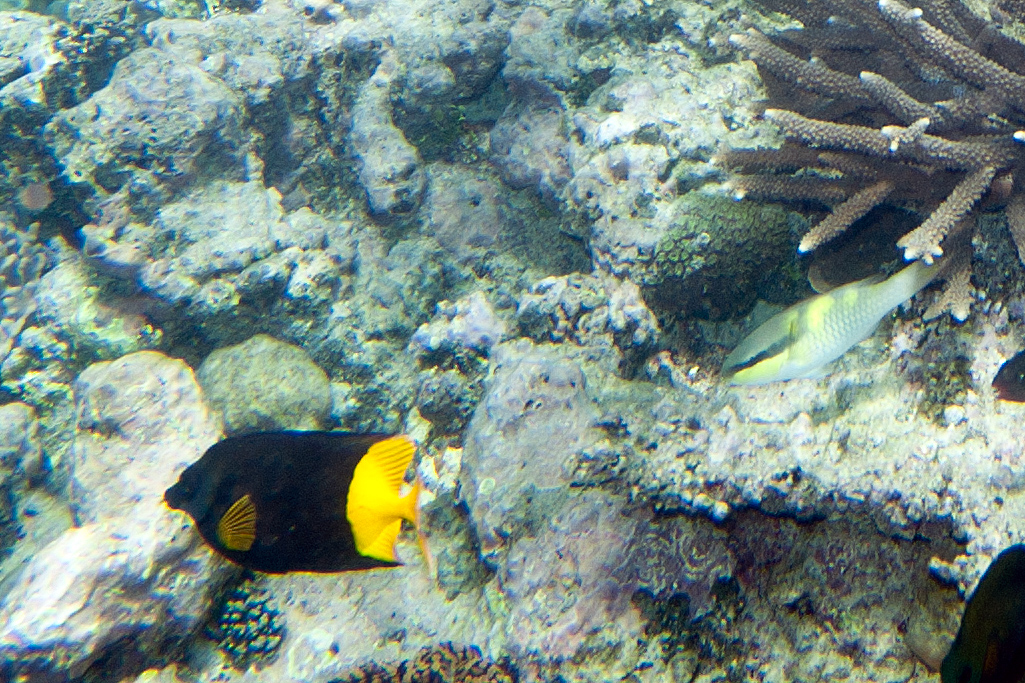
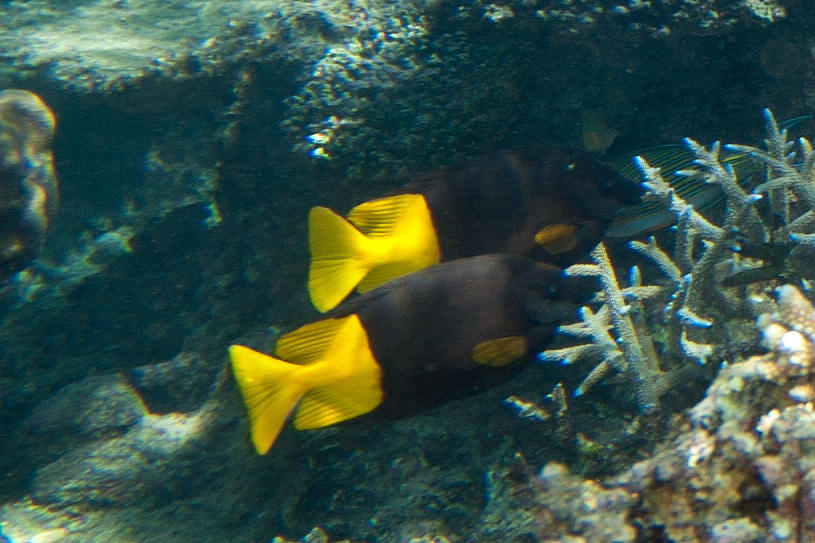
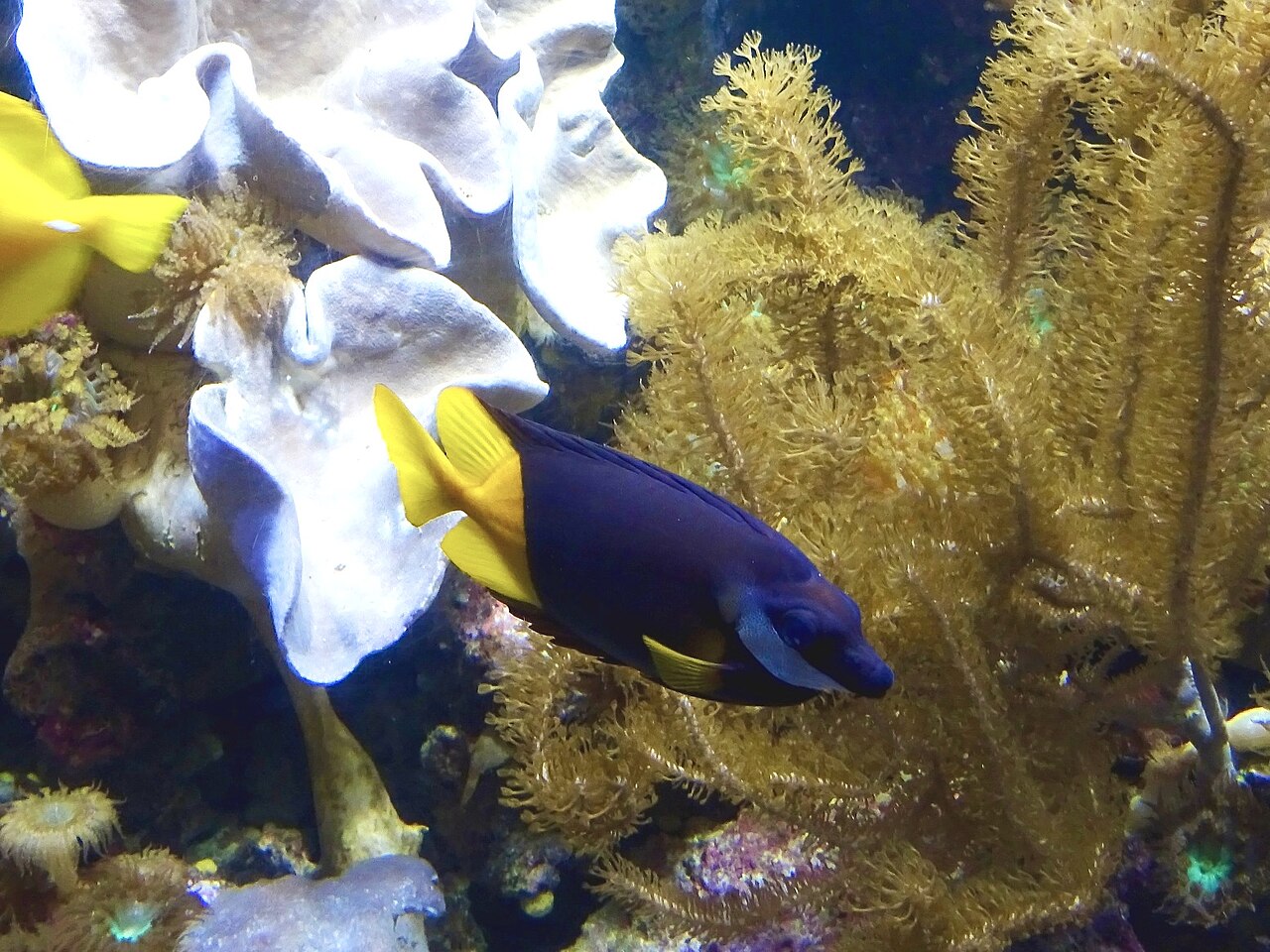
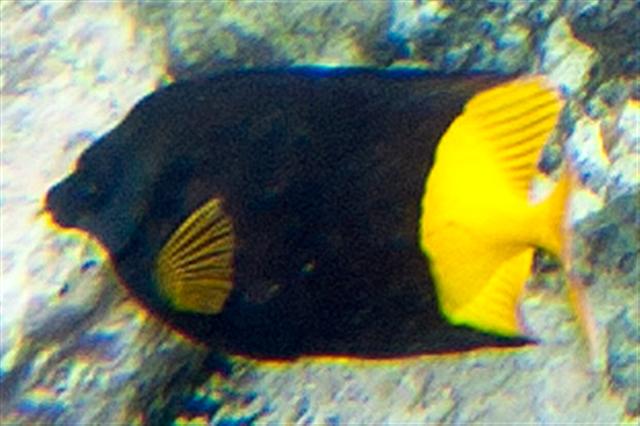
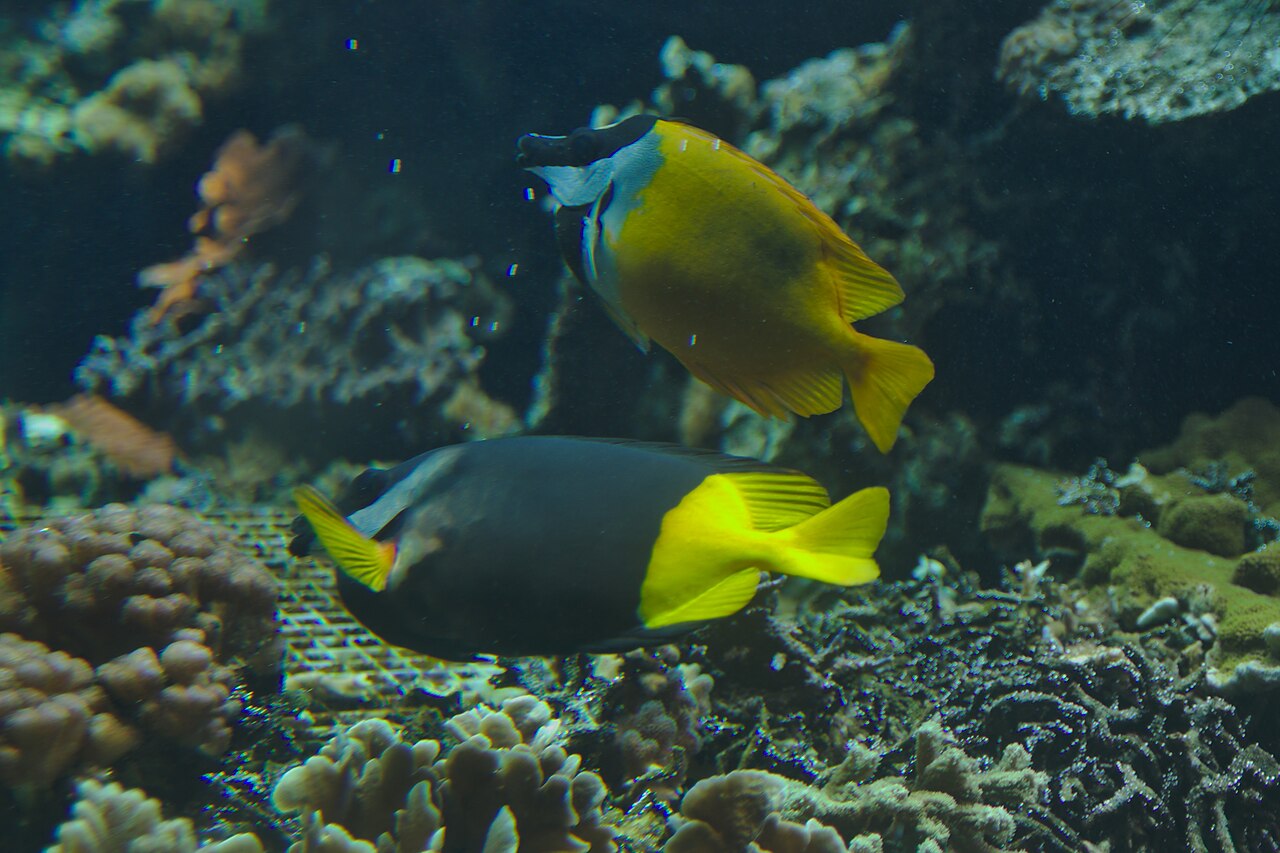
The bicolored foxface is immediately recognizable by its striking two-tone coloration. The body is predominantly a deep purplish brown, while the pectoral fins, the soft-rayed portions of both the dorsal and anal fins, the caudal fin, and the posterior section of the body all glow in a contrasting yellow. The boundary between these two color zones is sharply defined, giving the fish a bold, almost painted appearance. Its body is laterally compressed and deep, with its height fitting a little more than twice into its standard length, and it terminates in a weakly forked tail. A small procumbent spine sits just ahead of the dorsal fin, and the forward nostril opening takes the form of a very short tube that flares slightly toward the rear. Like every member of its family, it bears thirteen dorsal spines paired with ten soft rays, and seven anal spines with nine soft rays. Crucially, those spines are linked to venom glands. The species reaches a maximum total length of about 24 centimeters.
Life on the Reef Slopes
Restricted to the waters surrounding Fiji, the bicolored foxface is a true endemic, with only unconfirmed sightings of stray individuals reported near New Caledonia. It inhabits depths ranging from roughly three to twenty meters, favoring hard coral formations along the steep slopes where the reef edge drops away into deeper water, as well as the deeper pools tucked within the broader reef structure. As a herbivore, it subsists on seaweeds growing across these coral habitats. Its social structure shifts with age: mature individuals tend to form pairs, while younger fish gather in loose schools. The species also produces venom in its fin spines, and research on a closely related rabbitfish has shown that this venom shares characteristics with the potent toxin found in stonefish, underscoring the defensive significance of those spiny structures. Despite its limited geographic range, the bicolored foxface occupies a distinctive ecological niche on Fiji's coral slopes, where its two-tone coloring and venomous spines together shape its interactions with both predators and the reef environment it depends on.
A Fragile Endemic Under Pressure
Because the bicolored foxface is found nowhere else in the world, its entire population is confined to Fiji's coral reefs, making it inherently vulnerable. The species is described as uncommon to rare, and its population is likely highly fragmented across the scattered reef habitats it requires. As a shallow-water fish that depends on hard coral structures, it faces direct threats from habitat degradation in parts of its range, which could drive further population declines. Coastal development along Fiji's shores adds another layer of pressure, while the collection of individuals for the aquarium trade—carried out using drive-in nets—removes additional fish from already small populations. The IUCN has assessed the species as Near Threatened, citing its restricted geographic range combined with ongoing habitat loss. For a fish that grows to only about 24 centimeters and lives in pairs on specific reef slopes, the cumulative effect of these pressures is significant, and the long-term survival of this endemic rabbitfish hinges on the health of Fiji's coral ecosystems and the restraint of human activities that exploit them.
Gallery
Frequently Asked Questions
What is the Bicolored foxface (Siganus uspi)?
It is a small marine rabbitfish in the family Siganidae, commonly called the Uspi rabbitfish. The species was formally described by Gawel and Woodland in 1974 and belongs to the order Acanthuriformes.
Where does the Bicolored foxface live in the wild?
This reef-associated fish is native to coral reef habitats in Fiji, located in the Pacific Ocean. It is not known to occur in any other region.
How large does a Bicolored foxface grow?
Adults reach a maximum total length of about 24 cm (roughly 9.5 inches), making it a modestly sized reef fish.
Can I keep a Bicolored foxface in a home aquarium?
The species does occasionally appear in the aquarium trade, though it remains uncommon. Because it is a wild-caught reef fish, availability is sporadic and keeping one requires a well-established, reef-appropriate setup.
How is the Bicolored foxface classified taxonomically?
It sits in the genus Siganus within the rabbitfish family Siganidae, under the order Acanthuriformes. Its full binomial name is Siganus uspi, a designation established by Gawel & Woodland in 1974.
Spotted an error? Know more?
Reader corrections go straight into our review queue. Suggest an edit · How this site is sourced