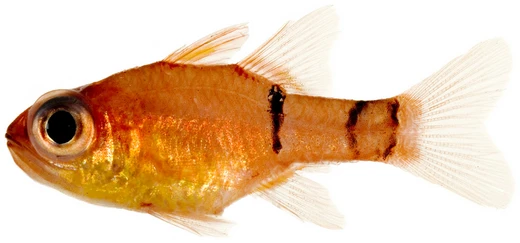
Belted cardinalfish (Apogon townsendi)
Source-cited species reference: taxonomy from WoRMS, biology from FishBase, occurrence map from GBIF, conservation from IUCN Red List, description from Wikipedia.

The belted cardinalfish (Apogon townsendi) is a tropical marine fish in the genus Apogon. They grow up to 6.5 cm in length. Belted cardinalfish are found in the waters of the western Atlantic Ocean, off Central and South America, inhabiting caves and holes. They are pinkish-red on the dorsal side and yellowish-red on the ventral side. Their eggs are carried in the mouth of the adult as they mature.
- Scientific name
- Apogon townsendi
- Authority
- (Breder, 1927)
- Family
- Apogonidae
- Order
- Apogoniformes
- Maximum length
- 6.5 cm
- Depth range
- 3–55 m
- Habitat zone
- reef-associated
- Iucn red list
- Least Concern
- Gbif occurrence records
- 20,563
Classification (WoRMS)
Full classification as recorded by WoRMS: Kingdom: Animalia · Phylum: Chordata · Class: Teleostei · Order: Apogoniformes · Family: Apogonidae · Genus: Apogon.
Accepted name: Apogon townsendi · Authority: (Breder, 1927) · Taxonomic status: accepted · AphiaID: 273108.
Synonyms and superseded combinations recorded for this taxon: Amia townsendi Breder, 1927; Apogon toensendi (Breder, 1927).
Source: World Register of Marine Species (WoRMS) — https://www.marinespecies.org/aphia.php?p=taxdetails&id=273108 (CC BY 4.0). Accessed 2026-09-23.
Biology and life history (FishBase)
Measured values published by FishBase for Apogon townsendi. Only fields the database actually holds for this species are shown; these are database values, not aquarium guidance.
Maximum length: 6.5 cm · Depth range: 3–55 m · Habitat zone: reef-associated · Body shape: fusiform / normal · Vulnerability index: 10 of 100.
FishBase notes: Inhabits coral and rocky areas, often near drop-offs. Solitary or in groups in caves or holes (Ref. 9710). Often seen hovering in the spines of long-spined urchin.
Source: FishBase species summary (SpecCode 3532) — https://www.fishbase.se/summary/Apogon-townsendi.html (CC BY-NC 3.0 — non-commercial use only). Accessed 2026-09-23.
Distribution and occurrence records (GBIF)
20,563 georeferenced occurrence records for Apogon townsendi are published through GBIF from 30 countries or marine areas. The map above plots 49 distinct locations from a sample of 3,000 records, omitting 2 inland records that carry an institution's coordinates rather than a collection site; it shows where the species has been observed and reported, not a modelled range.
Most records by country or area: United States of America (17,669); Puerto Rico (2,351); Belize (114); Virgin Islands (U.S.) (96); Bonaire, Sint Eustatius and Saba (63).
The full country table, WoRMS marine regions and the sampling notes are on this species' Distribution page.
Source: GBIF Occurrence Search (taxonKey 5211780) — https://www.gbif.org/occurrence/search?taxon_key=5211780&has_coordinate=true (records CC0 / CC BY); WoRMS distribution records (MarineRegions) — https://www.marinespecies.org/aphia.php?p=taxdetails&id=273108 (CC BY 4.0); Natural Earth 110m basemap — https://www.naturalearthdata.com/ (public domain). Accessed 2026-09-23.
Conservation status (IUCN Red List)
The IUCN Red List assesses Apogon townsendi (Breder, 1927) as Least Concern (code LC). No trend, population estimate or threat analysis is given here, because none is available from this source without the Red List API; follow the source link for the full assessment, including its date.
Source: IUCN Red List of Threatened Species (taxon 185936) — https://www.iucnredlist.org/species/185936/0; GBIF IUCN Red List category endpoint (taxonKey 5211780) — https://api.gbif.org/v1/species/5211780/iucnRedListCategory. Accessed 2026-09-23.
Description and natural history (Wikipedia)
Belted cardinalfish reach a maximum length of 6.5 cm. They have two dorsal fins; there are six spines in the first and one on the first with nine rays. The pectoral fins have 12 rays and the anal fins have two spines and eight rays. The caudal (tail) fin is forked with twelve scales around the caudal peduncle.
The dorsal side is red or reddish-pink, whereas the ventral side is reddish-yellow. A dark ring is present anterior to the caudal fin, lightening towards the caudal fin. A dark, thin belt extends from the base of the second dorsal fin to the base of the anal fin. The scales of the belted cardinalfish have a toothed margin and are shed periodically. The eggs are carried in the mouth of the adult as they mature. The edibility of this species has been described as "poor".
Belted cardinalfish are marine fish. They are distributed through the Caribbean Sea, Gulf of Mexico, and in waters off of northeastern South America. They are found in waters from northern South America north to southern Florida, including Bermuda. Their range comprises the Antilles as well. Belted cardinalfish are found in rocky areas and reefs near drop-offs. They are often found near reefs at depths of 3 to 55 m. Belted cardinalfish inhabit caves and holes, and may be found among the spines of the long-spined urchin.
Source: Wikipedia: Belted cardinalfish — https://en.wikipedia.org/wiki/Belted_cardinalfish (CC BY-SA 4.0). Accessed 2026-09-23.
Frequently Asked Questions
What is the Belted cardinalfish (Apogon townsendi)?
It is a small tropical reef fish in the cardinalfish family (Apogonidae), first formally described by Breder in 1927. It is native to the western Atlantic Ocean, occurring along the Central and South American coasts.
How large does a Belted cardinalfish grow?
Adults top out at roughly 6.5 centimeters in total length, placing them among the smaller members of the Apogon genus. They are typically encountered between 3 and 55 meters depth.
Where do Belted cardinalfish live and what kind of habitat do they prefer?
They range across the western Atlantic off Central and South America, favoring sheltered microhabitats like caves and crevices on reef structures. Their depth range spans approximately 3 to 55 meters, where they can retreat into tight spaces for protection.
How do Belted cardinalfish reproduce?
The male broods the fertilized eggs inside his mouth until they hatch, a strategy common among cardinalfish. This mouthbrooding behavior shields the developing young from predators during their vulnerable maturation stage.
What does a Belted cardinalfish look like?
The upper body displays a pinkish-red coloration that shifts to a warmer yellowish-red toward the belly. This two-tone scheme helps them blend into the dappled, shaded environments of the caves and holes they inhabit.
Related in Belted cardinalfish
Links follow this subject's own source article.
Elsewhere in Belted cardinalfish
Spotted an error? Know more?
Reader corrections go straight into our review queue. Suggest an edit · How this site is sourced