Frequently Asked Questions
The most-asked questions about Kelp pipefish.
What exactly is a kelp pipefish?
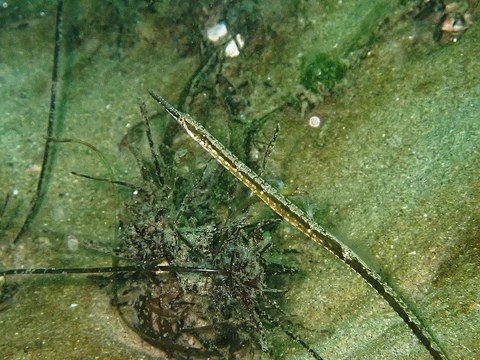
The kelp pipefish (Harpago bottgeri) is a tiny, elongated marine fish that lives among kelp fronds along the Pacific coast of North America. It belongs to the Syngnathidae family, making it a close relative of seahorses and other pipefish.
Where can I find them in the wild?
They inhabit kelp forests from roughly Alaska down to Baja California, typically staying within a few meters of the kelp canopy in shallow, well-oxygenated water. They are most commonly encountered by divers and snorkelers in the mid-Atlantic and north-Atlantic kelp beds.
How large do kelp pipefish get?
Adults usually measure between five and seven centimetres from snout to tail tip. Their slender, tube-like body makes them easy to overlook against a backdrop of swaying kelp.
What do they look like?
They have a long, translucent body with a distinctly elongated, straw-like snout and a row of small dorsal fins running along the back. Faint vertical bars and a pale lateral stripe help them blend into the green-brown kelp around them.
What do they eat?
Kelp pipefish are ambush-style micro-predators that dart out to grab tiny copepods, amphipods, and other planktonic crustaceans drifting through the kelp. They use their tubular mouths to suction prey rather than chasing it.
How do they reproduce?
Males carry the fertilized eggs in a ventral brood pouch, a trait shared with seahorses. After a gestation of roughly three to four weeks, the male releases fully formed, free-swimming fry.
Are kelp pipefish dangerous to humans?
They are completely harmless, possessing no venom, spines, or aggressive behavior toward people. Their only real defense is their small size and excellent camouflage among kelp blades.
How do they avoid predators?
Their primary strategy is crypsis: the pale, translucent body and vertical striping mimic the look of kelp stipes and air bladders. They also remain nearly motionless, relying on the chaotic movement of the canopy to hide their outline.
What threats does the species face?
Kelp pipefish are not individually listed as threatened, but their survival is tightly linked to healthy kelp-forest habitat, which is under pressure from ocean warming, urchin barrens, and coastal development. Protecting the kelp ecosystem is effectively the best way to protect the fish.
Can I keep a kelp pipefish in a home aquarium?
In practice it is extremely difficult: they are tiny, stress-sensitive, require a steady flow of live micro-plankton, and need a planted kelp or macroalgae setup to feel secure. Most experienced keepers recommend leaving them in the wild and observing them in their natural kelp-forest habitat instead.