Frequently Asked Questions
The most-asked questions about Barbour's seahorse.
What is Barbour's seahorse?
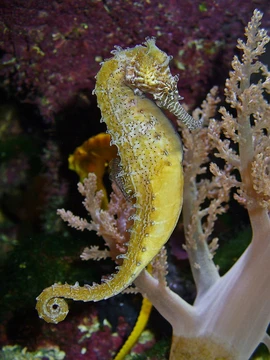
Barbour's seahorse (Hippocampus barbouri) is a small species of seahorse in the family Syngnathidae, native to the western Pacific Ocean. It is one of many Hippocampus species set apart by its particular body proportions and coloration.
Where does it live in the wild?
The species is primarily recorded from coastal waters around Japan and the broader western Pacific. It favors shallow, vegetated habitats such as seagrass beds and mangrove roots, where it can grip with its prehensile tail.
How large does it get?
Barbour's seahorse is a comparatively small member of the genus, typically reaching only a few centimeters in total length. Its compact build helps distinguish it from larger congeners in the same region.
Who first described the species?
It was formally named in the early twentieth century, with the specific epithet 'barbouri' honoring a naturalist of that name. Subsequent taxonomic revisions have retained it within the genus Hippocampus.
What does it eat?
It feeds on tiny crustaceans and planktonic organisms, drawing them in through its tubular snout. As an ambush predator, it holds a relatively stationary position and waits for prey to drift within striking range.
How does it reproduce?
Reproduction follows the familiar seahorse pattern: the female deposits fertilized eggs into the male's abdominal brood pouch, where he incubates them until they hatch as free-swimming young. The male does all of the parental carrying.
Is the species threatened?
It faces pressures from coastal habitat loss and the international seahorse trade, though its conservation status is less thoroughly assessed than that of more widespread relatives. Like all seahorses, it falls under CITES Appendix II, which regulates commercial export.
How do you tell it apart from other western Pacific seahorses?
Taxonomists rely on subtle morphological details such as the count of dorsal and anal fin rays, scale-row patterns, and overall body proportions. These characters separate it from visually similar congeners in the same waters.
Where should a newcomer start learning about it?
FishBase and the IUCN Red List are good starting points for taxonomy and conservation data, while Japanese marine-biology literature holds much of the original descriptive work. Seahorse-focused conservation groups also publish accessible overviews.
Can you keep one in a home aquarium?
Even experienced aquarists find it demanding, as it needs stable water parameters, a live-copepod diet, and a low-current, well-planted tank. CITES restrictions limit legal acquisition, and most enthusiasts are encouraged to support in-situ conservation rather than collection.