Frequently Asked Questions
The most-asked questions about Ringed pipefish.
What is a ringed pipefish?
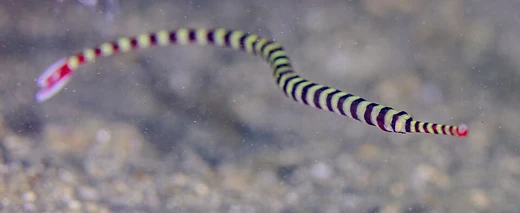
The ringed pipefish (Corythoichthys flavofasciatus) is a small marine fish in the family Syngnathidae, making it a close relative of seahorses and other pipefish. It is native to shallow coral-reef and seagrass habitats across the Indo-Pacific.
What does it look like?
It has a slender, elongated body decorated with bold dark rings set against a pale yellowish-brown background. Its head tapers into a long tubular snout that it uses to suction-feed on tiny prey.
How big do they get?
Adults typically measure around 8 to 10 centimetres (roughly 3 to 4 inches) from snout to tail. They are noticeably smaller than many of their larger pipefish cousins.
Where do they live in the wild?
They range from the Red Sea and East African coast eastward through the central Pacific, favouring sheltered reef flats, seagrass meadows, and rocky overhangs. They are usually found in water shallower than about 10 metres.
What do they eat?
They are sit-and-wait predators that hover near vegetation and dart forward to suck up tiny crustaceans, copepods, and other zooplankton. Their tubular mouth is perfectly adapted for this precision feeding.
How do they reproduce?
As with all members of Syngnathidae, the male carries fertilised eggs in a ventral brood pouch and later releases fully formed young. This paternal care is a hallmark trait shared across pipefish and seahorses.
How is it different from a seahorse?
Although both belong to the same family, pipefish swim horizontally with a free, undulating body and lack the prehensile tail and upright posture that define seahorses. Ringed pipefish are more actively mobile and less anchored to substrates.
What is its conservation status?
The IUCN currently classifies the species as Least Concern, reflecting its broad geographic range and the absence of targeted commercial fishing pressure. Coral-reef degradation and coastal development remain the principal long-term threats to its habitat.
Can you keep one in a home aquarium?
They are feasible but demanding: they need a well-structured, heavily planted or rock-featured tank with stable water parameters and a constant supply of live or frozen micro-crustaceans. Their small size, delicate feeding, and sensitivity to stress make them best suited to experienced reef-keepers.
Where should a newcomer start learning more?
Verified species data and distribution maps are available on databases like FishBase and the IUCN Red List, while dedicated Indo-Pacific reef-fish field guides offer detailed illustrations. Local aquarium societies and reef-keeping forums are also excellent sources for practical husbandry advice and community discussion.