Frequently Asked Questions
The most-asked questions about Blue chromis.
What exactly is a Blue chromis?
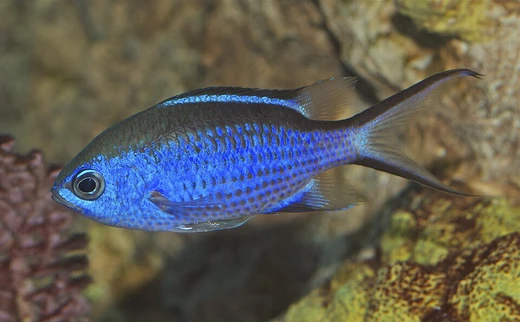
The Blue chromis (Chromis aeneos) is a small damselfish native to Indo-Pacific coral reefs, typically reaching about 4 to 5 cm in length. It belongs to the family Pomacentridae and is one of the more commonly encountered reef fish across that region.
Where can you find Blue chromis in the wild?
They range from the Red Sea and East African coast across to the central Pacific, usually at depths of roughly 1 to 20 metres. They favour areas with live coral, sheltered lagoons, and the upper portions of reef slopes.
What do they look like?
Adults display a uniform steel-blue to blue-green body, often with a small pale-blue or white spot on the opercular flap. Fins are translucent with a faint blue tinge, and juveniles may show slightly different shading before settling into adult coloration.
What is their typical diet?
Blue chromis are omnivorous, grazing on microscopic algae, detritus, and tiny planktonic animals they pick from the water column. In a reef aquarium they will readily accept flake, frozen, and micro-pellet foods.
How social are they in the wild?
They are schooling fish and are most often seen in loose groups of a dozen or more hovering near coral heads. They are not strongly territorial the way many other damselfish are, which makes them relatively peaceful reef inhabitants.
Are Blue chromis suitable for a home reef aquarium?
Yes—they are a go-to species for smaller reef setups because of their modest size, gentle temperament, and hardiness. Keeping them in groups of five or more helps reduce any mild nipping and encourages natural schooling behaviour.
How do they reproduce?
Like most damselfish, the male clears a small patch of substrate and guards a clutch of sticky eggs until they hatch. The female deposits her eggs during a brief spawning visit, and the male fans them with his pectoral fins to keep them oxygenated.
How is Blue chromis different from other Chromis species?
Several look-alikes exist, but C. aeneos is distinguished by its consistent all-blue coloration and the single pale opercular spot. Species such as Chromis viridis tend to be greener, and Chromis chromis shows more pronounced fin markings.
What is their conservation status?
The species is listed as Least Concern by the IUCN; it is widespread and abundant across its range. Local pressure from the aquarium trade is minimal given the population size, and no major habitat threats are currently identified.
What is a good starting point for learning more about Blue chromis?
Marine-biology field guides covering Indo-Pacific damselfish and reputable reef-aquarium forums are solid first stops. Observing them in a well-maintained community reef tank also gives a practical sense of their schooling and foraging behaviour.