Australian blacktip shark (Carcharhinus tilstoni)
Source-cited species reference: taxonomy from WoRMS, biology from FishBase, occurrence map from GBIF, conservation from IUCN Red List, description from Wikipedia.
Last updated

Distribution map plotted from GBIF.org occurrence records; basemap Natural Earth 110m · GBIF records CC0 / CC BY; Natural Earth public domain
The Australian blacktip shark (Carcharhinus tilstoni) is a species of requiem shark, in the family Carcharhinidae, endemic to northern and eastern Australia. Favoring the upper and middle parts of the water column, it can be found from the intertidal zone to a depth of 50 m. Appearance-wise this species is virtually identical to the common blacktip shark (C. limbatus), from which it can be reliably distinguished only by its lower vertebra number and by genetic markers. Generally reaching 1.5 - 1.8 m in length, it is a fairly stout-bodied, bronze-colored shark with a long snout and black-tipped fins.
Scientific classification
- KingdomAnimalia
- PhylumChordata
- ClassChondrichthyes
- SubclassElasmobranchii
- DivisionSelachii
- OrderCarcharhiniformes
- FamilyCarcharhinidae
- GenusCarcharhinus
- SpeciesCarcharhinus tilstoni
Named by (Whitley, 1950)
Close relatives
Other species of Carcharhinus with a Codexery entry.
- Smoothtooth blacktip shark Carcharhinus leiodon
- Australian blackspot shark Carcharhinus coatesi
- Bignose shark Carcharhinus altimus
- Blacknose shark Carcharhinus acronotus
- Blackspot shark Carcharhinus sealei
- Blacktip reef shark Carcharhinus melanopterus
- Blacktip shark Carcharhinus limbatus
- Bull shark Carcharhinus leucas
Sources: Wikipedia taxobox: Australian blacktip shark (CC BY-SA 4.0) · order, family and genus agree with WoRMS AphiaID 271325 (CC BY 4.0)
Conservation status
Least Concern (LC)
- LC▲ this species
- NT
- VU
- EN
- CR
- EW
- EX
Source: IUCN Red List assessment · GBIF copy of the Red List category
How big is it?
Largest length in the source, 2 m, next to a 1.8 m person.
Diagram: drawn by Codexery, schematic shapes to scale (not a likeness). Length: FishBase species summary
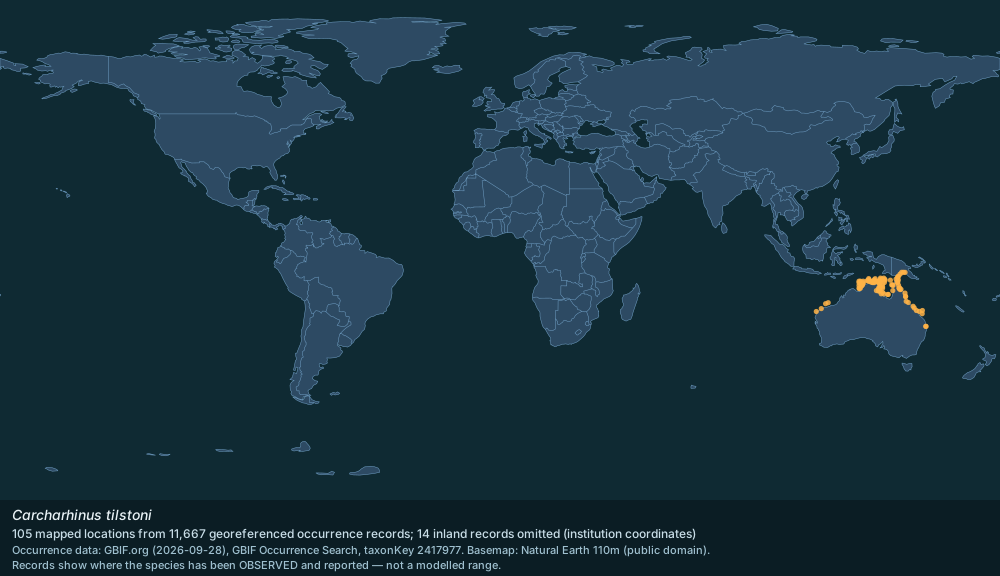
Where the australian blacktip shark (carcharhinus tilstoni) has been recorded
Each dot is a place where the species has been observed and reported (11,667 records, half-degree grid) — not a modelled range. 14 inland records left out (institution coordinates).
Map: drawn by Codexery. Data: GBIF occurrence search (records CC0 / CC BY) · Natural Earth basemap (public domain) · place coordinates: Wikipedia (CC BY-SA 4.0)
Classification (WoRMS)
Full classification as recorded by WoRMS: Kingdom: Animalia · Phylum: Chordata · Class: Elasmobranchii · Order: Carcharhiniformes · Family: Carcharhinidae · Genus: Carcharhinus.
Accepted name: Carcharhinus tilstoni · Authority: (Whitley, 1950) · Taxonomic status: accepted · AphiaID: 271325.
Synonyms and superseded combinations recorded for this taxon: Carcharhinus tilsoni (Whitley, 1950); Carcharias pleurotaenia tilstoni (Whitley, 1950); Galeolamna pleurotaenia tilstoni Whitley, 1950.
Source: World Register of Marine Species (WoRMS) — https://www.marinespecies.org/aphia.php?p=taxdetails&id=271325 (CC BY 4.0). Accessed 2026-09-28.
Biology and life history (FishBase)
Measured values published by FishBase for Carcharhinus tilstoni. Only fields the database actually holds for this species are shown; these are database values, not aquarium guidance.
Maximum length: 200 cm · Depth range: 0–150 m · Habitat zone: pelagic-neritic · Body shape: fusiform / normal · Vulnerability index: 69.8 of 100 · Fishery importance: minor commercial · Aquarium trade: never/rarely.
FishBase notes: Found on the continental shelf from close inshore to about 150 m depth (Ref. 9997). Found throughout the water column but usually near the sea bed during the day and near the surface at night (Ref. 6390). Prefers teleost fishes but also feeds on cephalopods to a lesser degree. Viviparous (Ref. 50449). Forms large aggregations (Ref.
6871). Utilized for its meat and fins (Ref. 6871). The flesh has a relatively high mercury content (Ref. 6871).
Source: FishBase species summary (SpecCode 15721) — https://www.fishbase.se/summary/Carcharhinus-tilstoni.html (CC BY-NC 3.0 — non-commercial use only). Accessed 2026-09-28.
Distribution and occurrence records (GBIF)
11,667 georeferenced occurrence records for Carcharhinus tilstoni are published through GBIF from 2 countries or marine areas. The map above plots 105 distinct locations from a sample of 3,000 records, omitting 14 inland records that carry an institution's coordinates rather than a collection site; it shows where the species has been observed and reported, not a modelled range.
Most records by country or area: Australia (11,654); Papua New Guinea (13).
The full country table, WoRMS marine regions and the sampling notes are on this species' Distribution page.
Source: GBIF Occurrence Search (taxonKey 2417977) — https://www.gbif.org/occurrence/search?taxon_key=2417977&has_coordinate=true (records CC0 / CC BY); WoRMS distribution records (MarineRegions) — https://www.marinespecies.org/aphia.php?p=taxdetails&id=271325 (CC BY 4.0); Natural Earth 110m basemap — https://www.naturalearthdata.com/ (public domain). Accessed 2026-09-28.
Conservation status (IUCN Red List)
The IUCN Red List assesses Carcharhinus tilstoni (Whitley, 1950) as Least Concern (code LC). No trend, population estimate or threat analysis is given here, because none is available from this source without the Red List API; follow the source link for the full assessment, including its date.
Source: IUCN Red List of Threatened Species (taxon 41739) — https://www.iucnredlist.org/species/41739/0; GBIF IUCN Red List category endpoint (taxonKey 2417977) — https://api.gbif.org/v1/species/2417977/iucnRedListCategory. Accessed 2026-09-28.
Description and natural history (Wikipedia)
Primarily piscivorous, the Australian blacktip shark forms large groups of similar size and sex that tend to remain within a local area. It exhibits viviparity, meaning that the unborn young are provisioned through a placental connection. There is a well-defined annual reproductive cycle with mating occurring in February and March. Females bear one to six pups around January of the following year, after a 10-month gestation period.
Human interactions
The Australian blacktip shark is among the sharks most commonly caught by northern Australian commercial fisheries. It is mainly valued for its meat, which is sold as "flake". This species was an important catch of a Taiwanese gillnet fishery that operated from 1974 to 1986, and of the Australian Northern Shark Fishery that continues to the present day. As current fishing levels are not thought to threaten this shark's population, the International Union for Conservation of Nature (IUCN) has assessed it as Least Concern.
Taxonomy and phylogeny
The Australian blacktip shark was described by Australian ichthyologist Gilbert Percy Whitley in a 1950 issue of the scientific journal Western Australian Naturalist. He named it Galeolamna pleurotaenia tilstoni in honor of Richard Tilston, assistant surgeon at Port Essington, Northern Territory.
The type specimen is a 1.5 m long female caught from Van Cloon Reef in Joseph Bonaparte Gulf. Later authors have regarded Galeolamna as a synonym of the genus Carcharhinus. This shark may also be referred to as blacktip whaler, Tilston's whaler shark, and Whitley's blacktip shark.
After Whitley's initial description, C. tilstoni was generally regarded as synonymous with C. limbatus, the common blacktip shark. In the 1980s, additional morphological and life history data again favored the recognition of C. tilstoni as a separate species, which was eventually confirmed by allozyme studies performed by Shane Lavery and James Shaklee. Several molecular phylogenetic studies based on allozymes, mitochondrial DNA, and nuclear DNA have found that the Australian and common blacktip sharks form a closely related clade with the graceful shark (C. amblyrhynchoides) and the smoothtooth blacktip shark (C. leiodon). The interrelationships between them have not been fully resolved, but available data suggest that C. tilstoni and C. limbatus are not the most closely related species within the clade despite their similarity.
Description
Physically, the Australian blacktip shark can only reliably be distinguished from the common blacktip shark by the number of vertebrae (174–182 total, 84–91 before the tail in C. tilstoni, 182–203 total, 94–102 before the tail in C. limbatus). It has a moderately robust, spindle-shaped body and a long, pointed snout. The anterior rims of the nostrils are slightly enlarged into low triangular flaps. The large, circular eyes are equipped with nictitating membranes.
The furrows at the corners of the mouth are barely evident. There are 32–35 upper and 29–31 lower tooth rows; each upper tooth has a slender, upright cusp and fine serrations that become coarser near the base, while the lower teeth are narrower and more finely serrated. The five pairs of gill slits are long.
The long and narrow pectoral fins are falcate (sickle-shaped) with pointed tips. The large first dorsal fin is also falcate and originates over or slightly behind the rear of the pectoral fin bases. The second dorsal fin is moderately tall and positioned about opposite the anal fin.
There is no midline ridge between the dorsal fins. A crescent-shaped notch is present on the caudal peduncle just before the upper caudal fin origin. The caudal fin is asymmetrical, with a strong lower lobe and a longer upper lobe with a ventral notch near the tip. The roughly diamond-shaped dermal denticles are placed closely together and slightly overlapping; each bears five to seven (three in juveniles) horizontal ridges leading to marginal teeth.
The Australian blacktip shark is bronze above (gray after death) and whitish below, with a pale stripe on the flanks. Some individuals have black tips on all fins, while others have unmarked pelvic and anal fins. It typically reaches 1.5 - 1.8 m long; the maximum length and weight on record are 2.0 m and 52 kg.
Distribution and habitat
Inhabiting the continental shelf, the Australian blacktip shark is found from Thevenard Island in Western Australia to Sydney in New South Wales. Within its range, it co-occurs with the common blacktip shark; the ratio between C. limbatus and C. tilstoni was once thought to be 1:300, but recent genetic studies have found it to be closer to 50:50. This species has been reported from the intertidal zone to a depth of 150 m; larger sharks tend to occur in deeper water. Though it occupies the entire water column, it is most common close to the surface or in midwater.
Genetic data suggest Australian blacktip sharks across northern Australia are all members of a single population. Tagging studies have found this species mostly moves only short distances along the coastline and rarely enters offshore waters. However, some individuals have been recorded traveling longer distances, up to 1348 km.
The Australian blacktip shark is known to form large groups, segregated by size and sex. It preys mainly on teleost fishes, including ponyfishes, grunters, tunas, and herring. Cephalopods are a secondary food source, which are particularly important around April.
This species also occasionally consumes smaller sharks, including snaggletooth sharks (Hemipristis pristis), spottail sharks (C. sorrah), and sharpnose sharks (Rhizoprionodon). Their diets shift with age: smaller individuals feed on proportionately more bottom-dwelling fish, while larger individuals feed on proportionately more midwater fish and cephalopods. Documented parasites of this shark include the tapeworms Fossobothrium perplexum and Platybothrium sp., and the copepod Perissopus dentatus.
Like other requiem sharks, the Australian blacktip shark is viviparous: once the embryos exhaust their yolk supply, the depleted yolk sac develops into a placental connection through which the mother provides sustenance. Females bear litters of one to six pups (average three) every year. Mating takes place in February and March, with the females storing the sperm until ovulation in March and April. After a gestation period of 10 months, the young are born around January of the following year.
Near-term females move into shallow, coastal nurseries, such as Cleveland Bay in northern Queensland, to give birth. Such nursery areas appear to be widespread, as newborns have been recorded throughout the range of the species. The newborns are relatively large, measuring about 60 cm long.
They grow rapidly in their first year, increasing in length by an average of 17 cm. The growth rate subsequently slows, averaging 8 - 10 cm per year by age five. Both sexes attain sexual maturity at three to four years of age, at lengths of roughly 1.1 and 1.2 m for males and females, respectively. The maximum lifespan is estimated to be 20 years.
Hybrids between the Australian blacktip shark and the common blacktip shark, comprising both F1 and backcrossed individuals, have been discovered all along the eastern coast of Australia. Despite the widespread incidence of hybridization, there is no evidence that the two parental lineages are merging and the mechanisms preventing introgression are unclear. This is the first confirmed case of hybridization among cartilaginous fishes.
Along with the spottail shark, the Australian blacktip shark is one of the most economically important sharks off northern Australia. It was historically fished for its meat and fins by a Taiwanese gillnet fishery, which began operating off northern Australia in 1974. The annual catch initially averaged around 25,000 tons (live weight), with approximately 70% consisting of Australian blacktip sharks, spottail sharks, and longtail tuna (Thunnus tonggol).
Source: Wikipedia: Australian blacktip shark — https://en.wikipedia.org/wiki/Australian_blacktip_shark (CC BY-SA 4.0). Accessed 2026-09-28.
Related in Australian blacktip shark
Links follow this subject's own source article.
Elsewhere in Australian blacktip shark
Test yourself
Three questions drawn from this entry’s sources. Pick an answer to check it.
Answers checked against the source article
Sources
Compiled from Wikipedia and the sources listed below. Text from Wikipedia is available under CC BY-SA 4.0; this entry is adapted from it.
- Wikipedia: Australian blacktip shark (CC BY-SA 4.0).
- Classification: the source article's taxobox; order, family and genus checked against WoRMS, the World Register of Marine Species (CC BY 4.0).
- Conservation status: IUCN Red List assessment.
- Occurrence records: GBIF (CC0 / CC BY). Basemap: Natural Earth (public domain).
- Biology values: FishBase species summary (CC BY-NC 3.0, non-commercial).
- Word definitions: the Codexery glossary, each quoted from its Wikipedia article.
Spotted an error? Know more?
Reader corrections go straight into our review queue. Suggest an edit · How this site is sourced