
Green egg crab (Atergatis floridus)
Source-cited species reference: taxonomy from WoRMS, biology from SeaLifeBase, occurrence map from GBIF, description from Wikipedia.
Atergatis floridus, the floral egg crab, green egg crab, pancake crab, or shawl crab, is a species of tropical Indo-Pacific crab from the family Xanthidae. The meat of this crab is toxic, even if cooked, and consumption often results in death.
- Scientific name
- Atergatis floridus
- Authority
- (Linnaeus, 1767)
- Family
- Xanthidae
- Order
- Decapoda
- Depth range
- 0–6 m
- Habitat zone
- reef-associated
- Gbif occurrence records
- 1,089
Classification (WoRMS)
Full classification as recorded by WoRMS: Kingdom: Animalia · Phylum: Arthropoda · Class: Malacostraca · Order: Decapoda · Family: Xanthidae · Genus: Atergatis.
Accepted name: Atergatis floridus · Authority: (Linnaeus, 1767) · Taxonomic status: accepted · AphiaID: 209061.
Synonyms and superseded combinations recorded for this taxon: Cancer floridus Linnaeus, 1767.
Source: World Register of Marine Species (WoRMS) — https://www.marinespecies.org/aphia.php?p=taxdetails&id=209061 (CC BY 4.0). Accessed 2026-09-23.
Biology and life history (SeaLifeBase)
Measured values published by SeaLifeBase for Atergatis floridus. Only fields the database actually holds for this species are shown; these are database values, not aquarium guidance.
Depth range: 0–6 m · Habitat zone: reef-associated · Aquarium trade: never/rarely.
SeaLifeBase notes: Found in shallow beaches. The smooth carapace is covered with lacework pattern. The pair of pincers is equal in size with black tips (Ref. 128968). This species contains paralytic shellfish toxins (PST) which are considered lethal when ingested by humans (Ref. 107779). Found along the neritic zone (Ref. 97241), on fringing reefs (Ref. 81564). Intertidal to subtidal (Ref. 106854).
Source: SeaLifeBase species summary (SpecCode 21386) — https://www.sealifebase.se/summary/Atergatis-floridus.html (CC BY-NC 3.0 — non-commercial use only). Accessed 2026-09-23.
Distribution and occurrence records (GBIF)
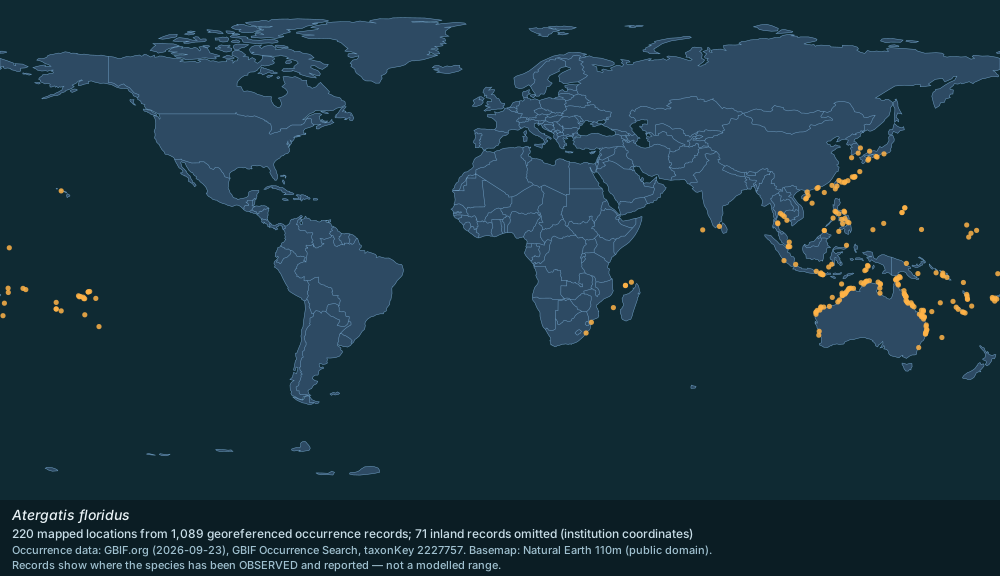
1,089 georeferenced occurrence records for Atergatis floridus are published through GBIF from 39 countries or marine areas. The map above plots 220 distinct locations from a sample of 1,089 records, omitting 71 inland records that carry an institution's coordinates rather than a collection site; it shows where the species has been observed and reported, not a modelled range.
Most records by country or area: Australia (516); Singapore (132); Japan (59); Papua New Guinea (54); New Caledonia (46).
The full country table, WoRMS marine regions and the sampling notes are on this species' Distribution page.
Source: GBIF Occurrence Search (taxonKey 2227757) — https://www.gbif.org/occurrence/search?taxon_key=2227757&has_coordinate=true (records CC0 / CC BY); WoRMS distribution records (MarineRegions) — https://www.marinespecies.org/aphia.php?p=taxdetails&id=209061 (CC BY 4.0); Natural Earth 110m basemap — https://www.naturalearthdata.com/ (public domain). Accessed 2026-09-23.
Description and natural history (Wikipedia)
Atergatis floridus has an oval, relatively narrow carapace which has a smooth surface and smooth margins. The carapace is greenish or greenish-blue-brown and is marked with a pattern which resembles lace and is made up of a fine network of fine white or yellow lines, resembling a shawl. It has large claws which are equal sizes and which are smooth with black spoon-shaped tips and which may be larger in males than females. The pereiopods are squarish in shape and quite thick with lilac edges and lack hair. The width of the carapace is 8 – 10 cm. The carapace is approximately 1.4 times broader than it is long.
Atergatis floridus occurs in the eastern Indian Ocean from south east Asia, south to Australia where it reaches Rottnest Island in Western Australia and possibly Sydney in the east, its range extends eastwards across the western pacific as far as Hawaii.
Atergatis floridus is an inhabitant of the neritic zone and prefers coral and rubble. It is largely nocturnal. A. floridus is host to the isopod Gigantione hainanensis and the rhizocephalan barnacles Loxothylacus aristatus, Loxothylacus corculum, Sacculina gordonae, Sacculina robusta, Sacculina spinosa and Sacculina weberi.
The meat of Atergatis floridus, like that of many related crab species from the family Xanthidae is toxic. The toxins are synthesised by bacteria of the genus Vibrio which live in symbiosis with the crab and the poisons are one similar to those found in puffer fish, i.e. tetrodotoxin, and also saxitoxin which is the primary toxin involved in paralytic shellfish poisoning.
Atergatis floridus was considered to have a wide Indo-Pacific distribution but some authorities consider that the western Indian Ocean specimens belong to a different species, Atergatis ocryoe, which was considered a junior synonym of A. floridus. A. floridus sensu stricto is found in the eastern Indian Ocean and Western Pacific.
Source: Wikipedia: Atergatis floridus — https://en.wikipedia.org/wiki/Atergatis_floridus (CC BY-SA 4.0). Accessed 2026-09-23.
Gallery
Related in Green egg crab
Links follow this subject's own source article.
Elsewhere in Green egg crab
Spotted an error? Know more?
Reader corrections go straight into our review queue. Suggest an edit · How this site is sourced