
Aspidodiadema jacobyi
Source-cited species reference: taxonomy from WoRMS, biology from SeaLifeBase, occurrence map from GBIF, description from Wikipedia.
Aspidodiadema jacobyi is a small sea urchin in the family Aspidodiadematidae. It lives in tropical seas at great depths. Aspidodiadema jacobyi was first scientifically described in 1880 by Alexander Emanuel Agassiz, an American scientist.
- Scientific name
- Aspidodiadema jacobyi
- Authority
- A. Agassiz, 1880
- Family
- Aspidodiadematidae
- Order
- Aspidodiadematoida
- Depth range
- 170–720 m
- Habitat zone
- benthic
- Gbif occurrence records
- 91
Classification (WoRMS)
Full classification as recorded by WoRMS: Kingdom: Animalia · Phylum: Echinodermata · Class: Echinoidea · Order: Aspidodiadematoida · Family: Aspidodiadematidae · Genus: Aspidodiadema.
Accepted name: Aspidodiadema jacobyi · Authority: A. Agassiz, 1880 · Taxonomic status: accepted · AphiaID: 124329.
Source: World Register of Marine Species (WoRMS) — https://www.marinespecies.org/aphia.php?p=taxdetails&id=124329 (CC BY 4.0). Accessed 2026-09-23.
Biology and life history (SeaLifeBase)
Measured values published by SeaLifeBase for Aspidodiadema jacobyi. Only fields the database actually holds for this species are shown; these are database values, not aquarium guidance.
Depth range: 170–720 m · Habitat zone: benthic.
Source: SeaLifeBase species summary (SpecCode 49971) — https://www.sealifebase.se/summary/Aspidodiadema-jacobyi.html (CC BY-NC 3.0 — non-commercial use only). Accessed 2026-09-23.
Distribution and occurrence records (GBIF)
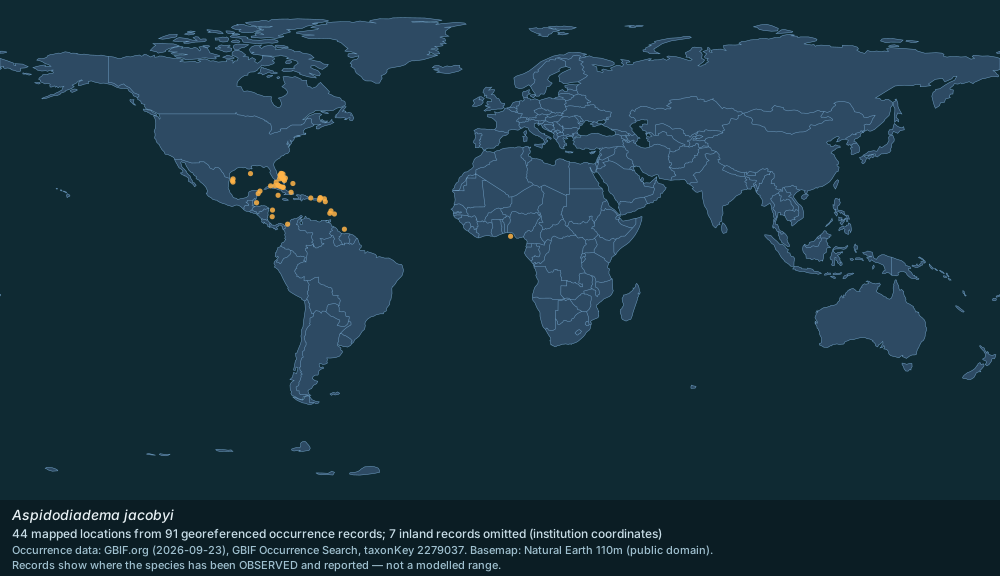
91 georeferenced occurrence records for Aspidodiadema jacobyi are published through GBIF from 18 countries or marine areas. The map above plots 44 distinct locations from a sample of 91 records, omitting 7 inland records that carry an institution's coordinates rather than a collection site; it shows where the species has been observed and reported, not a modelled range.
Most records by country or area: Bahamas (35); Mexico (16); Cuba (15); Colombia (5); Saint Kitts and Nevis (3); Saint Lucia (2); United States of America (2); Saint Vincent and the Grenadines (2); Virgin Islands (British) (2); Anguilla (1); Barbados (1); Belize (1); Dominican Republic (1); Cayman Islands (1); Nigeria (1).
Marine regions with a valid WoRMS distribution record: European waters (ERMS scope); West Indies; Gulf of Mexico; Belizean Exclusive Economic Zone; Colombian part of the Caribbean Sea; Nicaraguan part of the Caribbean Sea; Dominican Republic Exclusive Economic Zone; Mexico; Caribbean Sea; Mexican Exclusive Economic Zone [Caribbean part].
Source: GBIF Occurrence Search (taxonKey 2279037) — https://www.gbif.org/occurrence/search?taxon_key=2279037&has_coordinate=true (records CC0 / CC BY); WoRMS distribution records (MarineRegions) — https://www.marinespecies.org/aphia.php?p=taxdetails&id=124329 (CC BY 4.0); Natural Earth 110m basemap — https://www.naturalearthdata.com/ (public domain). Accessed 2026-09-23.
Description and natural history (Wikipedia)
Aspidodiadema jacobyi has a globular hard test or shell protecting the inner organs. The mouth has 10 buccal plates and small rounded buccal notches and is on the oral (bottom) surface which is slightly flattened. The aboral (top) surface has a small coronal ring of tubercles surrounding the anus. The test is composed of 5 radial ambulacral sets of 3 plates, separated by 5 ambulacral grooves. There are rows of pairs of pores between the ambulacral areas through which the tube feet protrude. Every third row of plates is larger than the other 2 and has a zig-zag row of large primary tubercles. This row does not extend quite as far as the other 2 rows of plates which have similar primary tubercles set serially in a straight line. These large tubercles are perforate and crenulate. There are smaller, secondary tubercles at the edge of the plates. Slender, flexible spines articulate with all these tubercles. These spines are hollow and have bridging structures across their lumina with minute needle-like pillars. The test has green tubercles with purple interambulacral areas.
Aspidodiadema jacobyi is found in the bathyal zone at depths of over 1000 m in the Caribbean Sea and Gulf of Mexico. Its range extends from the Bahamas and West Indies to Colombia, Nicaragua and Mexico.
Little was known about the reproductive biology of deep-water sea urchins, therefore a study was undertaken using Aspidodiadema jacobyi as a model. This species is dioecious with individuals being either male or female. Mature individuals were gathered during the spring on a number of occasions spanning several years. They were collected in the Bahamas by suction at depths of 500 to 750 m and were kept in containers in the laboratory. Attempts were made to initiate spawning but these were successful on only two occasions. The eggs measured 94–100μm and had a yolk so that newly hatched larvae do not need to feed at first. It was suggested that in the open sea this would allow the larvae to disperse in ocean currents, surviving in cold waters where little food is available. Alternatively, another study found that the eggs are surrounded by mucus through which the sperm, which have unusually elongated heads, must penetrate. The eggs clump together and may adhere in a viscous mass to the adult's spines and be brooded there. The sperm also form a mucous mass, and it may be that a form of pseudo-copulation takes place with the pressing together of the gamete masses of adjacent individuals.
In the laboratory, embryos developed over a period of 5 months into echinopluteus larvae measuring over 3000μm which were fed on unicellular algae. During their early stages the larvae developed 2 and then 4 larval arms before the mouth developed at about 11 days. Three further pairs of long arms developed over the next 30 days, after which a posterior process and a ciliated ring appeared successively. At 75 days a rudimentary echinus appeared and at 116 days, podia were apparent. None of the larvae completed metamorphosis into a juvenile and it was suggested that this may have been because the process needed to be initiated by chemical stimuli that were absent in this in vitro experiment.
Source: Wikipedia: Aspidodiadema jacobyi — https://en.wikipedia.org/wiki/Aspidodiadema_jacobyi (CC BY-SA 4.0). Accessed 2026-09-23.
Gallery
Spotted an error? Know more?
Reader corrections go straight into our review queue. Suggest an edit · How this site is sourced