
Argentine seabass (Acanthistius brasilianus)
Source-cited species reference: taxonomy from WoRMS, biology from FishBase, occurrence map from GBIF, conservation from IUCN Red List, description from Wikipedia.

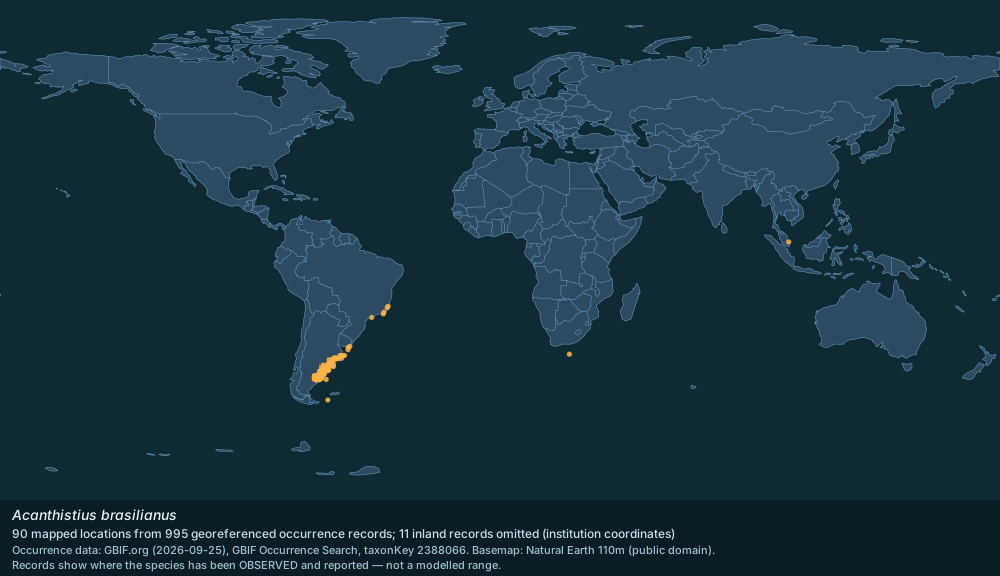
Distribution map plotted from GBIF.org occurrence records; basemap Natural Earth 110m · GBIF records CC0 / CC BY; Natural Earth public domain
The Argentine seabass (Acanthistius brasilianus) is a species of seabass in the family Serranidae. It occurs on the South American continental shelf of the western Atlantic Ocean, where it used to be caught commercially for human consumption.
- Scientific name
- Acanthistius brasilianus
- Authority
- (Cuvier, 1828)
- Family
- Acanthistiidae
- Order
- Perciformes
- Maximum length
- 60 cm
- Depth range
- 15–82 m
- Habitat zone
- benthopelagic
- Iucn red list
- Data Deficient
- Gbif occurrence records
- 995
Classification (WoRMS)
Full classification as recorded by WoRMS: Kingdom: Animalia · Phylum: Chordata · Class: Teleostei · Order: Perciformes · Family: Acanthistiidae · Genus: Acanthistius.
Accepted name: Acanthistius brasilianus · Authority: (Cuvier, 1828) · Taxonomic status: accepted · AphiaID: 278720.
Synonyms and superseded combinations recorded for this taxon: Plectropoma brasilianum Cuvier, 1828; Plectropoma patachonica Jenyns, 1840.
Source: World Register of Marine Species (WoRMS) — https://www.marinespecies.org/aphia.php?p=taxdetails&id=278720 (CC BY 4.0). Accessed 2026-09-25.
Biology and life history (FishBase)
Measured values published by FishBase for Acanthistius brasilianus. Only fields the database actually holds for this species are shown; these are database values, not aquarium guidance.
Maximum length: 60 cm · Depth range: 15–82 m · Habitat zone: benthopelagic · Body shape: fusiform / normal · Vulnerability index: 44 of 100 · Fishery importance: commercial · Aquarium trade: never/rarely.
FishBase notes: Found on the continental shelf in colder waters. Utilized to some degree for human consumption.
Source: FishBase species summary (SpecCode 351) — https://www.fishbase.se/summary/Acanthistius-brasilianus.html (CC BY-NC 3.0 — non-commercial use only). Accessed 2026-09-25.
Distribution and occurrence records (GBIF)
995 georeferenced occurrence records for Acanthistius brasilianus are published through GBIF from 5 countries or marine areas. The map above plots 90 distinct locations from a sample of 995 records, omitting 11 inland records that carry an institution's coordinates rather than a collection site; it shows where the species has been observed and reported, not a modelled range.
Most records by country or area: Argentina (963); Brazil (24); Uruguay (6); Malaysia (1); South Africa (1).
Source: GBIF Occurrence Search (taxonKey 2388066) — https://www.gbif.org/occurrence/search?taxon_key=2388066&has_coordinate=true (records CC0 / CC BY); WoRMS distribution records (MarineRegions) — https://www.marinespecies.org/aphia.php?p=taxdetails&id=278720 (CC BY 4.0); Natural Earth 110m basemap — https://www.naturalearthdata.com/ (public domain). Accessed 2026-09-25.
Conservation status (IUCN Red List)
The IUCN Red List assesses Acanthistius brasilianus (Cuvier, 1828) as Data Deficient (code DD). No trend, population estimate or threat analysis is given here, because none is available from this source without the Red List API; follow the source link for the full assessment, including its date.
Source: IUCN Red List of Threatened Species (taxon 154987) — https://www.iucnredlist.org/species/154987/0; GBIF IUCN Red List category endpoint (taxonKey 2388066) — https://api.gbif.org/v1/species/2388066/iucnRedListCategory. Accessed 2026-09-25.
Description and natural history (Wikipedia)
The Argentine seabass was first described by Georges Cuvier as part of his 22-volume work Histoire naturelle des poissons, which he wrote with Achille Valenciennes from 1828 to 1849. He originally named it Plectropoma brasilianum, though it is now considered a synonym of Acanthistius brasilianus. As a result of his participation in first voyage of HMS Beagle, Leonard Jenyns described a fish in 1840 that he named Plectropoma patachonica, and while many of the fishes he observed may have also been Argentine seabass, it is not totally clear whether P. patachonica is a true synonym of A. brasilianus.
The Argentine seabass' genus name, Acanthistius, comes from the Greek akantha (ακανθα), meaning thorn and Greek, istio (ιστίο) meaning sail, which is in reference to the spines along the front of its dorsal fin. The species name, brasilianus, means "Brazilian". This is a reference to where the first specimens to be reported were caught.
The Argentine seabass has a deep, compressed body and is covered in ctenoid scales, which are typical in teleost fishes. The dorsal profile is evenly arched and this arch is traced by the shape of the lateral line, which is covered by between 84 and 98 scales and runs from the upper margin of the operculum to the base of the caudal fin. The Argentine seabass' dorsal fin has 13 spines and 15 soft rays, while its anal fin has only 3 spines and 8 rays. They generally reach maturity when around 29 cm in length though they have been recorded to lengths of 60 cm. Individuals may weigh as much as 2.5-3 kg.
The Argentine seabass is a rare species, found only in the southwestern Atlantic Ocean, along the coasts of Argentina, Uruguay, and Brazil. They generally inhabit cold waters along the South American continental shelf, but also form a component of some subtropical reef communities, especially rocky reefs and outcrops. Typically marine (they may be rarely encountered in brackish waters), Argentine seabass have been reported at depths from 15 m to 60 m.
Argentine seabass are known to prey upon crabs and small fish. They are in turn eaten by predators such as the Imperial shag.
Argentine seabass are consumed by humans, typically being caught off Argentina and, to a lesser extent, Uruguay. Their meat is generally marketed fresh, frozen or filleted, and 10,000 - 15,000 tonnes were caught annually in the early 2000s. It is not known whether the Argentine seabass is experiencing any major environmental threats, and the overall population trend for this species is unknown. It is classified as Data Deficient by the IUCN.
There are no special regulations concerning the Argentine seabass, though the best harvesting season is from August to March. The species also occurs in a number of marine protected areas. In addition to commercial fishery, the Argentine seabass is also caught by anglers and is typically eaten fried or grilled.
Source: Wikipedia: Argentine seabass — https://en.wikipedia.org/wiki/Argentine_seabass (CC BY-SA 4.0). Accessed 2026-09-25.
Gallery
Spotted an error? Know more?
Reader corrections go straight into our review queue. Suggest an edit · How this site is sourced