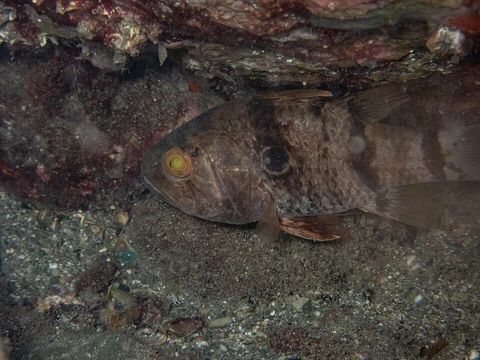
Pharaoh cardinalfish (Apogonichthyoides pharaonis)
Source-cited species reference: taxonomy from WoRMS, biology from FishBase, occurrence map from GBIF, conservation from IUCN Red List, description from Wikipedia.

Sönke Bonde · CC0
Apogonichthyoides pharaonis, commonly known as the Pharaoh cardinalfish, is a species of cardinalfish from the family Apogonidae which is found the western Indian Ocean and Red Sea. It is one of a group of species which have colonised the eastern Mediterranean Sea from the Red Sea via the Suez Canal, a process known as Lessepsian migration.
- Scientific name
- Apogonichthyoides pharaonis
- Authority
- (Bellotti, 1874)
- Family
- Apogonidae
- Order
- Apogoniformes
- Maximum length
- 9.5 cm
- Depth range
- 0–2 m
- Habitat zone
- demersal
- Iucn red list
- Least Concern
- Gbif occurrence records
- 282
Classification (WoRMS)
Full classification as recorded by WoRMS: Kingdom: Animalia · Phylum: Chordata · Class: Teleostei · Order: Apogoniformes · Family: Apogonidae · Genus: Apogonichthyoides.
Accepted name: Apogonichthyoides pharaonis · Authority: (Bellotti, 1874) · Taxonomic status: accepted · AphiaID: 475090.
Synonyms and superseded combinations recorded for this taxon: Apogon pharaonis Bellotti, 1874.
Source: World Register of Marine Species (WoRMS) — https://www.marinespecies.org/aphia.php?p=taxdetails&id=475090 (CC BY 4.0). Accessed 2026-09-23.
Biology and life history (FishBase)
Measured values published by FishBase for Apogonichthyoides pharaonis. Only fields the database actually holds for this species are shown; these are database values, not aquarium guidance.
Maximum length: 9.5 cm · Depth range: 0–2 m · Habitat zone: demersal · Body shape: fusiform / normal · Vulnerability index: 10 of 100 · Aquarium trade: never/rarely.
Source: FishBase species summary (SpecCode 60362) — https://www.fishbase.se/summary/Apogonichthyoides-pharaonis.html (CC BY-NC 3.0 — non-commercial use only). Accessed 2026-09-23.
Distribution and occurrence records (GBIF)
282 georeferenced occurrence records for Apogonichthyoides pharaonis are published through GBIF from 17 countries or marine areas. The map above plots 29 distinct locations from a sample of 282 records, omitting 21 inland records that carry an institution's coordinates rather than a collection site; it shows where the species has been observed and reported, not a modelled range.
Most records by country or area: Israel (185); Greece (32); Türkiye (27); Cyprus (14); Malta (4); Saudi Arabia (4); Egypt (3); Oman (3); Libya (2); Iran (Islamic Republic of) (1); Italy (1); Lebanon (1); Madagascar (1); Mozambique (1); Qatar (1).
Marine regions with a valid WoRMS distribution record: Israeli part of the Mediterranean Sea - Eastern Basin; Cypriote part of the Mediterranean Sea - Eastern Basin; Egyptian part of the Mediterranean Sea - Eastern Basin; Greece, with Cyclades and more islands; Lebanese part of the Mediterranean Sea - Eastern Basin; Syrian part of the Mediterranean Sea - Eastern Basin; Greek part of the Aegean Sea; Turkish part of the Mediterranean Sea - Eastern Basin; Greek part of the Mediterranean Sea - Eastern Basin.
Source: GBIF Occurrence Search (taxonKey 5853511) — https://www.gbif.org/occurrence/search?taxon_key=5853511&has_coordinate=true (records CC0 / CC BY); WoRMS distribution records (MarineRegions) — https://www.marinespecies.org/aphia.php?p=taxdetails&id=475090 (CC BY 4.0); Natural Earth 110m basemap — https://www.naturalearthdata.com/ (public domain). Accessed 2026-09-23.
Conservation status (IUCN Red List)
The IUCN Red List assesses Apogonichthyoides pharaonis (Bellotti, 1874) as Least Concern (code LC). No trend, population estimate or threat analysis is given here, because none is available from this source without the Red List API; follow the source link for the full assessment, including its date.
Source: IUCN Red List of Threatened Species (taxon 46076928) — https://www.iucnredlist.org/species/46076928/0; GBIF IUCN Red List category endpoint (taxonKey 5853511) — https://api.gbif.org/v1/species/5853511/iucnRedListCategory. Accessed 2026-09-23.
Description and natural history (Wikipedia)
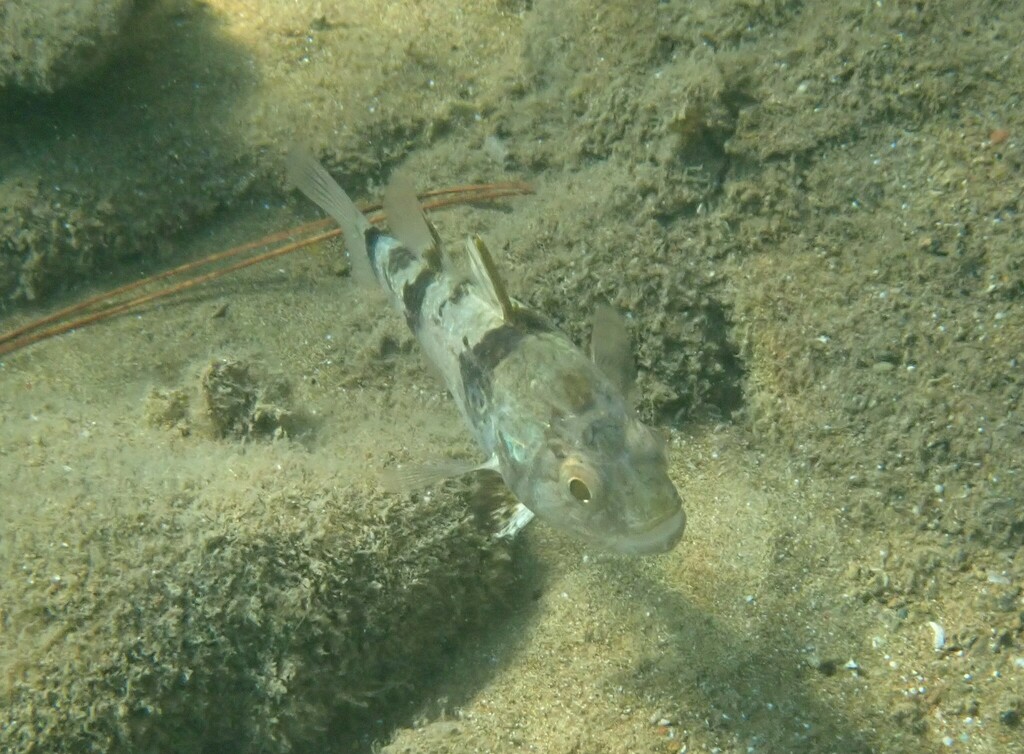
Apogonichthyoides pharaonis has an oblong, compressed body up to 10 cm in length but more commonly 4–6 cm, with two distinct dorsal fins. The first two spines in the first dorsal fin are very short, the third spine is the longest and there is a single spine on the second dorsal fin and 8–9 soft rays. The anal fin lies directly beneath the second dorsal fin and has 2 spines and 7-8 soft rays and the caudal fin is truncated. The pelvic fin, which has1 spine and 5 soft rays starts beneath the base of the pectoral fins each of which has 15-16 soft rays. The large mouth is oblique and has jaws, palatine and vomer which bear villiform teeth. The eye is large and has a diameter which is greater than the distance between the eye and the snout. The preoperculum has a smooth ridge and saw-like margin. There is a spine which projects from the operculum in line with the central point of the eye. There are three vertical black bars which contrast with the grey-brown ground colour of the body, there is one bar running down from each dorsal fin and the last bar is on the caudal peduncle. There is a characteristic black 'eye-spot' surrounded by a yellow ring within the first bar. The first dorsal fin has a dark leading edge while that of the pelvic fins is white.
Apogonichthyoides pharaonis is native to the western Indian Ocean from the Red Sea and eastern African coasts to Australia. It was first recorded in the Mediterranean Sea in the 1940s off Palestine but it was misidentified as Apogon taeniatus. It has since been recorded in Rhodes (Greece), Cyprus and Turkey up to Libyan waters.
Apogonichthyoides pharaonis is a nocturnal species which hides in caves and crevices or among beds of seagrass at depths of 1 – 50 m during the day. At night it emerges and feeds on zooplankton. Like other cardinalfish it is a mouth brooder, the males incubate the eggs in their mouths until the fry can swim free.
Apogonichthyoides pharaonis was first formally described as Agopogon pharaonis in 1874 by the Italian ichthyologist and paleontologist with its type locality given as Suez. Apogonichthyoides pharaonis was previously considered to be a synonym of Apogonichthyoides nigripinnis but it is now regarded as a separate species with A. nigripinnis being found in the eastern Indian Ocean and western Pacific Ocean.
Source: Wikipedia: Apogonichthyoides pharaonis — https://en.wikipedia.org/wiki/Apogonichthyoides_pharaonis (CC BY-SA 4.0). Accessed 2026-09-23.
Gallery
Frequently Asked Questions
What is the Pharaoh cardinalfish (Apogonichthyoides pharaonis)?
It is a small cardinalfish in the family Apogonidae, first described by Bellotti back in 1874. The species is native to the shallow waters of the western Indian Ocean and the Red Sea.
Where can I find a Pharaoh cardinalfish in the wild?
You'll encounter it in very shallow water, typically from the surface down to about two metres, along the coasts of the western Indian Ocean and the Red Sea. It has also established itself in the eastern Mediterranean after moving through the Suez Canal.
How big does a Pharaoh cardinalfish get?
Adults top out at roughly 9.5 cm in total length, which places it among the smaller members of the cardinalfish family. Its compact size suits the shallow, structured habitats it favours.
What does the Lessepsian migration have to do with the Pharaoh cardinalfish?
This species is one of the Red Sea fish that have colonised the eastern Mediterranean by passing through the Suez Canal, a process biologists call Lessepsian migration. It therefore serves as a concrete example of how a single canal can permanently reshape marine communities across two basins.
Why is the Pharaoh cardinalfish notable to fans and researchers alike?
Its shallow-water lifestyle (0–2 m) and small size make it a frequent sighting for coastal divers and a popular subject in the Red Sea aquarist community. More broadly, its spread into the Mediterranean turns it into a living case study of human-driven ecological change.
Spotted an error? Know more?
Reader corrections go straight into our review queue. Suggest an edit · How this site is sourced