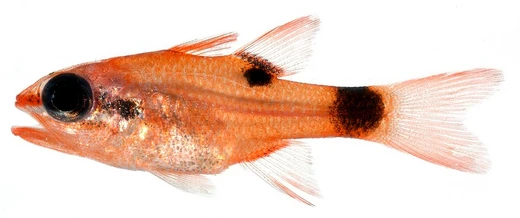
Flamefish (Apogon maculatus)
Source-cited species reference: taxonomy from WoRMS, biology from FishBase, occurrence map from GBIF, conservation from IUCN Red List, description from Wikipedia.

Williams, J. T.; Carpenter, K. E.; Van Tassell, J. L.; Hoetjes, P.; Toller, W.; · CC BY 2.5
Apogon maculatus, commonly known as the flamefish, is a species of cardinalfish from the Western Atlantic. The flamefish is nocturnal and typically hides in shadowy areas.
- Scientific name
- Apogon maculatus
- Authority
- (Poey, 1860)
- Family
- Apogonidae
- Order
- Apogoniformes
- Maximum length
- 11.100000381469727 cm
- Depth range
- 0–128 m
- Habitat zone
- reef-associated
- Iucn red list
- Least Concern
- Gbif occurrence records
- 22,019
A Palette of Living Fire
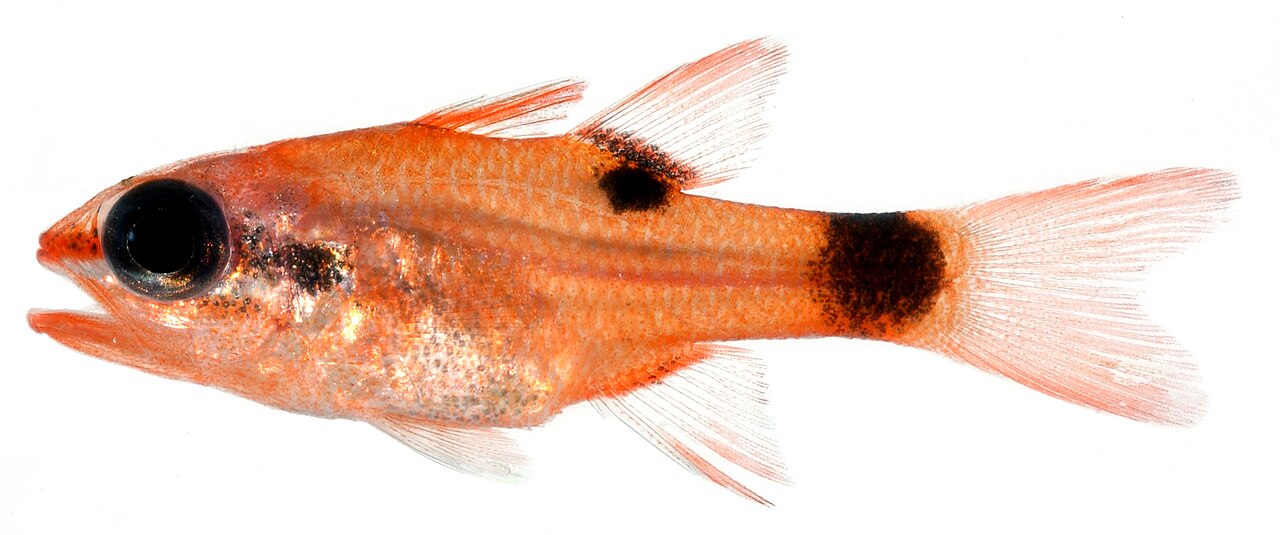
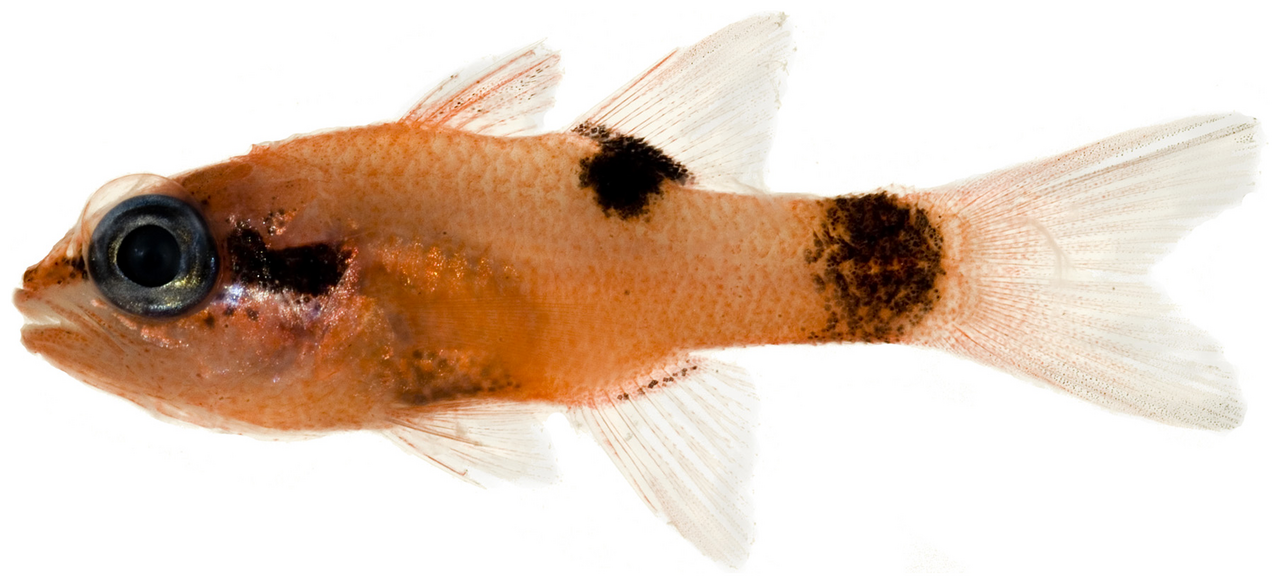
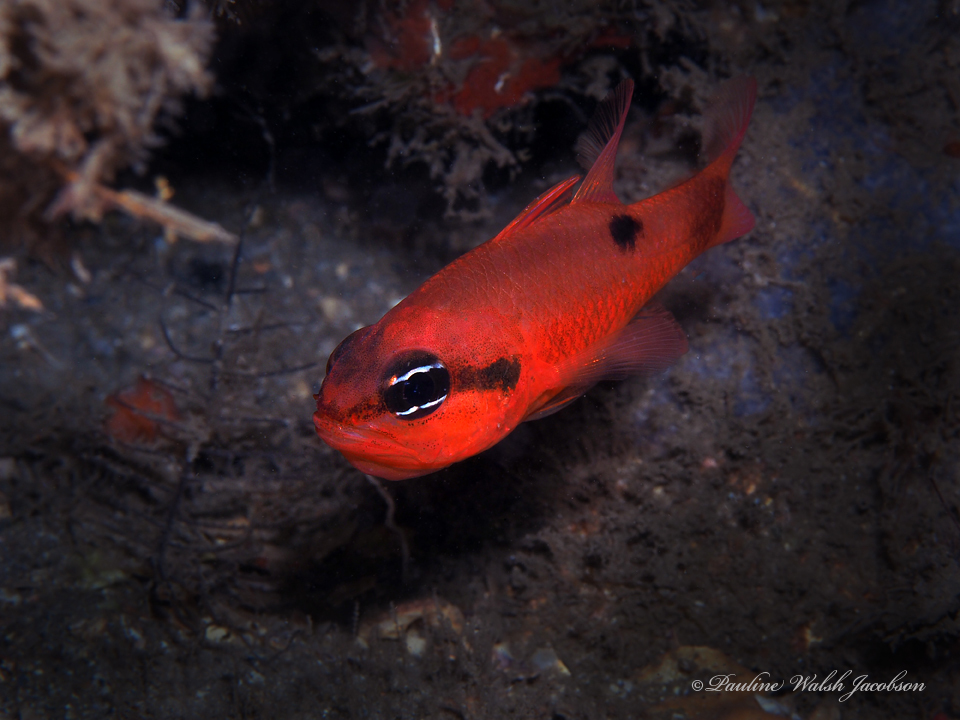
The flamefish earns its common name from a coloration that mirrors the flickering hues of fire: a vivid reddish-orange body scattered with small black spots, capped by a large dark patch on the tail. A long black stripe runs along the snout, adding contrast to the warm tones. Depending on environmental conditions, individuals range from about 6 to 11.1 centimetres (roughly 2.4 to 4.4 inches) in length. Beneath the striking exterior lies a suite of structural adaptations. Each scale houses tiny comb-like spines that grant the fish both protection and a degree of flexibility in movement. Pre-dorsal scales form a shield over the gill region, while a set of eleven to thirteen pectoral fins works in concert to allow rapid shifts in direction and speed. Together, these anatomical features make the flamefish a compact yet remarkably well-equipped inhabitant of its reef environment.
A Nocturnal Resident of the Western Atlantic
Native to the Western Atlantic, the flamefish is most commonly encountered in the warm waters surrounding the Gulf of Mexico, the Florida coast, and the Caribbean islands. Its range, however, extends well beyond these core areas; specimens have been documented as far north as Canada and Massachusetts, and as far south as Brazil, with additional reports from Bermuda and the Bahamas. In its natural setting, the flamefish is a creature of the night. During daylight hours it retreats into shadowy recesses, a behavior that is especially important given its modest size, which makes it vulnerable to larger predators. Coral reefs serve as its primary refuge, offering both the structural complexity needed for concealment and the abundant biological resources that sustain the ecosystem. These same reefs double as favored mating grounds, where the dense architecture provides safe pockets for reproductive activity. The combination of nocturnal habits, small stature, and reliance on reef structure defines the flamefish's ecological niche in the Western Atlantic.
The Father's Burden: Oral Brooding
Reproduction in the flamefish follows a pattern known as oral brooding, a strategy in which the male assumes the entire burden of egg incubation. After the female releases her eggs, the male fertilizes them and then holds them within his mouth for the duration of development. This arrangement makes the male's oral cavity a relatively secure nursery, shielding the developing young from many external threats. However, the system is not without vulnerability. Elevated stress levels can diminish the male's parental care, potentially compromising the survival of the eggs he carries. The reliance on a single parent for this critical phase underscores how sensitive the flamefish's reproductive success is to environmental conditions. In the wild, the dense coral reefs that serve as the species' preferred habitat likely provide the calm, resource-rich microenvironments that reduce stress and support the male through the incubation period. The flamefish's breeding biology thus highlights a delicate balance between parental investment and the need for a stable, low-stress habitat.
Life Behind Glass: The Flamefish in Captivity
Though the flamefish occasionally enters the aquarium trade, its unique coloration and behavioral quirks make it a demanding choice for hobbyists. In captivity, the fish's vivid orange tones tend to fade unless the keeper supplements its diet with color-enhancing vitamins. It reaches roughly 11 centimetres (4.3 inches) in a tank setting. Socially, the species shows aggression toward other cardinalfish, so only a single individual should be housed unless it is part of a bonded pair. Two flamefish require at least 55 imperial gallons (250 litres) of water. With peaceful tank mates, however, it thrives provided the aquarium includes caves and rockwork for hiding. Ideal conditions call for temperatures between 72 and 78 °F (22–26 °C), a pH of 8.1 to 8.4, specific gravity of 1.020–1.025, and dKH of 8 to 12. The fish prefers a fish-only setup and is fed minced crustaceans and clams, ideally in the early morning and evening. If it feels threatened, the flamefish may simply go dormant, hiding through the day.
Gallery
Frequently Asked Questions
What is the Flamefish (Apogon maculatus)?
The Flamefish is a small cardinalfish native to the Western Atlantic, classified in the family Apogonidae under the order Apogoniformes. It was first formally described by Poey in 1860.
Where does the Flamefish (Apogon maculatus) live?
It is found throughout the Western Atlantic, occupying depths from the surface down to roughly 128 meters. Within that range it gravitates toward shadowy, sheltered microhabitats rather than open water.
What is the Flamefish (Apogon maculatus) like behaviorally?
The species is nocturnal, spending daylight hours tucked into dark crevices or shaded structures. It becomes noticeably more active once ambient light drops in the evening.
How big does the Flamefish (Apogon maculatus) get?
Adults top out at approximately 11.1 centimeters in total length, placing it firmly in the small-fish category. Its compact build suits a lifestyle built around squeezing into tight, shadowed refuges.
Is the Flamefish (Apogon maculatus) threatened or endangered?
It does not currently carry a threatened listing on the IUCN Red List, and its broad depth range (0–128 m) across the Western Atlantic suggests a reasonably stable population. That said, localized pressures can still affect individual sites.
Related in Flamefish
Links follow this subject's own source article.
Elsewhere in Flamefish
Spotted an error? Know more?
Reader corrections go straight into our review queue. Suggest an edit · How this site is sourced