Antennarius scaber
Source-cited species reference: taxonomy from WoRMS, biology from FishBase, occurrence map from GBIF, conservation from IUCN Red List, description from Wikipedia.
Last updated

Pauline Walsh Jacobson · via Wikipedia: Antennarius scaber · CC BY 4.0
Antennarius scaber, the splitlure frogfish or striated frogfish, is a species of marine ray-finned fish belonging to the family Antennariidae, the frogfishes. This species is found in the Western Atlantic Ocean and was previously considered to be a synonym of Antennarius striatus.
Scientific classification
- KingdomAnimalia
- PhylumChordata
- ClassActinopterygii
- DivisionTeleostei
- OrderLophiiformes
- FamilyAntennariidae
- GenusAntennarius
- SpeciesAntennarius scaber
Named by (Cuvier, 1817)
Close relatives
Other species of Antennarius with a Codexery entry.
- Antennarius biocellatus Antennarius biocellatus
- Antennarius commerson
- Antennarius indicus
- Antennarius pardalis
- Antennarius multiocellatus
Sources: Wikipedia taxobox: Antennarius scaber (CC BY-SA 4.0) · order, family and genus agree with WoRMS AphiaID 301302 (CC BY 4.0)
Conservation status
Least Concern (LC)
- LC▲ this species
- NT
- VU
- EN
- CR
- EW
- EX
Source: IUCN Red List assessment · GBIF copy of the Red List category
Where the antennarius scaber has been recorded
Each dot is a place where the species has been observed and reported (205 records, half-degree grid) — not a modelled range. 7 inland records left out (institution coordinates).
Map: drawn by Codexery. Data: GBIF occurrence search (records CC0 / CC BY) · Natural Earth basemap (public domain) · place coordinates: Wikipedia (CC BY-SA 4.0)
Classification (WoRMS)
Full classification as recorded by WoRMS: Kingdom: Animalia · Phylum: Chordata · Class: Teleostei · Order: Lophiiformes · Family: Antennariidae · Genus: Antennarius.
Accepted name: Antennarius scaber · Authority: (Cuvier, 1817) · Taxonomic status: accepted · AphiaID: 301302.
Synonyms and superseded combinations recorded for this taxon: Antennarius cubensis Borodin, 1928; Antennarius nuttingi Garman, 1896; Antennarius nuttingii Garman, 1896; Antennarius teleplanus Fowler, 1912; Antennarius tenebrosus (Poey, 1852); Chironectes scaber Cuvier, 1817; Chironectes tenebrosus Poey, 1852; Lophius spectrum Gronow, 1854; Ostracion knorrii Walbaum, 1792; Phrynelox nuttingi (Garman, 1896); Phrynelox scaber (Cuvier, 1817).
Source: World Register of Marine Species (WoRMS) — https://www.marinespecies.org/aphia.php?p=taxdetails&id=301302 (CC BY 4.0). Accessed 2026-09-25.
Biology and life history (FishBase)
Measured values published by FishBase for Antennarius scaber. Only fields the database actually holds for this species are shown; these are database values, not aquarium guidance.
Depth range: 10–219 m · Habitat zone: reef-associated · Body shape: short and / or deep · Vulnerability index: 10.3 of 100 · Fishery importance: subsistence fisheries · Aquarium trade: never/rarely.
Source: FishBase species summary (SpecCode 69561) — https://www.fishbase.se/summary/Antennarius-scaber.html (CC BY-NC 3.0 — non-commercial use only). Accessed 2026-09-25.
Distribution and occurrence records (GBIF)
205 georeferenced occurrence records for Antennarius scaber are published through GBIF from 16 countries or marine areas. The map above plots 48 distinct locations from a sample of 205 records, omitting 7 inland records that carry an institution's coordinates rather than a collection site; it shows where the species has been observed and reported, not a modelled range.
Most records by country or area: United States of America (126); Mexico (45); Martinique (7); Trinidad and Tobago (4); Brazil (3); Cuba (3); Puerto Rico (3); Barbados (2); Bermuda (2); Guyana (2); Panama (2); Saint Vincent and the Grenadines (2); Belize (1); Honduras (1); Jamaica (1).
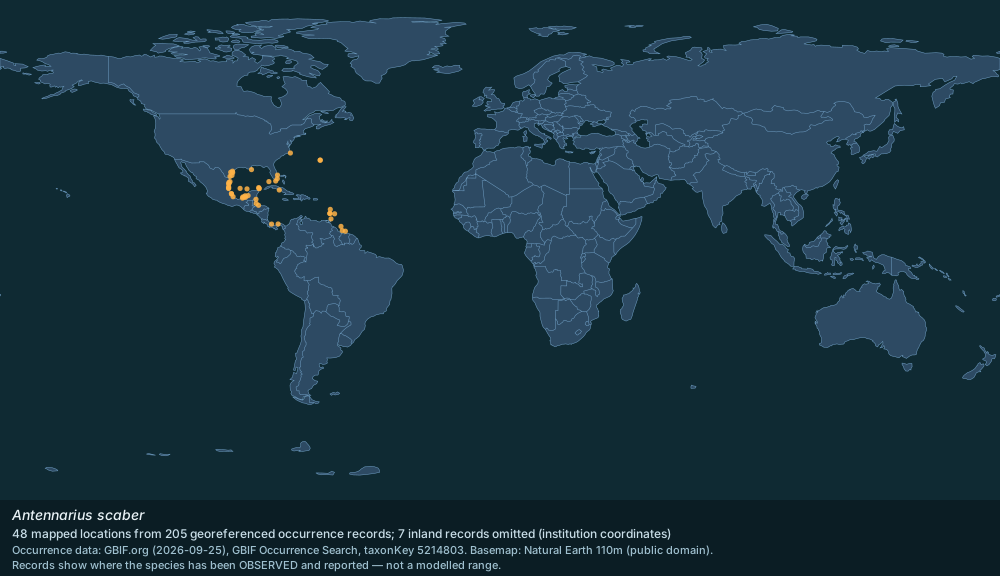
Source: GBIF Occurrence Search (taxonKey 5214803) — https://www.gbif.org/occurrence/search?taxon_key=5214803&has_coordinate=true (records CC0 / CC BY); WoRMS distribution records (MarineRegions) — https://www.marinespecies.org/aphia.php?p=taxdetails&id=301302 (CC BY 4.0); Natural Earth 110m basemap — https://www.naturalearthdata.com/ (public domain). Accessed 2026-09-25.
Conservation status (IUCN Red List)
The IUCN Red List assesses Antennarius scaber (Cuvier, 1817) as Least Concern (code LC). No trend, population estimate or threat analysis is given here, because none is available from this source without the Red List API; follow the source link for the full assessment, including its date.
Source: IUCN Red List of Threatened Species (taxon 67969128) — https://www.iucnredlist.org/species/67969128/0; GBIF IUCN Red List category endpoint (taxonKey 5214803) — https://api.gbif.org/v1/species/5214803/iucnRedListCategory. Accessed 2026-09-25.
Description and natural history (Wikipedia)
Antennarius scaber was first formally described in 1817 as Chironectes scaber by the French zoologist Georges Cuvier with its type locality given as the Martinique. A. scaber was regarded as a synonym of A. striatus of the eastern Atlantic, Indian and Pacific Oceans but molecular and morphological evidence has confirmed that A scaber is a valid species. Within the genus Antennarius this species belongs to the striatus species group. The 5th edition of Fishes of the World classifies the genus Antennarius in the family Antennariidae within the suborder Antennarioidei within the order Lophiiformes, the anglerfishes.
Etymology
Antennarius scaber has the genus name Antennarius which suffixes -ius to antenna, an allusion to first dorsal spine being adapted into a tentacle on the snout used as a lure to attract prey. The specific name scaber, means "rough", an allusion to the rough skin with its covering of spinules.
Description
Antennarius scaber has a globose rather compressed body with eyes on the sides of head. It has a very large, upwardly pointung mouth with numerous small teeth. The small round gill opening is located below and behind the base of the pectoral fin. There are three dorsal spines, the first is the Illicium which is tipped with an esca or "lure" made up of two vermiform appendages.
The second dorsal spine is roughly straight and is connected to head by a smooth membrane. The third dorsal spine is movable and is not fixed to the skin. The limb-like pectoral fins have a joint that resembles an elbow and is broadly connected to body. There are 7 soft rays in the anal fin and the dorsal fin has 12 soft rays.
There is a caudal peduncle and the dorsal and anal fins are not joined to the caudal fin. The rough skin of the body has a dense covering of bifurcated spinules. The overall colour varies through yellow, orange, green, brown, grey, or almost white. There are irregular, slender brown bars and spots on the head, body and fins with dark discontinuous lines radiating out from the eye.
Distribution and habitat
Antennarius scaber is found in the western Atlantic Ocean where it occurs as far north as New Jersey and Bermuda south through the Bahamas, the Gulf of Mexico and throughout the island groups of the Caribbean to the southernmost coast of Brazil. This species is found at depths between the surface and 219 m but is typically found at depths shallower than 30 m on reefs and sandy and muddy substrates.
Biology
Anetnnarius scaber, like other frogfishes, is an ambush predator using the illicium with its esca on the tip to lure prey within striking distance of the mouth. Fishes in the genus Antennarius lay their eggs in gelatinous masses called rafts or veils. The eggs remain within this mass until they hatch.
Source: Wikipedia: Antennarius scaber — https://en.wikipedia.org/wiki/Antennarius_scaber (CC BY-SA 4.0). Accessed 2026-09-25.
Sources
Compiled from Wikipedia and the sources listed below. Text from Wikipedia is available under CC BY-SA 4.0; this entry is adapted from it.
- Wikipedia: Antennarius scaber (CC BY-SA 4.0).
- Classification: the source article's taxobox; order, family and genus checked against WoRMS, the World Register of Marine Species (CC BY 4.0).
- Conservation status: IUCN Red List assessment.
- Occurrence records: GBIF (CC0 / CC BY). Basemap: Natural Earth (public domain).
- Biology values: FishBase species summary (CC BY-NC 3.0, non-commercial).
- Word definitions: the , each quoted from its Wikipedia article.
Spotted an error? Know more?
Reader corrections go straight into our review queue. Suggest an edit · How this site is sourced