Frequently Asked Questions
The most-asked questions about Antennarius pardalis.
What is Antennarius pardalis?
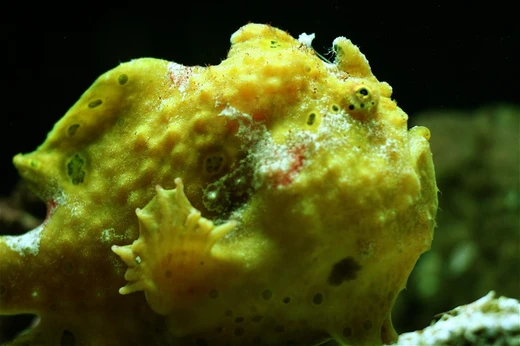
Antennarius pardalis, commonly called the leopard frogfish, is a small, bottom-dwelling marine fish in the family Antennariidae. It is found across the Indo-Pacific and is recognized for its heavily mottled, camouflaged body that blends into coral rubble and reef substrate.
Who first described the species and when?
The species was formally described by ichthyologist John E. Randall in 1955. His work catalogued numerous Indo-Pacific reef fishes, and this entry distinguished the leopard frogfish from its close relatives in the genus Antennarius.
Where can you find it in the wild?
Its range stretches from the Red Sea and the coast of East Africa eastward through the Indian Ocean and the western Pacific to Australia and the western Pacific islands. It typically occupies shallow coral-reef habitats, usually between roughly 1 and 30 metres depth.
How big does it get?
Adults generally reach a total length of around 15 to 20 centimetres, making it one of the smaller members of the frogfish group. Its stocky, laterally compressed body gives it a much larger visual impression than its actual length suggests.
How does it catch its prey?
Like all frogfishes, it is an ambush predator that uses a modified first dorsal-fin spine called the illicium, tipped with a fleshy lure called the esca. It waves the lure near the substrate to draw in small fish and crustaceans, then engulfs them with a rapid gape expansion.
What does its coloration look like?
The body is covered in irregular blotches of dark brown, tan, and cream over a lighter background, giving a leopard-like pattern that mimics algal-covered rock and dead coral. This cryptic coloration makes it extremely difficult to spot until it moves.
Is it dangerous to humans?
No. Antennarius pardalis has no venom, no sharp spines of concern, and a mouth too small to pose any threat to people. Divers and snorkelers can observe it safely, though it should not be handled to avoid stress and loss of protective mucus.
How does it differ from other Antennarius species?
It is set apart by its particular blotch pattern, the shape and size of its esca, and its distribution centred on the western Indo-Pacific. Close look-alikes such as A. striatus or A. pictus can be told apart by fin-ray counts, scale patterns, and geographic range.
Is it kept in aquariums?
It occasionally appears in large public aquaria where a well-planted reef or rubble habitat is provided, but it is rarely a home-aquarium species. It is a sedentary, slow-moving animal that requires stable parameters and a diet of live small fish, making long-term captive care challenging for most hobbyists.
What is its current conservation outlook?
The species is not currently listed as threatened by the IUCN, and no major population declines have been documented. Its primary long-term risk is the degradation of coral-reef habitat across its wide range, which would reduce available foraging and shelter sites.