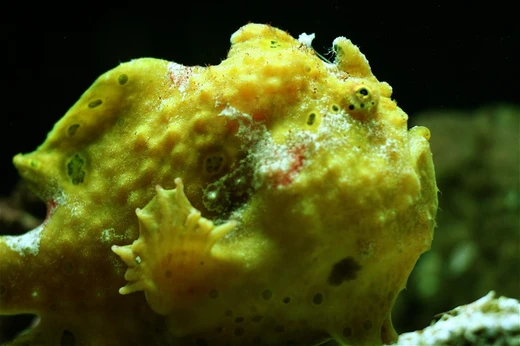
Antennarius pardalis
Source-cited species reference: taxonomy from WoRMS, biology from FishBase, occurrence map from GBIF, conservation from IUCN Red List, description from Wikipedia.

Michael Nordine from Berlin, Deutschland · CC BY 2.0
Antennarius pardalis, the leopard frogfish or peixe pescador, is a species of marine ray-finned fish belonging to the family Antennariidae, the frogfishes. This species is found in the eastern Atlantic Ocean.
- Scientific name
- Antennarius pardalis
- Authority
- (Valenciennes, 1837)
- Family
- Antennariidae
- Order
- Lophiiformes
- Maximum length
- 10.199999809265137 cm
- Depth range
- 18–50 m
- Habitat zone
- reef-associated
- Iucn red list
- Least Concern
- Gbif occurrence records
- 260
Classification (WoRMS)
Full classification as recorded by WoRMS: Kingdom: Animalia · Phylum: Chordata · Class: Teleostei · Order: Lophiiformes · Family: Antennariidae · Genus: Antennarius.
Accepted name: Antennarius pardalis · Authority: (Valenciennes, 1837) · Taxonomic status: accepted · AphiaID: 272540.
Synonyms and superseded combinations recorded for this taxon: Antennarius ampylacanthus Bleeker, 1863; Antennarius campylacanthus Bleeker, 1863; Antennarius pardal (Valenciennes, 1837); Chironectes pardalis Valenciennes, 1837; Lophiocharon campylacanthus (Bleeker, 1863).
Source: World Register of Marine Species (WoRMS) — https://www.marinespecies.org/aphia.php?p=taxdetails&id=272540 (CC BY 4.0). Accessed 2026-09-23.
Biology and life history (FishBase)
Measured values published by FishBase for Antennarius pardalis. Only fields the database actually holds for this species are shown; these are database values, not aquarium guidance.
Maximum length: 10.199999809265137 cm · Depth range: 18–50 m · Habitat zone: reef-associated · Body shape: short and / or deep · Vulnerability index: 10 of 100 · Aquarium trade: never/rarely.
FishBase notes: Inhabits coastal waters (Ref. 26999). Occurs in marine or brackish water (Ref. 97225). Feeds on fish and shrimps (Ref. 28587).
Source: FishBase species summary (SpecCode 5072) — https://www.fishbase.se/summary/Antennarius-pardalis.html (CC BY-NC 3.0 — non-commercial use only). Accessed 2026-09-23.
Distribution and occurrence records (GBIF)
260 georeferenced occurrence records for Antennarius pardalis are published through GBIF from 18 countries or marine areas. The map above plots 46 distinct locations from a sample of 260 records, omitting 33 inland records that carry an institution's coordinates rather than a collection site; it shows where the species has been observed and reported, not a modelled range.
Most records by country or area: Nigeria (40); Ghana (32); Côte d’Ivoire (27); Gabon (22); Senegal (21); Sierra Leone (17); Cameroon (16); Guinea (16); Liberia (16); Cabo Verde (14); Guinea-Bissau (11); Equatorial Guinea (9); Benin (5); Togo (4); Congo, Democratic Republic of the (3).
Source: GBIF Occurrence Search (taxonKey 5214735) — https://www.gbif.org/occurrence/search?taxon_key=5214735&has_coordinate=true (records CC0 / CC BY); WoRMS distribution records (MarineRegions) — https://www.marinespecies.org/aphia.php?p=taxdetails&id=272540 (CC BY 4.0); Natural Earth 110m basemap — https://www.naturalearthdata.com/ (public domain). Accessed 2026-09-23.
Conservation status (IUCN Red List)
The IUCN Red List assesses Antennarius pardalis (Valenciennes, 1837) as Least Concern (code LC). No trend, population estimate or threat analysis is given here, because none is available from this source without the Red List API; follow the source link for the full assessment, including its date.
Source: IUCN Red List of Threatened Species (taxon 21112785) — https://www.iucnredlist.org/species/21112785/0; GBIF IUCN Red List category endpoint (taxonKey 5214735) — https://api.gbif.org/v1/species/5214735/iucnRedListCategory. Accessed 2026-09-23.
Description and natural history (Wikipedia)
Antennarius pardalis was first formally described as Chironectes pardalis in 1837 by the French zoologist Achille Valenciennes with its type locality given as Gorée in Senegal. Within the genus Antennarius the leopard frogfish belongs to the pictus species group. The 5th edition of Fishes of the World classifies the genus Antennarius in the family Antennariidae within the suborder Antennarioidei within the order Lophiiformes, the anglerfishes.
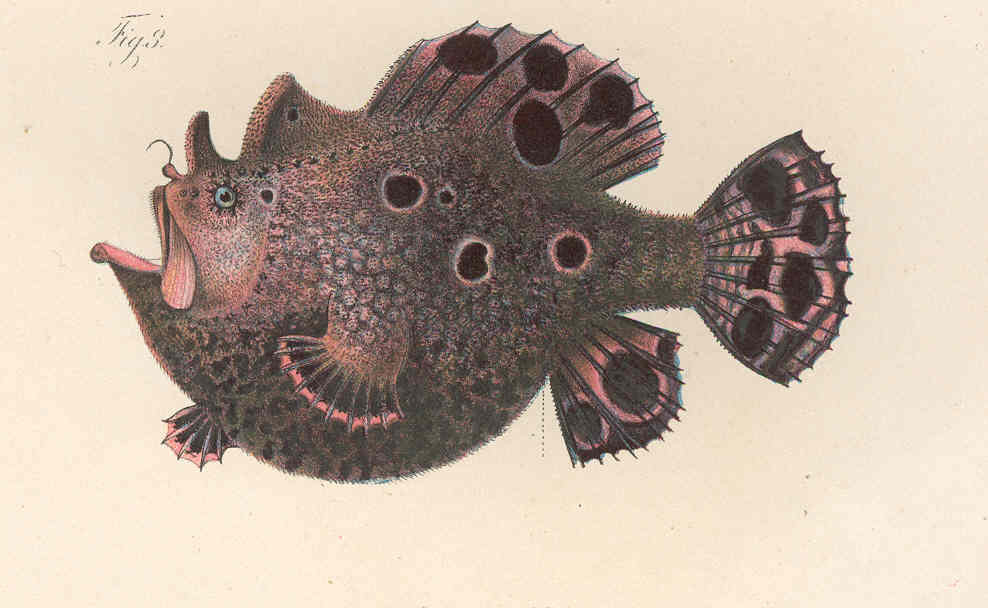
Antennarius pardalis has the genus name Antennarius which suffixes -ius to antenna, an allusion to first dorsal spine being adapted into a tentacle on the snout used as a lure to attract prey. The specific name pardalis means "leopard-like", a reference to the black spots and ocelli on the red body.
Antennarius pardalis has the globose, short body covered in rough skin with closely set spinules typical of the genus Antennarius. The lobe of the pectoral fin has a broad connection to the body with pelvic fins are short, less than a quarter of the standard length. The illicium is long, roughly double the length of the second dorsal spine. The second dorsal spine is attached to the head by a membrane. The body and fins are typically marked with dark spots and ocelli, frequently with three spots on the caudal fin arranged in a triangular pattern. The dorsal fin contains between 11 and 14 soft rays while the anal fin contains between 6 and 10 soft rays. The large mouth has many small, bristle-like teeth. This species has a maximum published standard length of 10.2 cm.
Antennarius pardalis is found in the eastern Atlantic Ocean along the western coast of Africa from southern Western Sahara to Angola, including Cape Verde and São Tomé and Príncipe. It is found in coastal waters at depths between 18 and 50 m on rocky reefs and rocky reefs.
Antennarius pardalis is an ambush predator which lures prey towards its mouth with a lure on the illicium.
Source: Wikipedia: Antennarius pardalis — https://en.wikipedia.org/wiki/Antennarius_pardalis (CC BY-SA 4.0). Accessed 2026-09-23.
Gallery
Frequently Asked Questions
What is Antennarius pardalis?
Antennarius pardalis is a small marine frogfish commonly called the leopard frogfish, and in Portuguese it is known as peixe pescador. It sits within the family Antennariidae and the order Lophiiformes.
Where does Antennarius pardalis live in the wild?
This species is restricted to the eastern Atlantic Ocean, where it typically occupies waters between roughly 18 and 50 meters below the surface.
How big does Antennarius pardalis get?
The leopard frogfish tops out at a maximum recorded length of about 10.2 centimeters, making it one of the smaller members of the frogfish family.
Who described Antennarius pardalis and when?
The species was first formally described by Valenciennes back in 1837, so its scientific name has been in use for nearly two centuries.
What makes Antennarius pardalis stand out among other frogfishes?
While it shares the classic ambush-predator lifestyle of its Antennariidae relatives, the leopard frogfish is set apart by its distinctive mottled coloration and its limited range confined to the eastern Atlantic.
Spotted an error? Know more?
Reader corrections go straight into our review queue. Suggest an edit · How this site is sourced