Frequently Asked Questions
The most-asked questions about Indian frogfish.
What exactly is the Indian frogfish?
The Indian frogfish (Antennarius indicus) is a small, bottom-dwelling ambush predator in the frogfish family (Antennariidae), native to the Indian Ocean. It belongs to the broader order Tetraodontiformes, which also includes pufferfish and filefish.
Where in the Indian Ocean can I find it?
It ranges across the western and central Indian Ocean, with records from the coasts of India, Sri Lanka, East Africa, and the Maldives. It typically occupies shallow reef flats, seagrass beds, and sandy or rubble substrates at depths of roughly 1 to 20 metres.
How large does an Indian frogfish grow?
Adults usually measure around 15 to 20 cm in total length, making them one of the smaller members of the genus Antennarius. They are noticeably more compact than the better-known dwarf or giant frogfish species.
What does it look like and how does it hide?
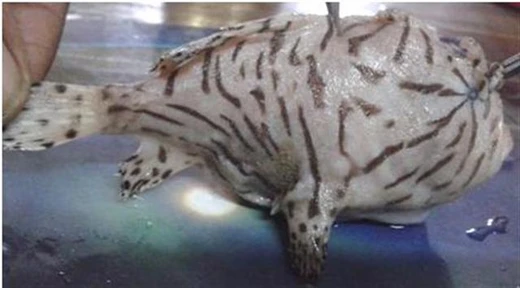
Its body is heavily mottled with irregular blotches of brown, tan, and grey, and its skin is covered in small fleshy projections that break up its outline. It sits motionless on the substrate, often mimicking a clump of algae or a piece of detritus, which makes it extremely hard to spot even at close range.
How does it catch its prey?
It is a sit-and-wait predator that dangles a modified dorsal spine tipped with a fleshy lure (the esca) in front of passing small fish and crustaceans. When prey comes within striking distance, the frogfish opens its large mouth in a rapid suction strike.
What does it eat?
Its diet consists mainly of small benthic fish, shrimp, and crabs that venture close to the reef floor. It is a generalist feeder and will take whatever small mobile prey is available in its immediate area.
Is it dangerous to people?
Like all tetraodontiforms, it possesses venomous spines along its dorsal and anal fins that can deliver a painful sting if handled carelessly. It is not aggressive toward humans and will not seek out contact, but divers and collectors should avoid grabbing it by hand.
How does it differ from other well-known frogfish species?
Its primary distinction is its restricted Indian Ocean range, whereas species like Antennarius pictus (dwarf frogfish) are Indo-Pacific and Antennarius maculatus (giant frogfish) are more widespread. Coloration patterns and the shape of its head tubercles also help separate it from close relatives.
What is its conservation status?
The Indian frogfish is not currently listed as threatened by the IUCN, and it is not heavily targeted by the aquarium trade. The main long-term concern is degradation of shallow reef and seagrass habitats across the Indian Ocean due to coastal development and pollution.
Where should a newcomer start learning more about Indian frogfish?
FishBase and the World Register of Marine Species provide reliable taxonomic and distribution data, while regional marine-biology field guides for the Indian Ocean cover identification tips and behaviour. Local aquarium-keeping forums and dive-club photo groups in India, Sri Lanka, and East Africa are also good sources of firsthand observations.