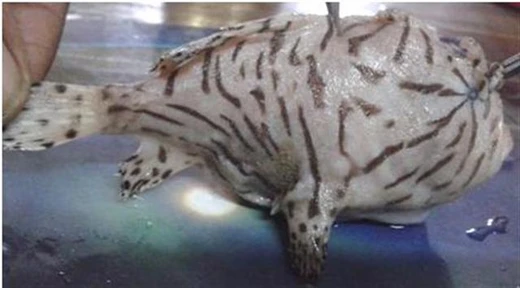
Indian frogfish (Antennarius indicus)
Source-cited species reference: taxonomy from WoRMS, biology from FishBase, conservation from IUCN Red List, description from Wikipedia.

Antennarius indicus, the Indian frogfish, is a species of marine ray-finned fish belonging to the family Antennariidae, the frogfishes. The Indian frogfish is found in the Indian Ocean.
- Scientific name
- Antennarius indicus
- Authority
- Schultz, 1964
- Family
- Antennariidae
- Order
- Lophiiformes
- Maximum length
- 23 cm
- Habitat zone
- reef-associated
- Iucn red list
- Least Concern
Classification (WoRMS)
Full classification as recorded by WoRMS: Kingdom: Animalia · Phylum: Chordata · Class: Teleostei · Order: Lophiiformes · Family: Antennariidae · Genus: Antennarius.
Accepted name: Antennarius indicus · Authority: Schultz, 1964 · Taxonomic status: accepted · AphiaID: 217841.
Source: World Register of Marine Species (WoRMS) — https://www.marinespecies.org/aphia.php?p=taxdetails&id=217841 (CC BY 4.0). Accessed 2026-09-23.
Biology and life history (FishBase)
Measured values published by FishBase for Antennarius indicus. Only fields the database actually holds for this species are shown; these are database values, not aquarium guidance.
Maximum length: 23 cm · Habitat zone: reef-associated · Body shape: short and / or deep · Vulnerability index: 13 of 100 · Aquarium trade: never/rarely.
FishBase notes: An uncommon species that occurs to a depth of at least 25 m.
Source: FishBase species summary (SpecCode 23738) — https://www.fishbase.se/summary/Antennarius-indicus.html (CC BY-NC 3.0 — non-commercial use only). Accessed 2026-09-23.
Conservation status (IUCN Red List)
The IUCN Red List assesses Antennarius indicus Schultz, 1964 as Least Concern (code LC). No trend, population estimate or threat analysis is given here, because none is available from this source without the Red List API; follow the source link for the full assessment, including its date.
Source: IUCN Red List of Threatened Species (taxon 67968687) — https://www.iucnredlist.org/species/67968687/0; GBIF IUCN Red List category endpoint (taxonKey 5214794) — https://api.gbif.org/v1/species/5214794/iucnRedListCategory. Accessed 2026-09-23.
Description and natural history (Wikipedia)
Antennarius indicus was first formally described in 1964 by the American ichthyologist Leonard Peter Schultz with its type locality given as Vizagapatam in India. Within the genus Antennarius the Indian frogfish belongs to the striatus species group. The 5th edition of Fishes of the World classifies the genus Antennarius in the family Antennariidae within the suborder Antennarioidei within the order Lophiiformes, the anglerfishes.
Antennarius indicus has the genus name Antennarius which suffixes -ius to antenna, an allusion to first dorsal spine being adapted into a tentacle on the snout used as a lure to attract prey. The specific name indicus refers to the type locality in India.
Antennarius indicus has an illicium which is roughly equal in length to the second dorsal spine and which has an esca, or lure, which is made up of leaf like appendages. The dorsal fin has 12 soft rays while the anal fin has 7 soft rays. In life the colour of the body is tawny to brown marked with dark brown to black bars on the fins, which may be interconnected and which form stripes when the fins are folded. There are 2 or 3 obvious pale-margined ocelli, one below the base of the dorsal fin, one above and to the rear of the base of the pectoral fin and the other close to the base of the anal fin. Preserved specimens may be beige with pale fins and dark mottling. The Indian frogfish has a maximum published total length of 23 cm.
Antennarius indicus is found in the western Indian Ocean from the Gulf of Aden south to northern Mozambique east tp southeastern India and Sri Lanka, including the Seychelles and Lakshadweep. The Indian frogfish between 0 and 30 m in sandy and muddy habitats close to coral reefs and algal beds.
Source: Wikipedia: Antennarius indicus — https://en.wikipedia.org/wiki/Antennarius_indicus (CC BY-SA 4.0). Accessed 2026-09-23.
Frequently Asked Questions
Who is Indian frogfish (Antennarius indicus)?
It is a small marine ray-finned fish placed in the frogfish family Antennariidae and the order Lophiiformes. Schultz first described the species in 1964, and it is restricted to waters of the Indian Ocean.
What are Indian frogfish (Antennarius indicus)'s powers/role?
As a classic sit-and-wait ambush predator, it dangles a modified dorsal-fin spine tipped with a fleshy lure to draw in small fish and invertebrates. Its mottled body lets it blend into surrounding reef structures while it waits motionless for prey to wander close enough to strike.
Where does Indian frogfish (Antennarius indicus) live?
Its known range is the Indian Ocean, where it occupies reef-associated, benthic zones near the seafloor. It does not venture into open pelagic water but stays anchored to or hovering just above coral and rocky substrates.
How big does Indian frogfish (Antennarius indicus) get?
The species reaches a maximum total length of about 23 cm, placing it in the smaller-to-mid range among frogfishes. That modest size suits its niche of ambushing tiny reef dwellers rather than taking larger prey.
Why is Indian frogfish (Antennarius indicus) important?
It documents the breadth of Antennariidae diversity in the Indian Ocean and gives researchers a reference point for studying how frogfishes partition reef habitats across tropical basins. Its 1964 description also underscores how much of the world's reef fauna was only formally catalogued in the mid-twentieth century.
Spotted an error? Know more?
Reader corrections go straight into our review queue. Suggest an edit · How this site is sourced