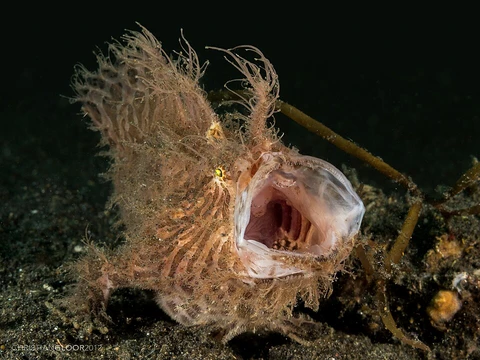
Brackishwater frogfish (Antennarius biocellatus)
Source-cited species reference: taxonomy from WoRMS, biology from FishBase, conservation from IUCN Red List, description from Wikipedia.

Antennarius biocellatus, the brackish water frogfish, brackish water anglerfish, freshwater frogfish twinspot frogfish or fishing frog, is a species of euryhaline ray-finned fish belonging to the family Antennariidae, the frogfishes. This fish is found in the Western Pacific Ocean.
- Scientific name
- Antennarius biocellatus
- Authority
- (Cuvier, 1817)
- Family
- Antennariidae
- Order
- Lophiiformes
- Maximum length
- 14 cm
- Depth range
- 0–10 m
- Habitat zone
- demersal
- Iucn red list
- Data Deficient
Classification (WoRMS)
Full classification as recorded by WoRMS: Kingdom: Animalia · Phylum: Chordata · Class: Teleostei · Order: Lophiiformes · Family: Antennariidae · Genus: Antennarius.
Accepted name: Antennarius biocellatus · Authority: (Cuvier, 1817) · Taxonomic status: accepted · AphiaID: 217844.
Synonyms and superseded combinations recorded for this taxon: Antennarius notophthalmus Bleeker, 1854; Chironectes biocellatus Cuvier, 1817.
Source: World Register of Marine Species (WoRMS) — https://www.marinespecies.org/aphia.php?p=taxdetails&id=217844 (CC BY 4.0). Accessed 2026-09-23.
Biology and life history (FishBase)
Measured values published by FishBase for Antennarius biocellatus. Only fields the database actually holds for this species are shown; these are database values, not aquarium guidance.
Maximum length: 14 cm · Depth range: 0–10 m · Habitat zone: demersal · Body shape: short and / or deep · Vulnerability index: 10 of 100 · Fishery importance: of no interest.
FishBase notes: Unusual among antennariids in often occupying brackish or even totally freshwater habitats. Most specimens were taken at 10 m depth or less. Oviparous. Eggs are bound in ribbon-like sheath or mass of gelatinous mucus called 'egg raft' or 'veil' (Ref. 6773).
Source: FishBase species summary (SpecCode 11113) — https://www.fishbase.se/summary/Antennarius-biocellatus.html (CC BY-NC 3.0 — non-commercial use only). Accessed 2026-09-23.
Conservation status (IUCN Red List)
The IUCN Red List assesses Antennarius biocellatus (Cuvier, 1817) as Data Deficient (code DD). No trend, population estimate or threat analysis is given here, because none is available from this source without the Red List API; follow the source link for the full assessment, including its date.
Source: IUCN Red List of Threatened Species (taxon 196304) — https://www.iucnredlist.org/species/196304/0; GBIF IUCN Red List category endpoint (taxonKey 5214703) — https://api.gbif.org/v1/species/5214703/iucnRedListCategory. Accessed 2026-09-23.
Description and natural history (Wikipedia)
Antennarius biocellatus''' was first formally described as Chironectes biocellatus in 1817 by the French zoologist Georges Cuvier, the type locality is not known. Within the genus Antennarius this species is a sister taxon to all of the others. The 5th edition of Fishes of the World classifies the genus Antennarius in the family Antennariidae within the suborder Antennarioidei within the order Lophiiformes, the anglerfishes.
EtymologyAntennarius biocellatus has the genus name Antennarius which suffixes -ius to antenna, an allusion to first dorsal spine being adapted into a tentacle on the snout used as a lure to attract prey. The specific name biocellatus. this means "two little eyes" and is an allusion to the two ocelli, one on the rear of the base of the dorsal fin, and the other (not always present) on the caudal peduncle.
DescriptionAntennarius biocellatus has a second dorsal spine which is longer than the first dorsal spine, the illicium which is tipped with a small esca, or lure. The second dorsal spine is not connected to the head by a membrane. The ocellus at the base of the rear of the dorsal fin is surrounded by a thin pale yellow, black-margined ring. The body is deep and slightly compressed. The second dorsal fin has 12 soft rays while the anal fin has 6 or 7 soft rays. This species has a maximum published standard length of 14 cm.
Distribution and habitatAntennarius biocellatus is found in the Western Pacific Ocean from Indonesia and the Philippines east through New Guinea and the Solomon Islands, north to Taiwan. records from elsewhere require verification. It is found at depths between 0 and 10 m in estuaries and inshore waters, including reefs. It has been recorded entering freshwater.
BiologyAntennarius biocellatus'' is and ambush predator which sits still and lures prey to its mouth using the esca. The females lay eggs in a gelatinous mass or ribbon known as an "egg-raft" or "veil".
Source: Wikipedia: Antennarius biocellatus — https://en.wikipedia.org/wiki/Antennarius_biocellatus (CC BY-SA 4.0). Accessed 2026-09-23.
Frequently Asked Questions
What is the Brackishwater frogfish (Antennarius biocellatus)?
It is a small euryhaline ray-finned fish in the frogfish family, originally described by Cuvier in 1817. You will also encounter it under names like twinspot frogfish, brackish water anglerfish, or simply fishing frog.
Where can I find a Brackishwater frogfish in the wild?
This species ranges across the Western Pacific Ocean, typically at shallow depths from the surface down to roughly 10 metres. Because it is euryhaline, it can also persist in brackish and even freshwater settings where salinity drops well below open-ocean levels.
How large does a Brackishwater frogfish get?
The species tops out at about 14 centimetres in total length, making it one of the smaller members of the Antennariidae family.
What is the Brackishwater frogfish's taxonomic placement?
It sits in the family Antennariidae, order Lophiiformes, grouping it with the other true frogfishes. The species authority is Cuvier, 1817, under the binomial Antennarius biocellatus.
What makes the Brackishwater frogfish stand out from other frogfishes?
Its euryhaline physiology lets it tolerate a wide salinity gradient, so it can live in brackish estuaries and freshwater bodies where most Antennariidae relatives would not survive. That broad habitat tolerance is the key trait that separates it from the strictly marine species in its family.
Spotted an error? Know more?
Reader corrections go straight into our review queue. Suggest an edit · How this site is sourced