Frequently Asked Questions
The most-asked questions about Thielle's anemonefish.
What exactly is Thielle's anemonefish?
Thielle's anemonefish (Amphiprion thiellei) is a small, reef-dwelling clownfish native to the western Pacific. It belongs to the family Pomacentridae and is recognized as a distinct species within the Amphiprion genus.
Who originally described the species and when?
The species was formally described by ichthyologists Fricke and Herre in 2002, based on specimens collected in the Philippines. Their taxonomic work separated it from previously confused look-alike species.
Where can you find it in the wild?
Thielle's anemonefish is known from a limited range in the Philippines, with the type locality on Palawan. Its distribution appears to be relatively restricted compared to more widespread clownfish relatives.
What does it look like?
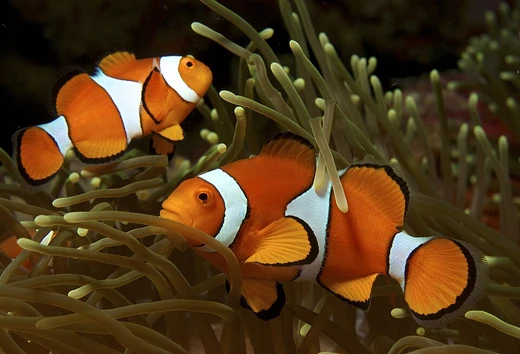
It is a compact fish with a dark, almost blackish body accented by pale to white vertical bars. Its overall appearance is more subdued and darker than the bright orange-and-white coloration of the familiar ocellaris clownfish.
Which anemone does it live in?
In its natural habitat it forms a symbiotic partnership with the giant anemone Heteractis magnifica, sheltering among the tentacles in exchange for protection and leftover food particles.
How large does it grow?
Adults typically reach only a few centimeters in total length, making it one of the smaller members of the anemonefish group. Its modest size is one reason enthusiasts find it appealing for smaller reef setups.
How is it different from other dark-bodied Amphiprion species?
Its combination of bar count, bar shape, and the specific anemone host it favors helps distinguish it from visually similar species like A. clarkii or A. melanocercus. Fricke and Herre's 2002 description laid out the diagnostic characters that set it apart.
What is its conservation outlook?
Because its known range is narrow and it depends on a particular anemone host, it is vulnerable to habitat degradation and over-collection. It has not received a broad IUCN assessment, so long-term population trends remain uncertain.
Can I keep one in a home aquarium?
Experienced reef keepers do house Thielle's anemonefish, but success depends on providing a mature Heteractis magnifica colony, stable water parameters, and a tank large enough to reduce stress. It is not considered a beginner species due to its specific host requirement.
Where should a newcomer start learning more?
The 2002 Fricke & Herre description paper remains the authoritative reference for morphology and distribution. From there, diving forums, reef-fish field guides covering the Philippines, and aquaculture community threads offer practical husbandry tips and photo comparisons.