Frequently Asked Questions
The most-asked questions about Pacific anemonefish.
What exactly is a Pacific anemonefish?
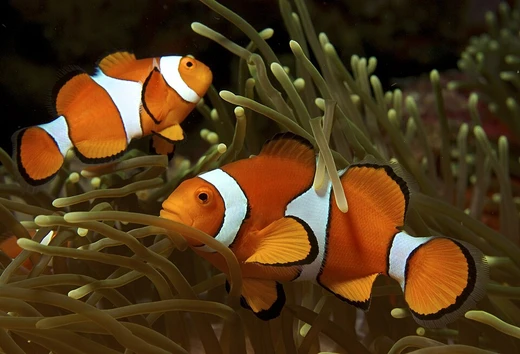
The term refers to small, brightly colored damselfish (subfamily Amphiprioninae) that live in the Pacific and western Indian Oceans, most commonly the ocellaris and percula clownfish. They are named for their lifelong partnership with stinging sea anemones, which they inhabit for shelter and feeding.
Which species do people usually mean when they say 'Pacific anemonefish'?
The two most recognized are the ocellaris clownfish (Amphiprion ocellaris) and the percula clownfish (A. percula), both small orange fish with white bars. A handful of other Amphiprion species range into the Pacific, but these two dominate aquarium trade and pop-culture references.
How are anemonefish connected to the movie Finding Nemo?
The character Nemo is based on the ocellaris clownfish, and the film's underwater setting mirrors the Indo-Pacific reef habitats where these fish are found. The movie sparked a massive surge in public interest and aquarium demand for the species.
Where in the wild can you find them?
They inhabit shallow coral reefs and rocky lagoons across the central and western Pacific, from Indonesia and the Philippines north to southern Japan. They typically stay within a few meters of their host anemone and rarely venture into open water.
How do they survive anemone tentacles that would kill other fish?
A specialized mucus layer on their skin prevents the anemone's nematocysts from firing, a tolerance they develop gradually by nibbling and rubbing against the tentacles as juveniles. In return, the fish clean the anemone, drive away polyp-eating predators, and provide nutrients through their waste.
What is their reproductive strategy?
All anemonefish are born male, and the largest, most dominant individual in a group reverses sex to become the breeding female. If that female dies, the next-largest male undergoes the same transformation, so a single anemone can always produce a new breeding pair.
How big do they typically grow?
Most Pacific anemonefish reach roughly 7 to 11 centimeters (about 3–4 inches) from snout to tail. The female is usually noticeably larger than the male, which is a visible sign of her reproductive role.
What do they eat in the wild versus in an aquarium?
In the ocean they graze on microalgae, detritus, and tiny zooplankton drifting past their anemone. In captivity they readily accept frozen brine shrimp, mysis, and commercial flake or pellet foods formulated for small reef fish.
Are Pacific anemonefish threatened in the wild?
As a group they are not currently listed as endangered, though heavy wild-collection for the aquarium trade has pressured some local populations. Captive breeding programs have largely shifted the trade toward lab-reared stock, reducing direct harvest pressure.
What should a beginner know before keeping one in a home tank?
They are generally hardy, need a minimum 40-gallon (≈150 L) reef or planted tank with stable parameters, and do best in a bonded pair rather than a single individual. Providing a live anemone is optional—many thrive without one if the tank is established and peaceful.