Frequently Asked Questions
The most-asked questions about Maldive anemonefish.
What exactly is the Maldive anemonefish?
It is Amphiprion maldiviensis, a small reef-dwelling fish in the family Pomacentridae, closely related to the more familiar clownfish. It is endemic to the Maldives, meaning it occurs naturally nowhere else on Earth.
Who are the key figures associated with this species?
The species was formally described by the ichthyologist Alfred W. C. Herre in 1935 based on specimens collected in the Maldives. Modern reef ecologists and Maldivian marine-park biologists have since contributed the bulk of what we know about its behavior and distribution.
Where should a newcomer start learning about it?
A good entry point is any standard reef-fish field guide that covers Indo-Pacific amphiprions, followed by Maldives dive-club species lists where the fish is occasionally noted on shallow-reef surveys. Online, the IUCN Red List entry and FishBase profile give concise, citable overviews.
How big is it and what does it look like?
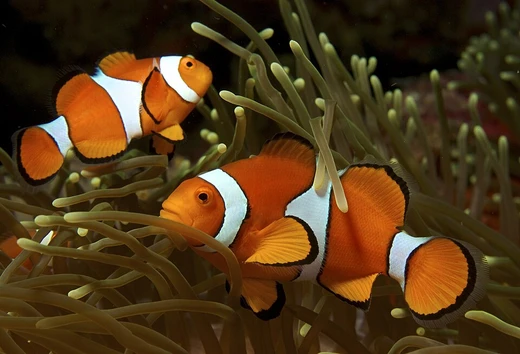
Adults typically top out around 6–7 cm in total length, making them one of the smaller anemonefish. They display the classic amphiprion body shape with one or two pale vertical bands on a dark brown to blackish background, though banding can be faint in some individuals.
What habitat does it prefer?
It is a shallow-reef specialist, generally found in lagoonal and fringing-reef zones at depths of roughly 1 to 10 meters. Like all anemonefish, it is tied to a host sea anemone for shelter, most often species in the genera Heteractis or Stichodactyla.
How does it differ from the more famous Ocellaris or Percula clownfish?
Beyond its restricted Maldivian range, A. maldiviensis tends to have a darker overall ground color and less sharply defined white bands than the widely traded aquarium species. It is also less commonly encountered by recreational divers, partly because its anemone hosts are smaller and often tucked into reef crevices.
What is known about its social and reproductive behavior?
It follows the protandrous hermaphroditic system shared by all Amphiprion species: every group starts as males, and the largest individual transitions to female if the breeding female is removed. Aggressive size-based hierarchy and mutual grooming of the host anemone are typical of the genus.
What is its conservation status?
Because its entire range is confined to the Maldives archipelago, it is inherently vulnerable to localized threats such as anemone loss from bleaching or reef degradation. It has not been the focus of a dedicated population study, so long-term trend data remain limited.
Can it be kept in a home aquarium?
In principle it is a small, anemone-dependent reef fish, but it is rarely imported for the aquarium trade and is not a practical choice for most hobbyists. Captive breeding of this particular species has not been widely documented, unlike A. ocellaris or A. percula.
What are a few quick facts that make it stand out among anemonefish?
It is one of the few amphiprions whose entire natural range fits within a single small island nation, and its description in 1935 predates most modern Maldivian marine-surveys. Despite over eighty years since its naming, it remains one of the least photographed and least studied members of the genus.