Frequently Asked Questions
The most-asked questions about Madagascar anemonefish.
What is the Madagascar anemonefish?
It is a small, reef-dwelling fish in the clownfish family, native exclusively to the coastal waters surrounding Madagascar. Like other members of the genus Amphiprion, it forms a symbiotic partnership with sea anemones for protection.
What is its scientific name and who first described it?
Its binomial name is Amphiprion madagascariensis, a designation published by ichthyologists Smith-Vaniz and Rosenblatt in 1986. The specific epithet simply references the island nation where the species was collected.
Where exactly does it occur in the wild?
The species is endemic to shallow lagoons and fringing reefs off the northern and western coasts of Madagascar. It has not been reliably recorded from any other region of the Indian Ocean.
What does it look like?
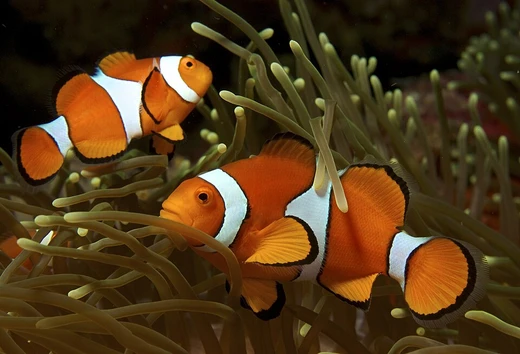
The body is a warm reddish-orange marked by one or two broad white bars edged in black, giving it a distinctly banded appearance. The fins are translucent with a faint orange tint, and the overall build is compact and laterally compressed.
How large does it grow?
Adults typically reach a total length of roughly nine to ten centimeters, making it one of the smaller Amphiprion species. Males and females are similar in size, though the dominant female is usually the largest individual in a host anemone.
Which anemone does it live with?
In the wild it is almost exclusively associated with the magnificent anemone, Heteractis magnifica. The fish secretes a protective mucus layer that allows it to move among the stinging tentacles without harm.
How does it differ from the widely kept ocellaris clownfish?
A. madagascariensis tends to be a deeper orange with broader, more diffuse white bars, whereas A. ocellaris is a brighter orange with thinner, crisper bands. Geographically, the Madagascar species is restricted to one island nation while the ocellaris ranges across the central Pacific.
Can it be kept in a home aquarium?
Experienced marine keepers do house them, but the fish is more sensitive to water-quality fluctuations than common clownfish and can be skittish when newly introduced. A well-established system with a live Heteractis magnifica and stable parameters greatly improves survival and display behavior.
What is its current conservation status?
The IUCN lists the species as Data Deficient, meaning there is not yet enough population or trade data to assign a more precise risk category. Because its range is limited to one island, localized threats such as coastal development carry disproportionate weight.
Where should a newcomer start learning more about this species?
A good first step is reviewing the original 1986 description by Smith-Vaniz and Rosenblatt alongside recent FishBase or WoRMS entries for up-to-date taxonomy. Field guides to Indian Ocean reef fish and hobbyist forums dedicated to wild-caught Amphiprion species offer practical husbandry tips and photo references.