Frequently Asked Questions
The most-asked questions about Wide-band Anemonefish.
What exactly is a Wide-band Anemonefish?
It is a small reef-dwelling clownfish, scientifically named Amphiprion chrysopterus, recognized by its pale silvery-white body crossed by a single broad black vertical band. The species name translates to 'golden fins,' referring to the yellowish hue of its pectoral and caudal fins.
Where in the wild can you find this species?
Its range spans the western Pacific, including waters around Indonesia, the Philippines, Papua New Guinea, and the northern coast of Australia. It typically inhabits shallow coral reefs from just below the surface down to roughly 15 meters.
How does it interact with sea anemones?
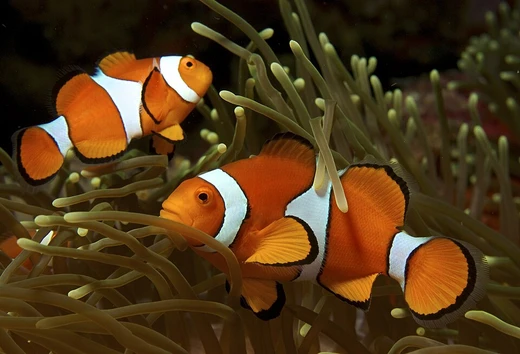
Like other clownfish, it lives in a mutualistic partnership with host anemones such as Heteractis magnifica and Stichodactyla gigantea, gaining protection from predators in exchange for cleaning and nutrient exchange. The fish develops a mucus coating that shields it from the anemone's stinging cells.
How big does an adult get?
Adults usually reach a total length of about 8 to 10 centimeters, making it a mid-sized member of the Amphiprion genus. Males and females are roughly the same size, though the dominant female in a group tends to be slightly larger.
What does it eat in the wild?
It is omnivorous, picking up small zooplankton, micro-algae, and organic detritus from the reef surface. In captivity it readily accepts flake, frozen brine shrimp, and finely chopped marine pellets.
How is it different from the more familiar Ocellaris or Percula clownfish?
Where those popular species show multiple thin orange-and-white stripes, the Wide-band Anemonefish has a predominantly white body with one single thick black band and distinctly golden-tinted fins. Its overall palette is far more subdued and high-contrast than the bright orange of most hobbyist-favorite clownfish.
Can it be kept in a home aquarium?
Yes, but it needs a well-established system with a live host anemone or at minimum a large, mature reef tank of 150 liters or more. It is generally peaceful but can become territorial toward other anemonefish of the same species, so keeping a bonded pair is the standard approach.
What is its conservation status?
The IUCN currently lists Amphiprion chrysopterus as Least Concern, as it has a broad distribution and is not heavily targeted by the aquarium trade compared to more colorful relatives. Local overfishing and coral-reef degradation remain the primary long-term threats to its habitat.
What is its social structure in the wild?
It lives in a small family group anchored to a single anemone, led by a dominant breeding female and one or more subordinate males. If the female dies, the largest male changes sex to become the new female, a process called protandrous hermaphroditism.
Where should a newcomer start learning more about this species?
Begin with a reliable field guide to western Pacific reef fishes or a dedicated marine-fish database entry for Amphiprion chrysopterus to confirm identification details. From there, hobbyist forums and anemone-keeping guides will give practical insight into its behavior, tank requirements, and long-term care.