Frequently Asked Questions
The most-asked questions about Chagos anemonefish.
What is the Chagos anemonefish?
It is a small, reef-dwelling anemonefish (genus Amphiprion, family Pomacentridae) that is endemic to the Chagos Archipelago in the central Indian Ocean.
Who first described the species scientifically?
The Chagos anemonefish was formally described by ichthyologist James A. Allen in 1981 based on specimens gathered from the Chagos islands.
Where can you find it in the wild?
Its entire known range is the coral-reef waters surrounding the Chagos Archipelago (British Indian Ocean Territory), so it occurs nowhere else on the planet.
What does it look like?
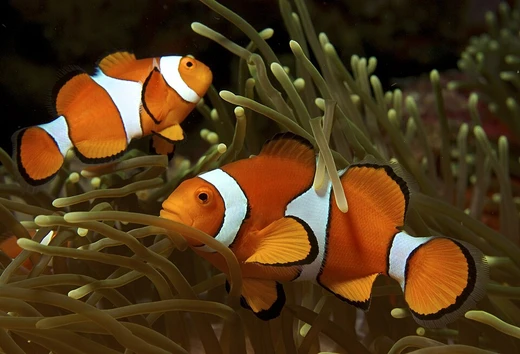
It has the classic laterally compressed anemonefish silhouette with a dark brownish body and one or two pale vertical bars, though it is generally smaller and more muted in color than popular aquarium species like A. ocellaris.
What is its host anemone?
Like every member of the genus, it lives in a mutualistic partnership with a sea anemone, sheltering among the stinging tentacles while the anemone gains protection and leftover food.
How large does it grow?
It remains a modestly sized fish, typically only a few centimeters in total length, which is consistent with many island-restricted Amphiprion species.
What is its conservation outlook?
Because every individual lives within a single small archipelago, the species is inherently vulnerable to coral degradation, pollution, and climate-driven reef loss, even though it has not always received a formal IUCN Red List assessment.
How does it reproduce?
As with all anemonefish, it is a sequential protandrous hermaphrodite: every individual hatches male, and if the breeding female is removed the largest male in the group transitions to become the new female.
How does it differ from the familiar ocellaris or percula clownfish?
Beyond its strictly limited range, it tends to be smaller, shows a subtly different bar pattern, and is tied to different anemone hosts than the two most commonly kept aquarium species.
Where can a newcomer or researcher dig deeper?
Start with Allen's 1981 original description, the FishBase entry for Amphiprion chagosensis, and the marine-biodiversity surveys of the Chagos Archipelago published by the BIOT administration and partner conservation organisations.