Frequently Asked Questions
The most-asked questions about Barrier reef anemonefish.
What exactly is the Barrier reef anemonefish?
It is a small marine fish in the genus Amphiprion (the clownfish group), scientifically named Amphiprion akindynos. Like all its relatives, it lives in a mutualistic partnership with one or more species of sea anemone, using the stinging tentacles as shelter while providing the anemone with cleaning and nutrients.
Where in the world can you find this species?
Its range is restricted to the Coral Sea off northeastern Australia, essentially the waters surrounding the Great Barrier Reef. It is not found in the Indian Ocean, the Pacific, or any other reef system, which makes it a regional endemic.
How big does a Barrier reef anemonefish get?
Adults typically reach roughly six to eight centimetres from snout to tail, placing it among the smaller clownfish species. Males, who are the smaller sex in a given anemone group, are noticeably shorter than the dominant female.
What does it look like?
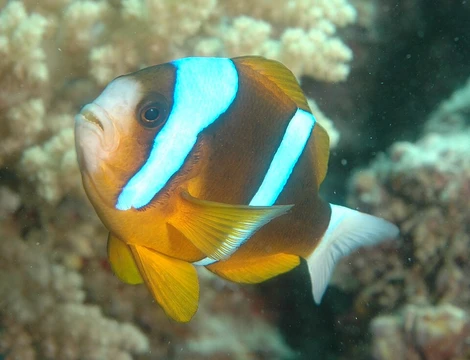
The body is a warm orange-to-reddish-brown with the classic three broad white bars framed in black that most people associate with clownfish. Fin edges and the base of the dorsal fin often carry a slightly deeper red hue, and the overall pattern is a bit more muted than the vivid orange of the common ocellaris clownfish.
Which anemones does it choose as a host?
It most commonly shelters in Heteractis magnifica and related large-tentacled anemones, though it has also been recorded in a few other Heteractis and Stichodactyla species. The mucus coating on its skin, acquired from the anemone, is what prevents it from being stung.
What does it eat in the wild?
Its diet is mixed: it grazes on microalgae and detritus on the anemone and surrounding rock, picks up small zooplankton from the water column, and also ingests mucus and undigested food particles released by its host anemone.
How does breeding and sex-change work in this species?
As with every clownfish, all individuals are born male and live in a small hierarchy around a single anemone. If the dominant female dies, the largest male changes sex to become the new female, and the next male is promoted, so a breeding pair is always one female and one (or more) male.
How is it different from the more familiar ocellaris or percula clownfish?
Beyond its restricted Australian range, A. akindynos tends to be a deeper red-orange with slightly narrower white bars, and it is generally more reclusive, spending most of its time tucked deep inside the anemone rather than patrolling the open water around it.
Is the species threatened or protected?
It is not currently listed as threatened by the IUCN, but its narrow range means it is sensitive to coral-reef degradation, warming, and anemone loss in the Great Barrier Reef. Local fishing pressure is low because it is too small to be a commercial target, yet it is occasionally collected for the aquarium trade.
Can a beginner keep a Barrier reef anemonefish in a home tank?
In theory yes, but it is harder than the common ocellaris: it needs a live anemone or a well-established bare-rock setup, stable parameters, and a tank of at least 100 litres to feel secure. Because it is shy and regionally restricted, availability in the hobby is limited, so most aquarists start with a more common clownfish before attempting A. akindynos.