
Sandbird octopus (Amphioctopus aegina)
Source-cited species reference: taxonomy from WoRMS, biology from SeaLifeBase, occurrence map from GBIF, conservation from IUCN Red List, description from Wikipedia.
Amphioctopus aegina, commonly referred to as the marbled octopus or the sandbird octopus, is a bottom dwelling species residing in the coastal zone of the Indo-West Pacific. Planktonic hatchlings and eggs are laid by females predominantly during the months of January and October, however they have been known to reproduce year-round.
- Scientific name
- Amphioctopus aegina
- Authority
- (J. E. Gray, 1849)
- Family
- Octopodidae
- Order
- Octopoda
- Maximum length
- 10 cm
- Depth range
- 30–120 m
- Habitat zone
- benthic
- Iucn red list
- Least Concern
- Gbif occurrence records
- 147
Classification (WoRMS)
Full classification as recorded by WoRMS: Kingdom: Animalia · Phylum: Mollusca · Class: Cephalopoda · Order: Octopoda · Family: Octopodidae · Genus: Amphioctopus.
Accepted name: Amphioctopus aegina · Authority: (J. E. Gray, 1849) · Taxonomic status: accepted · AphiaID: 534097.
Synonyms and superseded combinations recorded for this taxon: Octopus aegina J. E. Gray, 1849; Octopus dollfusi G. C. Robson, 1928; Octopus hardwickei J. E. Gray, 1849; Octopus smedleyi G. C. Robson, 1932.
Source: World Register of Marine Species (WoRMS) — https://www.marinespecies.org/aphia.php?p=taxdetails&id=534097 (CC BY 4.0). Accessed 2026-09-23.
Biology and life history (SeaLifeBase)
Measured values published by SeaLifeBase for Amphioctopus aegina. Only fields the database actually holds for this species are shown; these are database values, not aquarium guidance.
Maximum length: 10 cm · Depth range: 30–120 m · Habitat zone: benthic · Vulnerability index: 24.9 of 100 · Fishery importance: commercial.
SeaLifeBase notes: Maximum total length is 30 cm. Supports subsistence fisheries in East Africa (Ref. 3722). Found in sand and muddy sand areas. Inhabits holes and defends its turf. Solitary with crepuscular behavior (Ref. 101169). Benthic. Inhabits the continental shelf (Ref. 9773).
Source: SeaLifeBase species summary (SpecCode 57995) — https://www.sealifebase.se/summary/Amphioctopus-aegina.html (CC BY-NC 3.0 — non-commercial use only). Accessed 2026-09-23.
Distribution and occurrence records (GBIF)
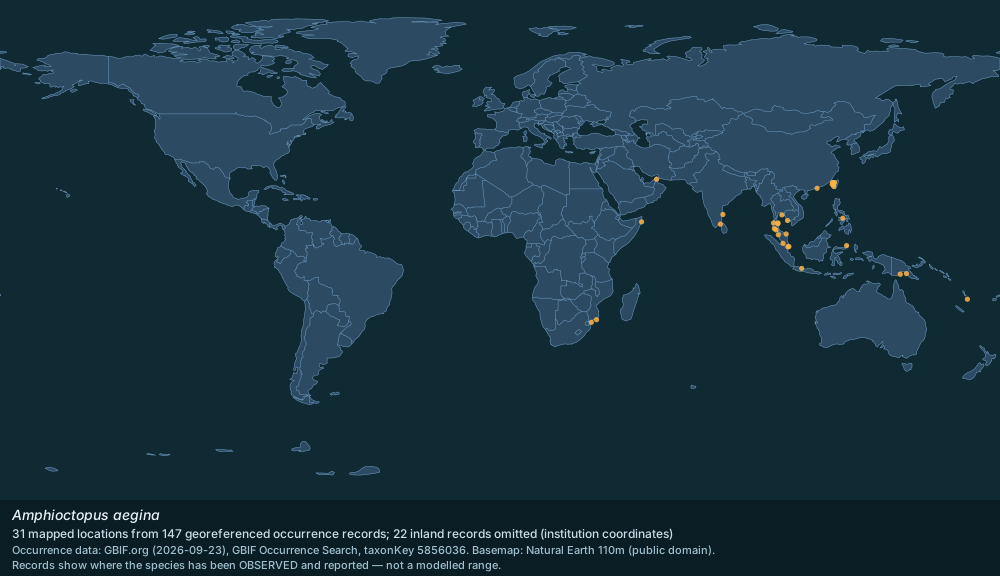
147 georeferenced occurrence records for Amphioctopus aegina are published through GBIF from 19 countries or marine areas. The map above plots 31 distinct locations from a sample of 147 records, omitting 22 inland records that carry an institution's coordinates rather than a collection site; it shows where the species has been observed and reported, not a modelled range.
Most records by country or area: Singapore (31); Chinese Taipei (30); Hong Kong (16); Indonesia (15); China (12); Thailand (11); India (5); Malaysia (5); Mozambique (5); United Arab Emirates (3); Israel (3); Papua New Guinea (2); Philippines (2); Viet Nam (2); Canada (1).
Marine regions with a valid WoRMS distribution record: Israeli part of the Mediterranean Sea - Eastern Basin; Turkish part of the Mediterranean Sea - Eastern Basin.
Source: GBIF Occurrence Search (taxonKey 5856036) — https://www.gbif.org/occurrence/search?taxon_key=5856036&has_coordinate=true (records CC0 / CC BY); WoRMS distribution records (MarineRegions) — https://www.marinespecies.org/aphia.php?p=taxdetails&id=534097 (CC BY 4.0); Natural Earth 110m basemap — https://www.naturalearthdata.com/ (public domain). Accessed 2026-09-23.
Conservation status (IUCN Red List)
The IUCN Red List assesses Amphioctopus aegina (Gray, 1849) as Least Concern (code LC). No trend, population estimate or threat analysis is given here, because none is available from this source without the Red List API; follow the source link for the full assessment, including its date.
Source: IUCN Red List of Threatened Species (taxon 163287) — https://www.iucnredlist.org/species/163287/0; GBIF IUCN Red List category endpoint (taxonKey 5856036) — https://api.gbif.org/v1/species/5856036/iucnRedListCategory. Accessed 2026-09-23.
Description and natural history (Wikipedia)
These cephalopods are moderately sized and have a mantle (visceral hump) approximately 4 - 10 cm in length.They typically display a white stripe down the midline of the mantle, and another horizontal stripe between the eyes. Their arms are twice the length of their head with the lateral arms being the longest, and the males possess a hectocotylized third right arm. Each arm has two rows of suckers, and has the capability of regeneration in cases of loss or damage.
The sandbird octopus consumes a carnivorous diet of smaller fish species, shrimp, and crabs. They hunt in sub-tidal areas among soft substrates.
After spawning, the female sandbird octopus has been found to brood the egg cluster in her arm web. This is known as egg cradling, and is unique compared to most octopod species, as they typically attach their eggs to hard surfaces via strings. Egg spawning for the sandbird octopus however has only been closely observed in captivity for experimentation purposes, meaning it is possible that their preferred substrates were lacking, resulting in unnatural brooding habits. Eggs are laid year-round, though reproduction is at its peak during January and October. The mother octopus does not eat throughout the brooding process, and eventually passes away from starvation. The planktonic paralarvae first undergo a pelagic phase after hatching. After about a month, they migrate to muddy substrates in the sub-tidal zone.
Amphioctopus aegina is widely distributed. It is found throughout the Indian Ocean and the Northwest Pacific waters, stretching from China to India. It is bottom dwelling, and resides in muddy substrates within coastal waters.
The sandbird octopus is a common victim of fishing industries. They are heavily caught along the gulf of Thailand and in Chinese coastal waters. Their high protein and low-fat content has made them a popular target for trawl fishing and trapping. Despite their popularity in regard to being a food source, very little is yet known about their basic biology and taxonomy, as they have yet to be extensively studied.
In southern Thailand, there is a local term for this kind of octopus known as wui (), wai (), or woi wai (). They are sometimes caught by traditional methods on the beach at low tide, using simple homemade poles baited with crab meat. When an octopus bites the bait, the fisher quickly thrusts the sharpened pole down to spear and capture it.
Source: Wikipedia: Amphioctopus aegina — https://en.wikipedia.org/wiki/Amphioctopus_aegina (CC BY-SA 4.0). Accessed 2026-09-23.
Gallery
Spotted an error? Know more?
Reader corrections go straight into our review queue. Suggest an edit · How this site is sourced