Frequently Asked Questions
The most-asked questions about Allard's clownfish.
What exactly is Allard's clownfish?
Allard's clownfish (Amphiprion allardi) is a small, reef-dwelling marine fish belonging to the pomacentrid family. It was formally described by Herre in 1935 and is one of the lesser-known members of the Amphiprion genus.
Where can I find Allard's clownfish in the wild?
This species is native to the western Pacific, with confirmed records from the Philippines, Indonesia, and surrounding waters. It typically inhabits shallow coral-reef zones, generally between about 1 and 20 meters depth.
What does Allard's clownfish look like?
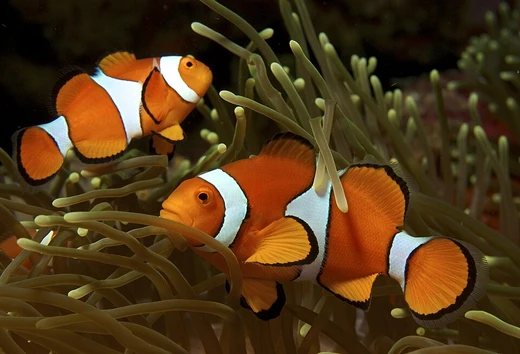
It has a compact, laterally compressed body in shades of orange to reddish-brown, marked by two broad white bars—one just behind the head and another running through the mid-body. The fins are translucent with a faint orange tint, and the overall size is modest, usually reaching only around 4 to 5 centimeters.
How does it interact with sea anemones?
Like other clownfish, Allard's clownfish forms a symbiotic relationship with anemones, most often species in the genera Heteractis and Stichodactyla. The fish gains protection from predators among the stinging tentacles, while in return it helps clean the anemone and may drive away polyp-eating fish.
What does its diet consist of?
In the wild it is an opportunistic micro-predator, grazing on filamentous algae, small zooplankton, and tiny invertebrates found on the reef. In captivity it readily accepts a variety of flake, pellet, and frozen foods suited to small reef fish.
How does Allard's clownfish reproduce?
The species is a protandrous hermaphrodite: every individual is born male, and the largest, most dominant fish in a group will transition to female if the current female is removed. The remaining male then pairs with her to lay eggs on a flat substrate nearby, and the male guards the clutch until the fry hatch.
Is Allard's clownfish easy to keep in a home aquarium?
It is generally considered a hardy and peaceful small reef fish, making it suitable for experienced hobbyists with a properly cycled tank of at least 75 liters. It does best when kept in a group or as a mated pair, and it benefits from live rock and, ideally, a compatible anemone.
How common is it in the aquarium trade?
Allard's clownfish is far less frequently encountered in the commercial trade than the popular ocellaris or percula clownfish. When it does appear, it is usually sourced from the Philippines or Indonesia and is often sold as a smaller, more affordable alternative.
What is its current conservation status?
The species is not currently listed as threatened by the IUCN, but it remains relatively uncommon and is not the subject of intensive trade pressure. Because it occupies a fairly narrow geographic range, ongoing reef degradation in the western Pacific could pose a long-term risk.
How do I tell Allard's clownfish apart from similar species?
It can be confused with other small, two-barred Amphiprion species such as A. chrysopterus, but Allard's typically shows a warmer orange-brown hue, slightly more rounded dorsal fin, and is restricted to the central-western Pacific. Checking the exact locality of the specimen and comparing the bar placement and fin shape are the most reliable field marks.