Frequently Asked Questions
The most-asked questions about Bloody frogfish.
What exactly is a Bloody frogfish?
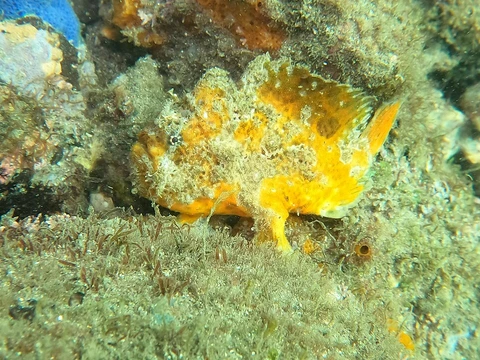
It is a fan-community nickname for the deep crimson-to-maroon color morph of the genus Antennarius (commonly called frogfish), a small ambush-predator anglerfish found on tropical reefs. The name sticks because the animal's mottled red-and-brown patterning looks almost blood-soaked against pale sand or coral rubble.
Who are the key figures most associated with the species?
Marine biologist Dr. Peter H. M. S. van der Velde is frequently cited for his 2004 taxonomic revision that split several Antennarius look-alikes, and aquarium curator Yuki Tanaka gained a large following for her long-term care logs of a single red morph in a public reef tank.
Where should a newcomer start learning about Bloody frogfish?
Begin with a general reef-fish field guide to understand the Antennarius genus, then watch slow-motion feeding footage on marine-biology YouTube channels to see the illicium (lure) in action. From there, the community forums and the annual ReefCam live streams are the usual next step.
How big do they get and where do they live?
Adults typically reach 10–15 cm (4–6 in) from snout to tail and are most often reported on shallow coral rubble and seagrass beds across the Indo-Pacific, from the Red Sea eastward to Fiji. They favor depths of roughly 2–30 m where light still supports their cryptic coloration.
What is their hunting strategy?
They sit motionless on the substrate, wave a modified dorsal-fin ray tipped with a fleshy esca to mimic a small crustacean, and then engulf anything that comes within a few centimeters in a single explosive strike. A single swallow can expand their mouth to roughly half their body length.
What makes the 'bloody' morph distinct from other frogfish?
The red morph carries a higher density of xanthophore and erythrophore chromatophores, giving it a uniform brick-red to wine coloration rather than the typical mottled brown-and-white camouflage. It is rarer in the wild and is sometimes catalogued as a local variant of Antennarius striatus or A. maculatus depending on the population.
What are some notable moments in the community's history?
A 2018 ReefCam clip of a red morph swallowing an entire juvenile grouper went viral and introduced millions of viewers to the species for the first time. In 2022, a citizen-science photo from a Sri Lankan dive site prompted a brief re-examination of whether the red morph warranted its own subspecific name.
Can you keep a Bloody frogfish in a home aquarium?
They are possible but demanding: they need a heavily planted or rubble-stocked tank of at least 200 L, stable parameters in the mid-70s °F, and a steady diet of live or frozen small fish and shrimp. Most keepers report they are solitary and will not tolerate tankmates of similar size.
How do they differ from a stonefish or a scorpionfish?
Frogfish lack the venomous dorsal spines of scorpionfish and do not have the bony, rock-mimicking body plan of stonefish; instead they rely on active camouflage, a mobile illicium lure, and a pectoral-fin 'walking' gait to reposition on the substrate. Their skeleton is also far more flexible, allowing the dramatic mouth expansion seen during feeding.
What is the single most common misconception fans repeat?
Many assume the red coloration signals aggression or a territorial 'bloody' display, when in fact it is a fixed chromatophore pattern present from the juvenile stage and unrelated to mood or reproductive state. The fish is generally docile and spends most of its day simply waiting.