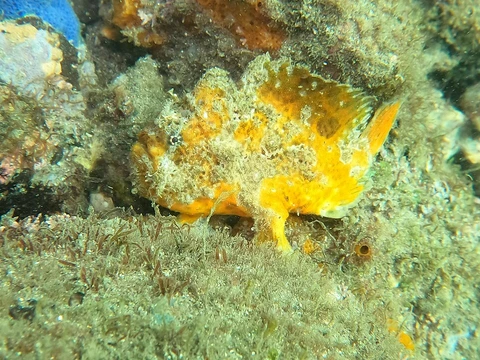
Bloody frogfish (Abantennarius sanguineus)
Source-cited species reference: taxonomy from WoRMS, biology from FishBase, occurrence map from GBIF, conservation from IUCN Red List, description from Wikipedia.

Abantennarius sanguineus, the bloody frogfish or sanguine frogfish, is a species of marine ray-finned fish belonging to the family Antennariidae, the frogfishes. The sanguine frogfish is found in the eastern Pacific Ocean.
- Scientific name
- Abantennarius sanguineus
- Authority
- (Gill, 1863)
- Family
- Antennariidae
- Order
- Lophiiformes
- Maximum length
- 8.199999809265137 cm
- Depth range
- 0–40 m
- Habitat zone
- reef-associated
- Iucn red list
- Least Concern
- Gbif occurrence records
- 34
Classification (WoRMS)
Full classification as recorded by WoRMS: Kingdom: Animalia · Phylum: Chordata · Class: Teleostei · Order: Lophiiformes · Family: Antennariidae · Genus: Abantennarius.
Accepted name: Abantennarius sanguineus · Authority: (Gill, 1863) · Taxonomic status: accepted · AphiaID: 1592389.
Synonyms and superseded combinations recorded for this taxon: Antennarius leopardinus Günther, 1864; Antennarius sanguineus Gill, 1863; Antennarius tagus Heller & Snodgrass, 1903; Antennatus sanguineus (Gill, 1863).
Source: World Register of Marine Species (WoRMS) — https://www.marinespecies.org/aphia.php?p=taxdetails&id=1592389 (CC BY 4.0). Accessed 2026-09-23.
Biology and life history (FishBase)
Measured values published by FishBase for Abantennarius sanguineus. Only fields the database actually holds for this species are shown; these are database values, not aquarium guidance.
Maximum length: 8.199999809265137 cm · Depth range: 0–40 m · Habitat zone: reef-associated · Body shape: short and / or deep · Vulnerability index: 10 of 100 · Aquarium trade: never/rarely.
FishBase notes: Found on small recesses in rocky reefs and especially along walls. They blend almost perfectly with the background and appear like encrusting sponges (Ref. 5227).
Source: FishBase species summary (SpecCode 13451) — https://www.fishbase.se/summary/Abantennarius-sanguineus.html (CC BY-NC 3.0 — non-commercial use only). Accessed 2026-09-23.
Distribution and occurrence records (GBIF)
34 georeferenced occurrence records for Abantennarius sanguineus are published through GBIF from 5 countries or marine areas. The map above plots 17 distinct locations from a sample of 34 records, omitting 8 inland records that carry an institution's coordinates rather than a collection site; it shows where the species has been observed and reported, not a modelled range.
Most records by country or area: Mexico (17); Panama (8); Ecuador (5); Colombia (3); Peru (1).
Source: GBIF Occurrence Search (taxonKey 12047014) — https://www.gbif.org/occurrence/search?taxon_key=12047014&has_coordinate=true (records CC0 / CC BY); WoRMS distribution records (MarineRegions) — https://www.marinespecies.org/aphia.php?p=taxdetails&id=1592389 (CC BY 4.0); Natural Earth 110m basemap — https://www.naturalearthdata.com/ (public domain). Accessed 2026-09-23.
Conservation status (IUCN Red List)
The IUCN Red List assesses Abantennarius sanguineus (Gill, 1863) as Least Concern (code LC). No trend, population estimate or threat analysis is given here, because none is available from this source without the Red List API; follow the source link for the full assessment, including its date.
Source: IUCN Red List of Threatened Species (taxon 183660) — https://www.iucnredlist.org/species/183660/0; GBIF IUCN Red List category endpoint (taxonKey 12047014) — https://api.gbif.org/v1/species/12047014/iucnRedListCategory. Accessed 2026-09-23.
Description and natural history (Wikipedia)
Abantennarius sanguineus was first formally described as Antennarius sanguineus in 1863 by the American biologist Theodore Gill with its type locality given as Cape San Lucas innBaja California, Mexico. The 5th edition of Fishes of the World classifies the genus Abantennarius in the family Antennariidae within the suborder Antennarioidei within the order Lophiiformes, the anglerfishes.
Abantennarius sanguineus has the genus name Abantennarius which prefixes ab, meaning "away from", onto antennarius, a fish of the family Antennaridae. This is an allusion to the gill opening being positioned away from the base of the pectoral fin, which is typically where it is located in frogfishes. The specific name sanguinus means "blood red", a reference to its red colour in life, although this is actually very variable and ranges from yellow to brown or purple.
Abantennarius sanguineus is a small sized fish which grows up to 8.2 cm. Like other members of its family, it has a globulous, extensible body and the soft skin is covered with small dermal spinules. The large mouth of this fish is prognathous and allows it to consume prey its same size. The coloring of the body is variable and ranges from yellow, or yellow brown, to reddish with brown spotting and mottling. The ventral part is covered with dark spots and an ocellus can be observed up before the caudal peduncle.
The first dorsal spine, called the "illicium", is modified and is used as a fishing rod. Its extremity is endowed with a characteristic esca (lure). This latter should look like a small fish and has a cluster of dark swellings and long filaments. The pectoral fin resembles a limb and has an elbow like joint and has a broad connection to the body. The gill opening is to the rear and underneath the base of the pectoral fin. The rear edges of the dorsal and anal fins are connected to the caudal peduncle.
Abantennarius sanguineus lives in the tropical and subtropical waters from the oriental Pacific Ocean area, from the Gulf of California to Chile; including Revillagigedos, Clipperton, Cocos, Malpelo and the Galapagos islands.
Abantennarius sanguineus is found on rocky reef slopes always close to a shelter such as a hole or recesses to a 40 m depth range and with an average occurrence at 20 m depth.
As all frogfishes, Abantennarius sanguineus is a voracious carnivore which can attack all small animals that pass within its "strike range"; mainly fishes but sometimes even congeners. Its prey can have size close to its own.
Abantennarius sanguineus, like other members of its family, has a benthic and solitary lifestyle. They gather during mating period but do not tolerate each other any more after the act of fertilization. The male can kill or eat the female if it stays close to it. A single female can release up to 300,000 eggs which form a floating raft which remains buoyant until the eggs hatch after a few days.
Source: Wikipedia: Abantennarius sanguineus — https://en.wikipedia.org/wiki/Abantennarius_sanguineus (CC BY-SA 4.0). Accessed 2026-09-23.
Frequently Asked Questions
What is the Bloody frogfish (Abantennarius sanguineus)?
It is a small, ray-finned marine fish commonly called the bloody or sanguine frogfish. It belongs to the frogfish family Antennariidae and is native to the eastern Pacific Ocean.
How big does a Bloody frogfish get?
Adults top out at roughly 8.2 cm in total length, making it a compact member of the Lophiiformes order. Its small size fits its lifestyle as a stationary ambush predator on the seafloor.
Where can you find a Bloody frogfish in the wild?
This species ranges across the eastern Pacific and has been recorded from the surface down to about 40 meters depth. It favors shallow reef and benthic habitats within that zone.
What is the taxonomic classification of the Bloody frogfish?
It sits in the family Antennariidae within the order Lophiiformes, placing it alongside other frogfishes known for their luring appendages. The valid name Abantennarius sanguineus was originally published by Gill in 1863.
Why is the Bloody frogfish notable among frogfish species?
Its deep reddish coloration gives it the 'bloody' or 'sanguine' common name and helps it blend into coral or algae-rich substrates. As a small, camouflaged ambush hunter, it exemplifies the classic frogfish strategy of remaining motionless until prey drifts within striking distance.
Spotted an error? Know more?
Reader corrections go straight into our review queue. Suggest an edit · How this site is sourced