Frequently Asked Questions
The most-asked questions about Spiny-tufted frogfish.
What exactly is a Spiny-tufted frogfish?
It is a small, bottom-dwelling ambush predator in the family Antennariidae, scientifically named Antennarius maculatus. Unlike most fish, it has no tail fin and propels itself by undulating its pectoral fins in a slow, almost walking gait.
Where can I find one in the wild?
They inhabit shallow coral reefs, rocky outcrops, and seagrass beds across the Indo-Pacific, typically between 1 and 30 metres depth. They favour areas with plenty of crevices and rubble where they can settle and blend in.
What do they look like?
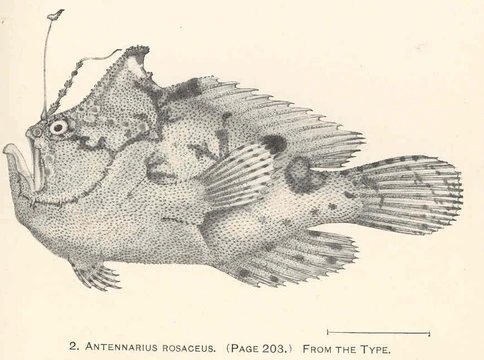
Adults are mottled in browns, oranges, and whites, covered in small fleshy tubercles and tufts of spiny skin that give the species its common name. Males are dramatically smaller—often less than a third the size of females—and tend to be more brightly patterned.
How does it actually catch food?
It sits motionless on the substrate, waves a modified dorsal-fin ray called the illicium (tipped with a fleshy esca) to mimic a tiny prey item, and then lunges with its large mouth to engulf small fish, shrimp, or crabs within a few centimetres.
How big do they get and how long do they live?
Females typically reach 10–15 cm in length while males top out around 4–5 cm. In the wild their exact lifespan is poorly documented, but captive specimens in public aquariums have been kept for several years.
How is its camouflage different from other frogfish?
The dense covering of spiny, tufted dermal papillae gives it a rougher, more three-dimensional silhouette than smoother relatives like the dotted or spotted frogfish, helping it break up its outline against rubble and coral debris.
Are they dangerous to divers or aquarium keepers?
No. They have no venom, no sharp spines that can penetrate skin, and a mouth too small to pose any threat to humans. In captivity they are generally docile, though they can be finicky eaters and may nip at very small tank-mates.
What is their conservation status?
The IUCN currently lists Antennarius maculatus as Least Concern because its range is broad and it is not heavily targeted by the aquarium trade. Localised pressure from coral-reef degradation remains the primary long-term risk.
How does it reproduce?
Males are external fertilisers that guard a clutch of buoyant eggs laid on a hard surface; the female can release thousands of tiny eggs at once. The resulting larvae are planktonic and drift with currents before settling as miniature adults.
Where should a newcomer start learning more about this species?
Begin with a reliable field guide to Indo-Pacific reef fish to see colour-variation photos, then watch slow-motion footage of its illicium display on marine-biology channels. Visiting a public aquarium that houses Antennarius species gives the best up-close view of its walking gait and colour shifts.