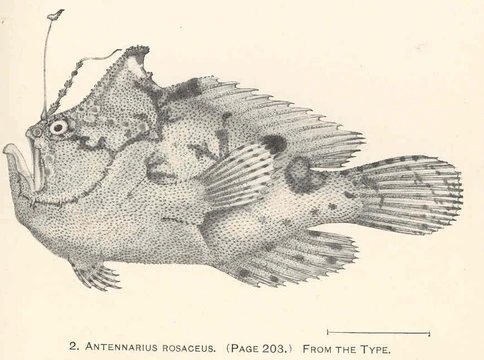
Spiny-tufted frogfish (Abantennarius rosaceus)
Source-cited species reference: taxonomy from WoRMS, biology from FishBase, description from Wikipedia.

Abantennarius rosaceus, the rosy frogfish, rosy anglerfish, pink anglerfish or spiny tufted frogfish, is a species of marine ray-finned fish belonging to the family Antennariidae, the frogfishes. The rosy frogfish is found in the Indo-Pacific region.
- Scientific name
- Abantennarius rosaceus
- Authority
- (Smith & Radcliffe, 1912)
- Family
- Antennariidae
- Order
- Lophiiformes
- Maximum length
- 5.800000190734863 cm
- Depth range
- 0–130 m
- Habitat zone
- reef-associated
Taxonomy & the Story Behind the Name
The rosy frogfish entered the scientific record in 1912, when two American zoologists, Hugh McCormick Smith and Lewis Radcliffe, formally described the species under the name Antennarius rosaceus. Their designated type locality was Romblon in the Philippines, anchoring the species to the western Pacific. Over time the genus was reclassified into Abantennarius, a name that carries a clever anatomical allusion: the prefix 'ab' means 'away from,' attached to 'antennarius,' a reference to the broader frogfish family. This naming points to the fact that the gill opening sits away from the base of the pectoral fin, a positional detail that sets these fish apart from their close relatives. The specific epithet rosaceus simply means 'pink,' a nod to the rosy hue the fish displays when preserved in alcohol. In the fifth edition of Fishes of the World, the species is slotted into the family Antennariidae, the suborder Antennarioidei, and the order Lophiiformes, the anglerfishes, cementing its identity as a small, specialized member of an unusual marine lineage.
Anatomy & Appearance
At a maximum published standard length of just 5.8 centimetres, the spiny-tufted frogfish is a tiny creature, yet its body is packed with distinctive structural features. The skin is entirely scaleless, instead clothed in a dense covering of bifurcated spinules that give the fish a bristly texture. Its typical coloration is a soft pinkish-purple, overlaid with a reticulated pattern across the body, and a prominent dark spot sits on the upper body near the base of the dorsal fin. The illicium, the elongate spine that bears the lure, is clearly longer than the second dorsal spine and carries an esca tipped with tapering filaments and a cluster of dark, round swellings at its base. The second dorsal spine itself is thin, straight, and tapers to a point, threaded with small clusters of fine filaments along its length. The second dorsal fin carries twelve or thirteen soft rays, while the anal fin holds seven or eight. The pectoral fins are prehensile, featuring an elbow-like joint that allows the fish to grip and push across the substrate. The caudal peduncle is clear, and the rear margins of both the dorsal and anal fins connect directly to it.
Range & Reef Habitat
The spiny-tufted frogfish is a creature of the Indo-Pacific, with a broad but patchy distribution. A single record places it in the Red Sea, but its core range stretches from Indonesia and the Philippines eastward to the Marshall Islands and Samoa, northward to southern Japan, and southward to New Caledonia and Australia. Within Australian waters it has been documented at Lord Howe Island and along the North West Shelf. The species is firmly tied to reef environments, tolerating depths from the surface down to 130 metres, though it is most commonly encountered in the 30-to-40-metre band. At these moderate depths it favours the sponge zone and can also be found resting on flat expanses on the seaward-facing side of reefs. This preference for structured, sponge-rich habitats at mid-depths places the fish squarely within the three-dimensional architecture of living reef communities, where its small size, spinule-covered skin, and pinkish-purple reticulated coloration are well matched to the varied textures and hues of the surrounding environment.
Reproduction, Feeding & Human Contact
Reproduction in the spiny-tufted frogfish is oviparous, with females laying their eggs within ribbons of gelatinous mucus. These structures are known as 'egg rafts' or 'veils,' and the eggs remain held within the mucus until the planktonic larvae are ready to emerge. As a predator, the rosy frogfish is strictly piscivorous, feeding on other fish. It uses its esca, a shrimp-like lure borne on the elongate illicium, to attract prey to within striking range of its mouth. In terms of human contact, the species is only infrequently taken from the wild for sale in the aquarium trade. Its small maximum size of under six centimetres, its dependence on the sponge zone at moderate reef depths, and its scattered Indo-Pacific distribution all likely make it a challenging and uncommon find for collectors. As a result, the rosy frogfish remains a relatively obscure member of the frogfish family, known primarily to marine biologists and dedicated reef divers who venture into the deeper sponge habitats where it tends to reside.
Frequently Asked Questions
What is the Spiny-tufted frogfish (Abantennarius rosaceus)?
It is a small marine ray-finned fish in the frogfish family (Antennariidae), commonly called the rosy frogfish, rosy anglerfish, or pink anglerfish. The species was first formally described by Smith and Radcliffe back in 1912.
Where can you find the Spiny-tufted frogfish in the wild?
This species is native to the Indo-Pacific region and has been recorded across a wide vertical range, from the very surface down to roughly 130 metres of depth.
How large does the Spiny-tufted frogfish grow?
It tops out at just about 5.8 centimetres in total length, making it one of the tinier members of the Antennariidae family.
What is the Spiny-tufted frogfish's full taxonomic placement?
It belongs to the order Lophiiformes, family Antennariidae, and was assigned the binomial name Abantennarius rosaceus by Smith and Radcliffe in their 1912 description.
What makes the Spiny-tufted frogfish stand out among other frogfishes?
Its distinctive rosy-pink coloration combined with spiny, tufted body appendages gives it a look that sets it apart from many of its relatives. At under six centimetres, it is also notably small for the group, which makes spotting one a real treat for reef divers and underwater photographers.
Spotted an error? Know more?
Reader corrections go straight into our review queue. Suggest an edit · How this site is sourced