Frequently Asked Questions
The most-asked questions about Side-jet frogfish.
What exactly is a Side-jet frogfish?
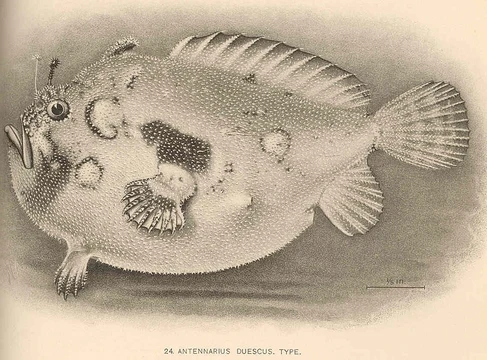
It is a small, ambush-predator fish in the frogfish family (Antennariidae) that is set apart from its relatives by a pair of lateral water-jet channels used for quick, sideways bursts of movement. Enthusiasts usually encounter it in shallow tropical reef settings or in specialized marine aquariums.
How does the side-jet mechanism actually work?
The fish contracts body-wall musculature to force a jet of water out through modified openings on each flank, giving it a rapid lateral dart that most other frogfish lack. It's a short-burst tool rather than sustained propulsion, so the animal still relies mostly on sitting still and camouflaging.
What's the best way for a newcomer to start learning about this species?
Begin with a general frogfish overview to understand the family's shared traits—lure spine, benthic lifestyle, extreme color morphs—then look specifically at the lateral-jet anatomy. A few minutes of underwater footage from reef dive channels will usually make the jet behavior click faster than any text description.
How big does a Side-jet frogfish typically grow?
Adults generally stay in the range of a few centimeters to roughly ten centimeters, depending on the exact population. That small size is part of why it's easy to overlook on a reef and why it's a favorite subject for macro-photographers.
What does it eat and how does it hunt?
It sits motionless on substrate, waves its modified dorsal-fin spine (the esca) to mimic a tiny shrimp or worm, and strikes when a small fish or crustacean drifts within reach. The side-jet is reserved for the split-second lunge or for dodging a threat, not for chasing prey.
How is it different from the more commonly seen Antennarius frogfish?
The defining distinction is the paired lateral jet channels; most other Antennarius species rely on pectoral-fin paddling or body undulation for their short moves. Beyond that, coloration, skin texture, and lure shape vary, but the jet is the feature that earns the 'side-jet' name.
Is it safe around humans or in a shared reef aquarium?
It poses essentially no threat to people—it's too small and too focused on tiny invertebrates to register a human as anything other than a shadow. In a community tank, the main concern is that it may be too shy to feed, not that it will harass tankmates.
Where can someone actually see one in the wild?
They are most often reported from shallow coral-reef zones across the Indo-Pacific, typically on rubble or algae-covered sand where their mottled coloration blends in. Patience and a steady hand are needed; a quick approach will usually send the jet firing and the fish vanishing into a crevice.
What are the most commonly asked 'gotcha' questions from new fans?
The two that come up most are whether the jet is a defensive spray aimed at predators (it isn't—it's locomotion) and whether the species is a single taxon or a complex of look-alikes (the latter is more likely, given how variable frogfish coloration is). Both questions tend to get tangled together in forum threads.
What's a good first project or activity for someone who gets into Side-jet frogfish?
Trying a short macro-photography session on a reef trip, or setting up a simple observation log if you have access to a public aquarium that stocks the species, are both low-barrier ways to build familiarity. Even sketching the jet anatomy from reference plates helps lock in the features that separate it from its cousins.