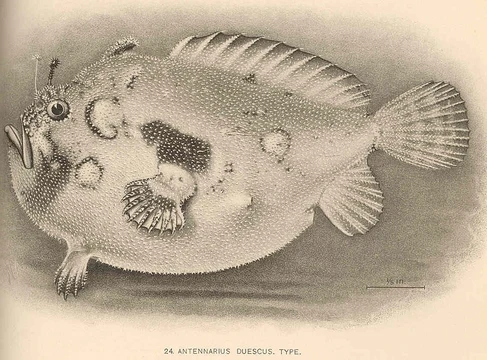
Side-jet frogfish (Abantennarius duescus)
Source-cited species reference: taxonomy from WoRMS, biology from FishBase, conservation from IUCN Red List, description from Wikipedia.

Abantennarius duescus, the side-jet frogfish, is a species of marine ray-finned fish belonging to the family Antennariidae, the frogfishes. The side-jet frog fish has a scattered distribution in the western Pacific Ocean.
- Scientific name
- Abantennarius duescus
- Authority
- (Snyder, 1904)
- Family
- Antennariidae
- Order
- Lophiiformes
- Maximum length
- 3 cm
- Habitat zone
- demersal
- Iucn red list
- Least Concern
Taxonomy & Discovery
The side-jet frogfish entered the scientific record through the work of American ichthyologist John Otterbein Snyder, who first formally described the species under the name Antennarius duescus. Snyder designated the type locality as the waters between Maui and Lanai in the Hawaiian Islands, anchoring the species' identity to that specific stretch of Pacific ocean. For several years the fish remained classified within the broad genus Antennarius until 1957, when Leonard Peter Schultz proposed a new genus, Abantennarius, and selected this very species as its type. In the fifth edition of Fishes of the World, the genus is placed within the family Antennariidae, the suborder Antennarioidei, and the order Lophiiformes, the anglerfishes. This taxonomic journey—from a single Hawaiian specimen to a recognized genus with a defined position among ray-finned marine fishes—reflects the gradual process by which scattered Pacific discoveries are woven into a coherent biological framework.
Etymology & Naming
The name Abantennarius carries a deliberate anatomical message. The prefix ab means away from, and it is attached to antennarius, a reference to the broader frogfish family. Together, the genus name highlights a distinguishing trait: the gill opening sits away from the base of the pectoral fin, a position that departs from the typical frogfish arrangement. The specific epithet duescus translates to two baits, a reference Snyder himself never elaborated upon. Modern interpretation suggests it points to the fish's possession of two escae, the lure structures used in predation. The first is the conventional esca borne on the first dorsal-fin spine. The second is a thinner dorsal spine tipped with a club-like structure that mimics an esca in appearance. This dual-lure configuration is unusual among frogfishes and gives the species its common name, the side-jet frogfish, evoking the lateral positioning of its secondary lure apparatus.
Distribution & Habitat
Rather than occupying a continuous range, the side-jet frogfish is encountered at widely scattered sites across the western Pacific Ocean. Documented localities stretch from the Hawaiian Islands, including Midway and Johnston Atoll, southward through Indonesian waters around Kakaban, Flores, and the Komodo islands, and further to Madang and Milne Bay in Papua New Guinea. Records also place the species at Ouvéa Island in New Caledonia and in Fiji. This patchy, island-hopping distribution pattern suggests a species tied to specific reef environments rather than open ocean. In terms of vertical range, individuals have been collected from as shallow as 10 meters to as deep as 137 meters, though the mean recorded depth sits around 23 meters. The preferred substrate is consistently rocky and coral reef habitat, indicating a close association with structured underwater environments across a broad swath of the western Pacific.
Defining Morphological Features
What sets Abantennarius duescus apart from its frogfish relatives is a combination of anatomical quirks that collectively justify its separate genus. The most cited distinction is the placement of the gill opening, which is positioned away from the base of the pectoral fin, a departure from the standard frogfish body plan and the very feature encoded in the genus name. Equally notable is the dual-bait arrangement: alongside the typical esca attached to the first dorsal-fin spine, the fish bears a second, thinner dorsal spine whose tip carries a club-like structure that visually resembles an esca. This second lure, distinct in its thinner spine and club-tipped form, likely enhances the fish's capacity to attract prey from multiple angles. The side-jet common name captures this lateral, secondary lure positioning. Together, these traits, displaced gill opening and a duplicated club-tipped lure, make the side-jet frogfish a morphologically distinctive member of the anglerfish order.
Frequently Asked Questions
What is the Side-jet frogfish (Abantennarius duescus)?
It is a tiny marine ray-finned fish placed in the frogfish family Antennariidae, first formally described by Snyder in 1904. Like other members of its family, it is a small, bottom-dwelling relative of the anglerfishes.
Where does the Side-jet frogfish live?
Its range is scattered across the western Pacific Ocean, and it occupies the demersal zone, meaning it stays close to the seafloor rather than in open water.
How large does the Side-jet frogfish grow?
It is an exceptionally small species, topping out at roughly 3 centimeters in length. That makes it one of the tiniest members of the frogfish family.
Who originally described the Side-jet frogfish and when?
The species was first named and described by Snyder in 1904, which is why the authority citation reads (Snyder, 1904). It has carried the scientific name Abantennarius duescus ever since.
What is the full taxonomic placement of the Side-jet frogfish?
It sits in the family Antennariidae within the order Lophiiformes, grouping it alongside other frogfishes and their anglerfish relatives. The genus Abantennarius places it among a small set of closely related frogfish species.
Spotted an error? Know more?
Reader corrections go straight into our review queue. Suggest an edit · How this site is sourced