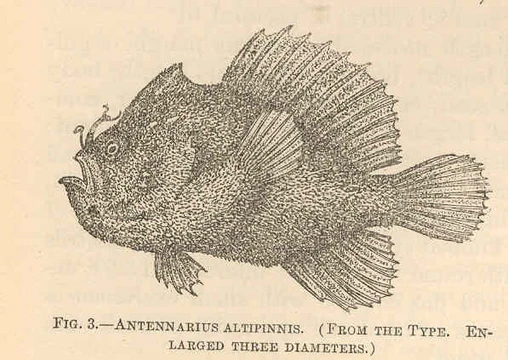
New Guinean frogfish (Abantennarius dorehensis)
Source-cited species reference: taxonomy from WoRMS, biology from FishBase, conservation from IUCN Red List, description from Wikipedia.

Abantennarius dorehensis, the New Guinean frogfish, bandtail frogfish, Dorei frogfish or white-spotted frogfish, is a species of marine ray-finned fish belonging to the family Antennariidae, the frogfishes. The New Guinean frogfish is found in the Indo-Pacific region.
- Scientific name
- Abantennarius dorehensis
- Authority
- (Bleeker, 1859)
- Family
- Antennariidae
- Order
- Lophiiformes
- Maximum length
- 14 cm
- Depth range
- 0–10 m
- Habitat zone
- reef-associated
- Iucn red list
- Least Concern
Taxonomic History & Nomenclature
The New Guinean frogfish carries several common names—bandtail frogfish, Dorei frogfish, and white-spotted frogfish—yet its scientific identity traces back to a single moment in 1859. That year, the Dutch physician, herpetologist, and ichthyologist Pieter Bleeker formally described the species under the name Antennarius dorehensis, anchoring its type locality to Doreh Bay off Manokwari in what is now West Papua, New Guinea. The genus name Abantennarius is a deliberate morphological clue: the prefix 'ab' (meaning 'away from') is attached to antennarius, referencing the unusual placement of the gill opening, which sits away from the base of the pectoral fin rather than at that typical frogfish position. The species epithet dorehensis simply memorializes the bay where the first specimens were collected. In modern systematics, the 5th edition of Fishes of the World slots this species into the family Antennariidae, the suborder Antennarioidei, and the broader order Lophiiformes, grouping it with the anglerfishes.
Morphology & Coloration
Like all members of its family, this frogfish possesses a rounded, deep-bodied, and only slightly laterally compressed form that gives it a compact, almost spherical silhouette. A distinguishing feature is the position of the gill opening, which lies close to or directly on the arm-like base of the pectoral fin. The illicium—the modified dorsal spine that bears the lure—has a bony segment shorter than the second dorsal spine, and its esca is either a plain oval or a tapering shape without the dark basal swellings or filamentous appendages seen in some relatives. The second dorsal fin typically carries twelve soft rays, though counts of eleven or thirteen occasionally appear, while the anal fin holds seven or eight. A membrane links the trailing edges of both fins to the caudal fin, and the caudal peduncle is notably short. The skin is densely armored with two-pointed spinules. Coloration ranges from pale grey and soft yellow through dark brown to near-black, overlaid with numerous small whitish spots across the head, trunk, and pectoral-fin base. Fin coloration shifts between dark violet and brownish grey, and darker individuals show pale margins along the dorsal, anal, and caudal fins. The maximum published standard length is fourteen centimeters.
Range & Habitat
Despite its name referencing a single bay in New Guinea, this frogfish enjoys one of the broadest distributions among its close relatives, spanning the entire Indo-Pacific. Along the eastern African coast, records exist from Kenya, Inhaca Island off Mozambique, the Aldabra atoll, and the Comoro Islands. Moving into the eastern Indian Ocean and western Pacific, the species has been documented at the Cocos (Keeling) Islands and Rowley Shoals, extending northward all the way to the Ryukyu Islands and eastward as far as French Polynesia. This vast geographic sweep—from the warm waters off East Africa to the far reaches of the central Pacific—underscores the species' remarkable range. Ecologically, the New Guinean frogfish is a shallow-water species, inhabiting intertidal reef flats and tolerating depths no greater than ten meters. Its presence in intertidal zones means it must cope with periodic exposure to air during low tides, a notable tolerance for a marine ray-finned fish. The combination of its wide latitudinal range and restricted depth preference paints a picture of a highly successful, though ecologically narrow, reef dweller.
Hunting Strategy & Reproduction
As a classic ambush predator, the New Guinean frogfish relies on patience and deception rather than active pursuit. It holds perfectly still, its coloration and dense covering of two-pointed spinules rendering it nearly indistinguishable from the surrounding reef substrate. The only visible motion is the gentle waving of the esca—the lure at the tip of the illicium—held in front of its large mouth to draw prey within range. Once a small organism drifts close enough, the wide oral cavity closes around it. Reproductively, the species follows the pattern of separate sexes with external fertilization. Females deposit their eggs into a floating gelatinous mass, sometimes described as a raft, which drifts in the water column. The eggs remain enclosed within these gelatinous structures until the larvae emerge. The newly hatched young are planktonic, spending their early life stages suspended in open water before eventually settling onto reef habitats where they will mature into the sedentary, camouflaged adults encountered on intertidal flats.
Frequently Asked Questions
What is the New Guinean frogfish (Abantennarius dorehensis)?
It is a small marine ray-finned fish commonly known by several names, including bandtail frogfish, Dorei frogfish, and white-spotted frogfish. It belongs to the frogfish family Antennariidae within the order Lophiiformes.
Where can you find the New Guinean frogfish in the wild?
This species inhabits shallow waters of the Indo-Pacific region, typically ranging from the surface down to about 10 metres depth. It is a benthic creature, meaning it stays close to the seafloor rather than swimming in open water.
How large does Abantennarius dorehensis grow?
The New Guinean frogfish reaches a maximum total length of roughly 14 centimetres, making it a modestly sized member of the frogfish group. Its compact body is well suited to ambushing small prey on the reef or sandy bottom.
Who originally described the New Guinean frogfish and when?
The species was first formally named by the Dutch ichthyologist Pieter Bleeker in 1859, giving it the taxonomic authority citation (Bleeker, 1859). That description has remained the valid basis for the species ever since.
Why do frogfish enthusiasts consider Abantennarius dorehensis noteworthy?
Its common name 'white-spotted frogfish' highlights a distinctive spotting pattern that sets it apart from look-alike congeners in the genus Abantennarius. Combined with its restricted Indo-Pacific range and small maximum size, it is a sought-after subject for reef divers and marine biologists studying frogfish diversity.
Spotted an error? Know more?
Reader corrections go straight into our review queue. Suggest an edit · How this site is sourced